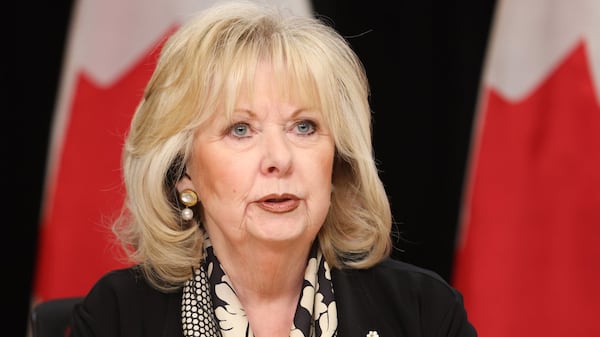
EDMONTON - It was a sad moment for the figurehead and "backbone'' of one of Canada's most decorated infantry units. Eighty-three years old, stooped and walking with a cane, Lady Patricia, the Countess Mountbatten of Burma, realized she couldn't be there for her members of the Princess Patricia's Canadian Light Infantry in their latest battle in Afghanistan. "I have come to the conclusion, rather sadly, of course, aged now 83, and no longer so active . . . I can no longer give all the active support I have so loved doing and which I believe you all deserve,'' Lady Patricia said Saturday as she bid farewell to hundreds of "her'' soldiers. She said she drew "great comfort'' as another Canadian legend stepped up to fill her storied shoes, and to take control of Canada's oldest "regimental family.'' Adrienne Clarkson -- well known to soldiers and the Canadian public from her time as governor general -- became the first Canadian, and first non-royal, to hold the position of colonel-in-chief for the Patricias. It's not a symbolic job --Clarkson is expected to roll up her sleeves and jump in to wherever the thousands of PPCLI soldiers are stationed, from Bosnia to Croatia and Kosovo -- and now Afghanistan. "My predecessor is an extraordinary person who has spent over 30 years as the colonel-in-chief to the regiment to whom she has been completely devoted,'' said Clarkson of Lady Patricia. "She's visited them in the field over the years, everywhere that they've been, except Afghanistan.'' Her dedication to the regiment has struck a chord with soldiers, who were full of praise for their "Lady Patricia,'' who paid them 45 visits over the 32 years she held the post. "I'll start off by saying when they coined the word lady, they had her in mind. She's a very, very beautiful, dedicated lady,'' said Oscar Lacombe, a retired soldier who met Lady Patricia several times in Canada and once while stationed in Germany. Bill Miller -- a soldier for 23 years, but a member of the Patricias for 51 and counting -- said such visits mean a lot to soldiers. "I think it's a great morale booster,'' he said of the former colonel-in-chief's visits. "It means they're not forgotten by the regimental family, they're not forgotten from the Canadian public, hopefully, and when they mingle, like that, it makes the guys feel good, they know they're doing the right thing.'' He said those qualities were what made him think Clarkson was the right successor. "I think she gained a lot of acceptance by visiting Bosnia, by visiting Afghanistan, decorating our troops, being there and supporting them,'' he said. Clarkson was chosen for her history with the military -- she visited extensively with troops during her time as governor general -- and because she has a special connection to the Patricias through her husband, John Ralston Saul, whose father was part of the regiment. Clarkson and various soldiers referred to her time with soldiers and the family of soldiers after the friendly fire incident in Afghanistan in 2002. She was the first public figure in Germany after the wounded and dead were brought out of the warn-torn country. "These moments are engraved in my heart forever,'' she told the soldiers. She said she always made a point of calling families of fallen soldiers. "I think (the military) is a family, after all,'' she said. ". . . that kind of thing you can do in a regiment, because these are people, not statistics.'' The position of colonel-in-chief was originally held by a granddaughter of Queen Victoria, Lady Patricia Ramsay -- from whom the regiment gets their name -- and is normally reserved for members of the royal family. Special permission was needed from the Queen to allow Clarkson to take up the position, but Brigadier-General Glenn Nordick said they were looking for the perfect person, not for a title. "The conversation was about personality, it wasn't about whether they're Canadian, or whether they come from the royal family,'' he said. Asked about controversy over the war in Afghanistan, Clarkson said she was a member of the Canadian Forces, which were deployed by a democratically elected government. She said her role is to "support the troops, no matter what they are doing and where they are.'' She said soldiers sign up for a life of service. "That's the kind of thing I understand,'' she said.