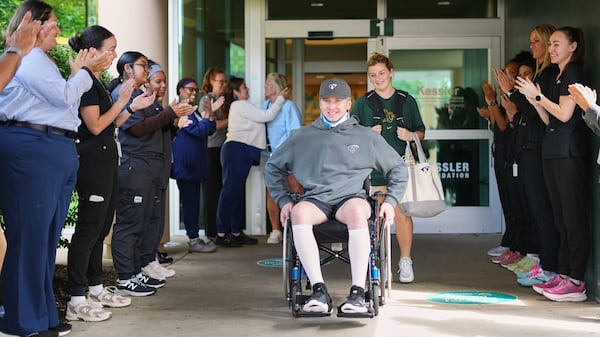
Elysia Bryan was 34 years old when she first noticed a lump on her breast. It was the summer of 2020 and her career as a health and safety consultant was taking off. “I sat on it for a long time, hoping that it would go away,” she said. It didn’t. When Bryan eventually went to her doctor, a diagnostic mammogram and biopsy revealed the lump she hoped would vanish was a cancerous tumour. She was diagnosed with Stage 3 breast cancer. Within two weeks, she had a lumpectomy to remove the tumour. Her treatment—eight rounds of chemotherapy and twenty-four sessions of radiation—lasted a year. Eventually she decided to have a double mastectomy and reconstruction surgery because she didn’t want to experience what she went through again. “My cancer was caught early. I went through a really aggressive but effective round of treatment and I stand here today healthy, strong,” she said. Now 38, Bryan is proud to call herself a cancer survivor. She’s been in remission for three years and is an ambassador for The Olive Branch of Hope, an organization dedicated to raising awareness and providing support to black women affected by breast cancer. As many Canadian provinces lower the age of self-referral for breast cancer screening programs to 40, the cancer-survivor-turned-advocate wants to encourage others to know their province’s rules and if they can, book a mammogram. “Just go and do the test. Go and do it scared. Get it out of the way. It’s the putting it off and not getting screened where it becomes dangerous,” she said. The best age to begin routinely screening people with an average risk of developing breast cancer has been hotly debated. In May 2024, the Canadian Cancer Society recommended screening start at 40 and has urged provinces to lower their thresholds. Weeks later, the Canadian Task Force on Preventative Health said people in their 40s who have an average or moderately increased risk should not be routinely screened for breast cancer, but said women aged 40 to 49 should be able to get a mammogram if they ask their doctor for one. In its draft recommendations, the task force noted harms, such as likelihood of unnecessary biopsies and overdiagnosis, may outweigh the benefits. That guidance was criticized by advocates and Canada’s health minister, leading to an external review that’s since called for modernization and reform of the task force. Most provinces and territories have begun providing routine breast cancer screenings starting at age 40. Nova Scotia was an early adopter, with its program existing since 1991. From July 2022 to December 2024, 38 per cent of eligible women in their 40s self-referred for a mammogram. Ontario introduced this option in October 2024. Since its expansion, Ontario Health said approximately 184,000 women ages 40-49 have been screened in the Ontario Breast Screening Program—that’s about 18 per cent of Ontario’s female population in that age group. People who are 30 to 69 and deemed high-risk, such as those with a family history of breast cancer or who carry genes that increase the risk of breast cancer, are already eligible for screening. Dr. Belinda Curpen, a radiologist and specialist in breast imaging at the Sunnybrook Health Sciences Centre in Toronto, pointed out that there’s still a need for more education about the benefits of screening. “Usually in a screening program we aim for 70 per cent of women being screened. But we have not achieved that yet especially for the women, 40 to 49, because there has been a lot of controversy about the guidelines,” she said. Curpen pointed out it’s especially important to reach women who are of lower socio-economic status or who are Asian or of African descent, ethnic groups where she said incidence of breast cancer is even higher. “Often they do not get the information that they should be screening earlier,” she said. Dr. Jean Seely, a radiology professor at the University of Ottawa and the head of breast imaging at the Ottawa Hospital, said of the 20,000 people being screened at the hospital, approximately a quarter of patients are in their 40s— similar to those who are in their 50s and 60s. She says that’s “great news.” “I am diagnosing early breast cancer in these young women, which makes me feel so much better because, I don’t want to diagnose breast cancer,” she said. “But we know it exists and I am seeing it at an early stage in these young women, which is wonderful news. So, it’s showing the benefit.” She says women under 50 are not being invited to screen in Ontario at this time, so “they don’t get that reminder from the province to say, oh, you’re 40, you should start screening.”