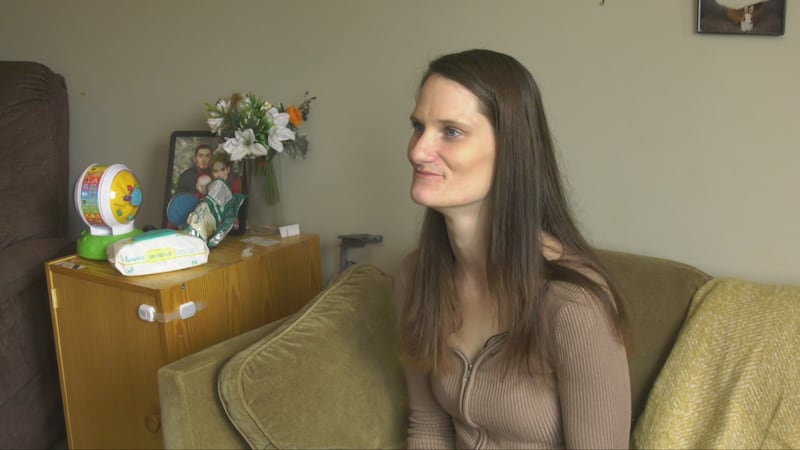
Ashley Weese is playing with her 15-month-old son, Aiden, in her living room. He’s a little fussy; he takes crying breaks between inquisitively staring up at the CTV News Edmonton camera filming him and his mom. But Weese doesn’t mind the fussy moments. Each laugh, tear or shout is a reminder of why she’s housed and sober. “I can’t do both. I can’t live that life and have him. It’s not fair to him,” she said of her young son. Weese battled an addiction to fentanyl and homelessness for five years. She first moved to Edmonton from a small town in southern Ontario a year before the world retreated into their homes for the COVID-19 pandemic. She stayed on the streets. “My daily routine was just trying to get my fix … The only resources I took advantage of at that time was getting fed,” she said. After a few stints in jail – she says she stole a car to drive back to her mom in Ontario – Weese realized she couldn’t handle an Edmonton winter without a roof over her head. That’s when she dipped her toes into the resources Hope Mission might offer her. In 2024, Hope Mission’s Cindy Smith was the follow-up support worker assigned to ease Weese’s transition to her new housing and lifestyle. When they first met, Smith says Weese was “very, very high.” “She did want to get sober, like right away, but she didn’t really have what she calls, ‘the why,’” Smith said. The ‘why’ showed up in the form of a sudden pregnancy that Weese was determined to get clean for. “That switch in her mind went off, and she did everything she could to get clean.” Smith’s job title, officially, doesn’t include supporting people through pregnancy or driving them to appointments. Her role was to bridge the gap between what resources Weese might need on the way to becoming independent. “Ashley would have been able to,” Smith remembered of Weese’s determination to show up. “She’s very resourceful. But my thinking was that transportation is a barrier to having a healthy pregnancy … So I decided, for as much as I’m able to, I will take her to those appointments.” Weese now credits a few things for her sobriety: her son, having a roof over her head, and the extra mile Smith went to to ensure she had a healthy, supported pregnancy. “I had to go to ultrasounds every couple weeks, and she drove me there. She drove me to deliver him. She was there when I delivered him and then she was there afterwards,” Weese said. “She was the one that rooted for me. She drove me to rehab and picked me up … She’s like my second mom, honestly.” Smith says Weese did all the hard work: “She worked really hard to get where she is now, and she’s working hard to stay there.” At the time, Weese had told her that it would’ve been impossible to get sober without a place to live. “You’re surrounded by sometimes horrific things that happen on a daily basis. The only way to deal with that when you’re an addict is to continue using those substances, just to drown out those experiences,” Smith explained. “While the supports are necessary, the housing provides a place to say, ‘OK, now I’m safe. Now I can look at what I want for my life.’ When you’re in survival mode, you can’t really think about that.” Hope Mission employs a landlord relations specialist who spends the days scouring for landlords who will work with the agency to provide supportive housing for a client. Agency spokesperson Brenton Driedger said the team considers short-term shelters and housing to be interconnected. “People come to shelter, they get stabilised, from there they get connected to supports like housing,” he said. “Making sure that response is something that produces a lasting outcome, and making sure that they’re supported along the way.” Weese is now on the other end of those ongoing supports – she still keeps in touch with Smith, if only to share a smiling photo of Aiden every now and then. But she says she has everything she needs. “I hope that somebody that’s struggling sees this and gets hope from it … I’m hoping that they see me doing better and it inspires them to do better. That’s my goal for talking about it. I don’t feel like I’m being vulnerable, because I’m proud of it. I did something pretty hard. She intends to make the most of it by becoming a support worker and addictions counsellor, like Smith was for her. “I’m thankful for (Aiden) being born. I look at him and I’m just happy. I’m happy that I am where I am,” she added. “I just want to keep fighting.” With files from CTV News Edmonton’s Jeremy Thompson