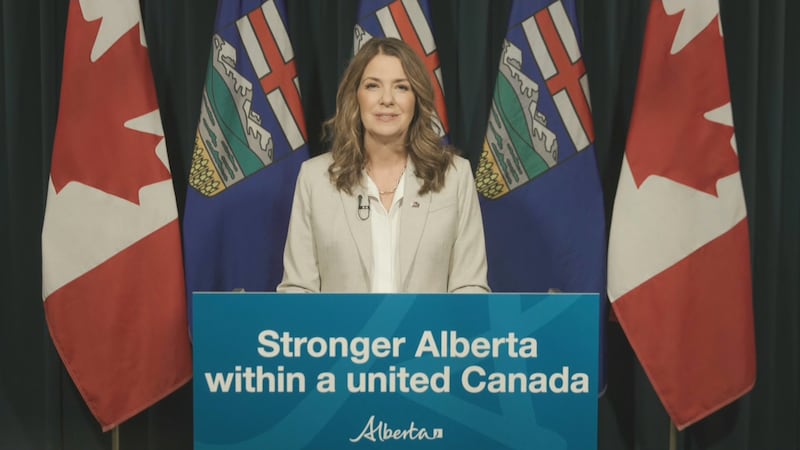
Reaction from Indigenous communities appears mixed in the wake of the federal government’s fast-tracking of a new pipeline from Alberta to the west coast which would put all plans – including required First Nations consultation – on an accelerated timeline. The Pacific Link pipeline, announced as Canada’s primary national interest project by Prime Minister Mark Carney on Thursday, will now see less time for the legally required consultations, about two months, with affected Indigenous communities. Half a dozen chiefs from First Nations joined Carney and Premier Danielle Smith in northern Alberta this week to support the announcement. Carney told reporters there was Indigenous support for the Pacific Link, and that consultation was being done properly in the early stages of the program. “We’re developing this pipeline with Indigenous peoples. Involved from the start – this is the start of that development. With the opportunities to share in the prosperity Pacific Link will create,” he said. His comments come on the heels of the National Day for Truth and Reconciliation, where Carney told an Edmonton ceremony that “nation-building” alongside First Nations was of utmost importance for his government. Ottawa also recently offered eligible Indigenous communities a 15-per-cent stake in Trans Mountain pipeline equities – which was strongly accepted by the National Coalition of Chiefs at an Indigenous forum late last month. Consultation requirements under the Building Canada Act have been squeezed in order to speed up the process, but Carney says they are still strong enough to adhere to Canada’s obligations under the United Nations Declaration on the Rights of Indigenous Peoples. In the last two months, he says, the federal major projects office has fielded more than 100 submissions from Indigenous rights holders about Pacific Link and has conducted what he says are “rigorous consultations” with more than 140 communities along the potential pipeline route. Some First Nations, especially those across British Columbia, have denounced the expansions altogether, worrying about the impact on climate change and natural disasters. Others said during those consultations that consultation time was already too short and decried a lack of necessary details to make informed decisions about the proposed pipeline, such as routing, engineering, environmental effects or emergency responses. The pipeline – a 1,200-kilometre project spanning from Bruderheim, Alta., south to Delta, B.C. – is estimated to carry an extra million barrels a day when finished, mainly to Asian markets. Despite the compressed timeline, a summary of those consultations posted online by the federal government on Thursday says the Major Projects Office is satisfied that it has provided a meaningful opportunity for consultations, and that further questions can be addressed as they arise. Assembly of First Nations National Chief Cindy Woodhouse Nepinak has said staff in the Major Projects Office do not have an understanding of how to work with First Nations communities and that “junior staffers” aren’t helping build relationships. “They have a lot of work to do,” she said at a news conference in Ottawa last week. Corey Snelgrove, a political science professor researching economic reconciliation at the University of Alberta, says it’s expected for opinions to differ among communities. He added the Building Canada Act itself has been historically controversial for its hierarchical approach to consent from affected jurisdictions. “It sounds like this expedited path at the very least is going to create some challenging discussion within Indigenous communities, because it’s not just black and white,” he told CTV News Edmonton. “Reconciliation emerges because, when Canada was set up as a country, it did not ask for the consent of Indigenous nations to that project.” He says Ottawa is likely prepared for legal challenges – with the need for “consent” versus “consultation” being a key argument. The Trans Mountain pipeline saw a major setback last year when a court ruled consultation with Indigenous groups had been inadequate. Carney said Thursday the government would be working this year toward completing consultations on the project itself, as well as environmental safeguards, financing, and Indigenous partnerships. It wants to begin construction in September 2027. With files from The Canadian Press and CTV News Edmonton’s Jeremy Thompson