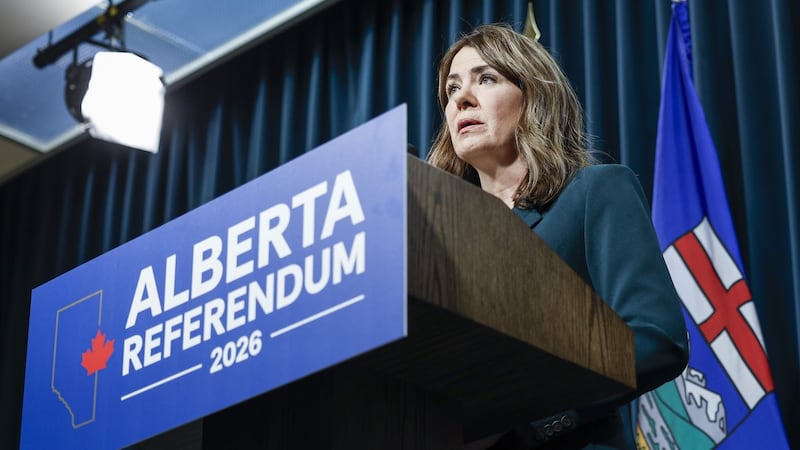
A chief economist with ATB says it could take several years to see any meaningful economic impact following the capture of Venezuela’s leader Nicolás Maduro by the U.S. Venezuela has the largest oil reserves in the world, and has been eyed by U.S. President Donald Trump as he pushes to take over the country’s oil industry. This has the potential for competition, said ATB chief economist Mark Parsons, where the U.S. would turn to Venezuela to purchase oil, rather than Canada. “Venezuela produces very similar quality of crude oils as Alberta, and they’re in direct competition with each other on the U.S. Gulf Coast,” said Parsons. “If Venezuela is successful at ramping up their production, then Canada could face more competition.” But the unstable political environment in Venezuela does not lend itself to a lot of investment, he adds. “It’s not like Venezuela can turn on the taps overnight. Billions of dollars of investment needs to take place and it will take several years to get any meaningful impact on oil production in that country,” said Parsons. “It’ll take time for companies to be reassured that they’re going to be operating in a stable enough climate for them to pour billions of dollars into Venezuela’s oil sector.” Parsons says one way to mitigate these pressures is to diversify Canada’s oil exports. Alberta Premier Danielle Smith has been hungry for a pipeline to Canada’s west coast, making oil exports more readily available to Asia. Her government has now been the closest ever to making it happen following a memorandum of understanding with Prime Minister Mark Carney on a possible west coast pipeline. “We need more customers in Asia, and we need to find ways to get our oil to non-U.S. markets,” said Parsons. The United Conservative Party government launched a Northwest Coast Oil Pipeline webpage on Tuesday to promote and provide information to the public about its work towards a pipeline. While the webpage has been in the works since the fall, the Ministry of Energy and Minerals says the events in Venezuela “reinforce how critical it is for a new pipeline to be built to Canada’s northwest coast.” “A new pipeline is crucial to diversifying our trading partners, becoming an energy superpower, and meeting a growing global demand for our responsibly produced oil, especially in Asia,” said a statement from the ministry. The province is working to deliver a submission on the pipeline to Ottawa’s Major Projects Office by July 1. With economic uncertainty, comes the question of national security, particularly with regards to Trump, says Christian Leuprecht, a professor at the Royal Military College of Canada and Queen’s University. “I worry very much that Trump has a strategy for making Canada the 51st state,” Leuprecht told CTV News Edmonton. As Trump vows to take over Venezuela’s oil industry, he has also been looking to take Greenland in some capacity, which could have two “deleterious” consequences for Canada. “On the one hand, it would be the end of NATO, which is Canada’s most important multilateral institution, and therefore significantly reduce Canada’s ability to assert its interests in the world,” explained Leuprecht. “On the other hand, it would mean that Canada would be surrounded by the U.S. It would mean that Canadian sovereignty would be very significantly constrained.” But with six days from the capture of Maduro, impacts to Canada and Alberta remain in limbo as the world watches to see what’s next. With files from CTV News Edmonton’s Miriam Valdes-Carletti