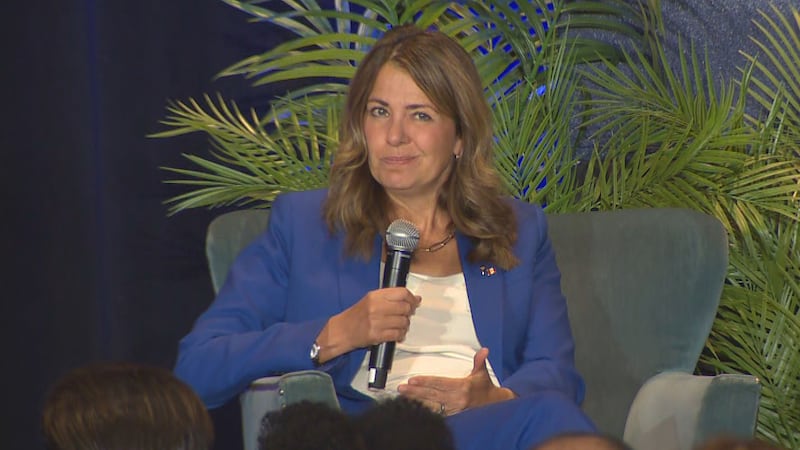
U.S. President Donald Trump announced Monday it had struck a deal to tap into Venezuela’s oil industry as it continues to battle Canada in an acrimonious trade dispute. Some industry analysts believe the new deal would take years before the impact was felt in Alberta’s energy sector. Heather Exner-Pirot, a senior director at the Macdonald-Laurier Institute, discusses why Trump’s latest promise may be a lofty one with Alberta Primetime’s Michael Higgins. The following interview has been edited for length and clarity. Michael Higgins: How much stock do you put into the U.S. president’s claim of the biggest oil deal in history – is this more than just a social media post to create disruption in the thick of a trade war? Heather Exner-Pirot: No, I think this is classic Trump hyperbole. I expect Venezuela will squeeze out a couple 100,000 more barrels. The more interesting announcement today was an investment from Chevron, which probably has more credibility, but that ‘big beautiful deal’ that Trump made, all those reserves – those are in the ground. They’re expensive and risky to get out. There’s always competition for Canada from Venezuela, but I don’t think it’s any existential threat MH: Beyond Chevron, what would need to happen to clear the way for more major oil producers to actually take the leap and invest in Venezuela to rehabilitate that country’s oil industry? HEP: This deal from Trump isn’t really about private sector investment. They have a hard time getting American companies to invest in Venezuela, so they’ve had to do their own deal. The Pentagon is sponsoring some things, a few shady things with some Venezuelan business people, and I don’t think politically it’s sustainable in Venezuela either. This (deal) is absolutely making Venezuela an energy colony. It is ceding some of their sovereignty. It is ceding some of their royalties to the United States, and I don’t think that will sustain very long in a country that has very strong anti-Imperialist tendencies, so if anything I think this deal adds more risk to Venezuelan oil investment, more potential for pushback coming into the future. But again, the Chevron investment is probably a real thing, and we will compete for those barrels in the Gulf refineries. MH: Were this to actually happen, how much competition could it ultimately pose to oil produced in our province? At what point would you see U.S. refiners replacing Alberta crude with that of Venezuela’s? HEP: We always do compete. The reason we focus on Venezuela is because they also produce heavy oil, just like Alberta does, and only about 10 per cent of the world’s oil production is heavy. Canada is the biggest heavy oil producer, but we compete with Venezuela, Mexico, Iraq in that smaller market. Where we really compete with them is in the Gulf Coast refineries. Those were built with Venezuela oil in mind in the late 1970s, as a response to the OPEC (Organization of Petroleum Exporting Countries) embargo, so it’s well-suited for that crude. We’ve been able to make some headway since then, so you always have to be nimble. You always have to be competitive. I’ll say we’re also competing with Guyana, and we’re also competing with Brazil. But the opportunity here is that if you did displace, if you did have more Venezuelan barrels in those Gulf Coast refineries, it might be allowing more of an opportunity in the Pacific Basin with China, for example, which has been until now taking a lot of those Venezuelan barrels. MH: In warning against the use of Alberta oil as leverage in the trade war, the premier last week suggested the U.S. would reverse pipeline flows, ship Venezuelan oil north to midwest refineries. Is that feasible? HEP: I don’t think the export tax or the restrictions are feasible on our end, and I think it’s quite far off and a very remote possibility that they would go to those extents either. I think the broader point is that this is a very mutually beneficial deal that we have, selling oil to the United States. It’s particularly beneficial for us now that the oil WTI (West Texas Intermediate) has surpassed $90 per barrel. We are getting a lot more revenues from selling that oil, and I can see why we don’t want to risk that. When you see China weaponize critical minerals, Iran weaponize oil, Russia weaponize natural gas, it doesn’t work out for them in the medium and the long term economically. MH: Even if it’s not as competitive against Alberta oil, as more Venezuelan oil flows into the U.S., does that then have a knock-on effect on the price Alberta producers receive? HEP: It could, and absolutely even that small increment that you’ve seen in Venezuela since January has reduced that differential, a little bit. We’ve now filled Trans Mountain as a result though, and prices are up anyway, so we haven’t really felt the pain. I’ll say the market does not see this Venezuelan deal as a real threat. A few producers also saw all-time highs yesterday, so the market’s still pretty bullish on Canadian oil and gas. MH: To put focus back on our province, to what degree do you see any of this fueling an accelerated timeline for the proposed West Coast pipeline? HEP: I think it just reiterates the importance of having that optionality. Not only do we want to sell more barrels, we want to give ourselves a bit of leeway if we do compete more with Venezuela in the Gulf. I think Carney sees this. Certainly Smith sees this. MH: How likely are overseas buyers to line up for expanded access to Alberta oil off of the coast of B.C.? HEP: They’ve lined up. Trans Mountain has been apportioned or full for the last two months. It’s making profits. It’s sending dividends back to the government, and now we’re again at a point where we can’t really export anymore to that Asian market. As soon as you get Canadian barrels into that Pacific Basin, they are getting snapped up. You’ve seen Japan, Korea say explicitly that they would like to buy more of our oil. If there’s a million barrels coming through with this West Coast oil pipeline, all of a sudden it might make sense to invest in some heavy oil refineries on their side of the Pacific because now there’s enough volume to make these investments make sense. And then of course China has turned out to be the biggest customer for those West Coast barrels. MH: If there is a lesson to take away from Donald Trump’s Venezuelan announcement, what would it be? HEP: Optionality is king. Give yourself options. Don’t be tied to a single customer, don’t be tied to a single producer. For Canada, it’s so clear the solution is the Pacific Basin, the Asian market, West Coast barrels. MH: The federal government today also extended its fuel excise tax into the new year. Your thoughts on that, and what kind of pressure that could put on our province to do the same? HEP: One of the benefits of the Strait of Hormuz is certainly that Canada has seen five monthly trade surpluses in a row. We’ve seen a 3.3-per-cent GDP annualised increase that is mostly driven by energy and the higher price we’re getting from it. Governments are taking some of those revenues too. This is a windfall for both the federal and the Alberta government, and the federal government has come out quickly and is now extending… they’re going to pass some of that benefit on to the customer. Canada should benefit, as a major oil exporter, from having that additional income. It’s been a surprise to me that the Carney Liberals are the ones that have been doing this and not the Smith UCP when we actually already had a program in place that was meant to pass some of that money back to customers in the event of high oil prices.