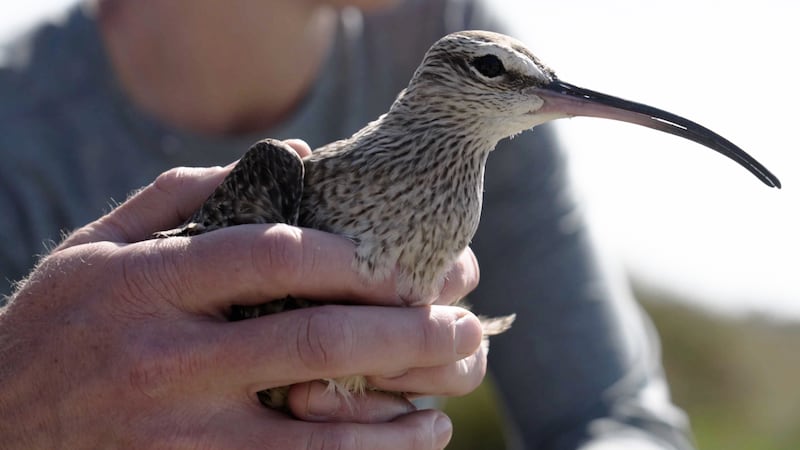
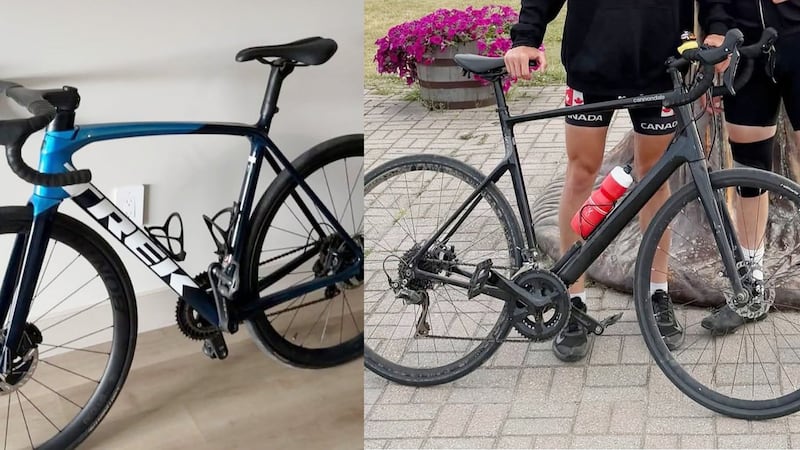
A scientist and an athlete bike along the coast. It might sound like the start of a joke, but it’s actually a 30,000-kilometre trek to study a threatened bird species. Canada is home to hundreds of species of birds, though not all of them live here full time. Some, like the Hudsonian whimbrel, migrate at different times of the year. These whimbrels have one of the longest mating migrations in the animal kingdom, flying from South America to the shores of Canada or Alaska to breed, according to the University of Alberta. The flight takes around two months, with the birds pausing for a week or two at a time to gorge on crabs, marine worms and insects. Joining the birds along this migratory path will be Timm Döbert, a scientist at the University of Alberta, and Leanna Carriere, an extreme athlete. The goal of the expedition, Wings of Survival, is to learn about the threatened shorebird’s migratory route, behaviour and survival rates. “I’m excited to understand what it actually takes a bird to embark on such an outrageous journey,” Döbert said. “I really wanted to do something where I feel it has a much bigger impact than just writing a scientific paper, which is usually what I do.” The Hudsonian whimbrel has lost more than 70 per cent of its entire population since the 1970s, in part due to habitat destruction along its migratory route, according to Birds Canada. The expedition will also further a different study on how the human body withstands long-term physicial and psychological exertion. This will be the first time humans have deliberately followed physically a migratory bird species along a global flight path, according to Döbert. The humans will be taking significantly longer than two months to make this trip, closer to nine months. The trip by bike is longer due to the twists and turns ground-dwellers need to take, and the fact they can’t bike continuously for six to seven days. Unlike the whimbrel, which can continuously flap its wings for six to seven days at a time and cover 8,000-9,000 kilometres without eating, drinking or sleeping. The project has been in the works for five years and kicked into gear when Döbert and his team went to southern Chile to tag five whimbrels with GPS trackers. Two of those five birds have arrived in Alaska, with the other three stopping elsewhere along the migratory path. The GPS signal for one of the five birds has since been lost. “We’re now trying to meet those birds again in Chile, the same birds, the same beach. That’s the overarching goal,” Döbert said. “It’s like a lottery win to see those same birds again.” Carriere, after seeing a world-record attempt of a bike ride from Alaska to Patagonia, jokingly asked if Döbert wanted to join her before the project began. “He didn’t say no, so he agreed to ride 30,000 kilometres briefly after meeting me,” she said. Two years ago, the pair cycled across Canada as a “test.” “Being on a road is always scary, being a cyclist you’re very vulnerable and fragile on a road, so you have to trust that people have the right intentions and they look after you, give you enough space, so that’s a concern,” Döbert said. “But otherwise, I’m just incredibly excited.” In order to prepare for this longer trip, Carriere said she did plenty of strength training, gymnastics, swimming, running, and, of course, biking. The physical trails, including the challenge of consuming enough to offset burning 14,000 calories a day while biking 150 kilometres, isn’t what Carriere thinks will be the most difficult part. “We cross 15 different countries, every border crossing with the vehicle and bikes and our equipment … I think it’s going to be a challenge,” she said. “I hope it goes smoothly, and I hope we’re prepared and have all of our paperwork, but that probably makes me most nervous.” The expedition is set to begin on the Alaskan coast on the shore of the Beaufort Sea on Aug. 1 and end in Tierra del Fuego. Their goal is to reach Chiloé Island in southern Chile before the whimbrels start flying back north at the end of March. They will then continue south into Argentina. The team invites people to track their journey online, where they’ll be posting videos and photos daily. “Something we’ve really lost over the years is the connection to nature,” Döbert said. “We oftentimes talk about climate change and biodiversity loss, and different environmental and social issues, but essentially, it’s all rooted in the human disconnect from nature. “We want to create stories of hope and resilience and how beautiful the planet is, and by protecting the planet, essentially protecting us as well.” They’re also partnering with Exploring by the Seat of Your Pants, and will be tuning into virtual classrooms throughout the expedition. With files from CTV News Edmonton’s Curtis Goodrum