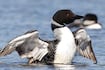
The fate of one of Canada’s most iconic birds may be in jeopardy after researchers say its population has been on a steady decline for decades. Researchers behind a recent study say the number of common loon chicks has dropped by approximately 40 per cent over the past 30 years or so, across breeding sites monitored in nine Canadian provinces and seven U.S. states. It’s unclear what’s causing the decline, Matt Fuirst, research ecologist and observatory manager with Birds Canada, a bird conservation non-profit, told CTV’s Your Morning on Thursday. “We don’t know,” he said. “But we suspect that climate change is acting in different ways to influence the decline of these chicks.” The study, published on Oct. 22 in the journal FACETS, collected data on loon breeding events from non-profits, governments, and academic monitoring projects, encompassing 49 years of bird activity on 3,421 lakes from 12 regions across northern North America. Half of the data included thousands of volunteer observations as part of a long-running citizen science effort, the Canadian Lakes Loon Survey, hosted by Birds Canada. Ontario, Quebec, British Columbia, Newfoundland and Labrador, New Brunswick, Nova Scotia, Alberta, Saskatchewan and Manitoba were included in the study. Canada houses 94 per cent of the global common loon population, according to the organization, which means an estimated 254,0000 breeding pairs migrate north every year. U.S. states included New Hampshire, Vermont, Maine, New York, Washington, Wisconsin, and Massachusetts. Climate change suspected Climate change might partly be behind the decline, Fuirst said, by influencing the quality of lakes. “Climate change contributes to acid rain, and when you have acid rain that then contributes to what fish can sustain in lakes. And loon rely on fish, and that influences their survival essentially,” he said. Heavier rain could also hamper water clarity by causing more runoff from shorelines, Fuirst said, making it difficult for loons to hunt efficiently. Fuirst said his team is conducting an analysis based on satellite imagery to look at the clarity of lakes across North America to see if there is any impact on the birds’ reproductive success. Human activity like boating and use of lead tackle when fishing could also reduce breeding habitats and kill loons, Fuirst said. In an October interview with CTV News Channel, Fuirst said it’s “hard to tell” if the common loon could become endangered. “Their status in Canada is still doing very well,” he said. Much of the data had been collected from regions located in the southern edge of the monitored breeding range, he added. “So it might be an indicator of what might happen if these threats continue to creep up north.”