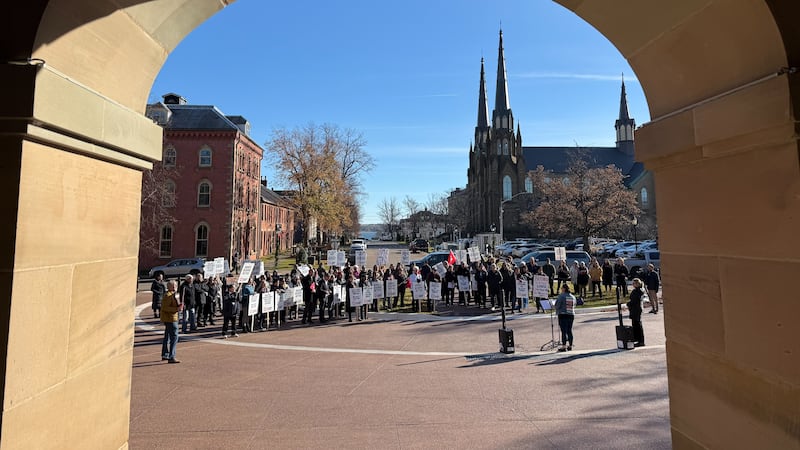
CHARLOTTETOWN – Prince Edward Island nurses took their contract fight outside the legislature Tuesday, calling on the province to invest in its public health-care workforce and reduce spending on private staffing agencies. More than 1,600 registered nurses, registered psychiatric nurses and nurse practitioners have been without a collective agreement for more than a year and a half. Their rally comes as the cost of relying on temporary agency workers climbs. According to the P.E.I. Nurses’ Union, Health P.E.I. spent approximately $44 million on agency staff in 2025–26. “What it means for our members is the focus is purely on filling the gaps and not the causes of why those vacancies are there,” said union President Kim Sears. “The focus needs to be on retention. Recruitment alone isn’t going to help when you can’t retain the nurses.” Sears said she’s also hearing that spending could approach $60 million in the current fiscal year, though that projection has not been confirmed. The union wants the health authority to prioritize working conditions for permanent staff, pointing to what it describes as unsafe staffing ratios, inadequate recognition of specialized nursing roles and compensation that falls behind other provinces. Wages could push nurses to leave P.E.I. P.E.I. general-duty registered nurses have the lowest base hourly wages in Atlantic Canada, according to a November comparison by the Canadian Federation of Nurses Unions. For nurse practitioner Laurie Thomas, the concern is that pay hasn’t kept pace with growing responsibilities. “Our role and responsibility in the system has grown exponentially, and our wages haven’t,” she said. Thomas, who has worked as a nurse practitioner on the Island since 2013, worries more of her colleagues could leave Health P.E.I. for opportunities elsewhere if a new agreement doesn’t reflect the work they do. P.E.I.’s fall fiscal update forecasts the province’s health authority will run $74.3 million over its 2026–27 operating budget, with agency staffing listed as one of several pressures, but not the sole cause. According to reporting by The Guardian, Health P.E.I. spent more than $27 million on private agency staff between Jan. 1 and July 10, 2026. The figures were detailed in a freedom of information request received by the Charlottetown newspaper. Region-wide ban on travel nurses Health Minister Cory Deagle said the Island is working to reduce its reliance on nurses supplied by private agencies, adding taxpayers can’t afford the cost. But for now, several facilities can’t operate without them, and they also allow permanent nurses to take vacations. “The reality is we’d have to close beds if we reduce those staff,” he said. “Our system can’t handle that overnight.” He added that it will take time for staffing reductions to show up in spending figures. Deagle also plans to meet with counterparts in Nova Scotia and New Brunswick, ideally before year’s end, to advocate for a region-wide ban on travel nurses. “Our goal should always be zero. Will it get there? My hope is yes,” he said. The pressure on pay extends beyond the Island. Statistics Canada found that registered nursing employees aged 25 to 54 earned 1.4 per cent less per hour in 2025 than before the pandemic, once inflation is factored in. Meanwhile, hours purchased from private staffing agencies by Canadian hospitals more than doubled between 2019–20 and 2023–24, according to the Canadian Institute for Health Information. The nurses’ union says it walked away from negotiations in September after 32 days of bargaining, citing a lack of meaningful counterproposals from Health P.E.I. “We felt we were being stonewalled at the bargaining table and had no choice but to walk,” Sears said. She added that it was the first time in 24 years the union had taken that step. “We did not take this lightly.” The two sides are scheduled to meet with a conciliation officer on Dec. 21 and 22, in an effort to resolve the outstanding issues and reach a new agreement.