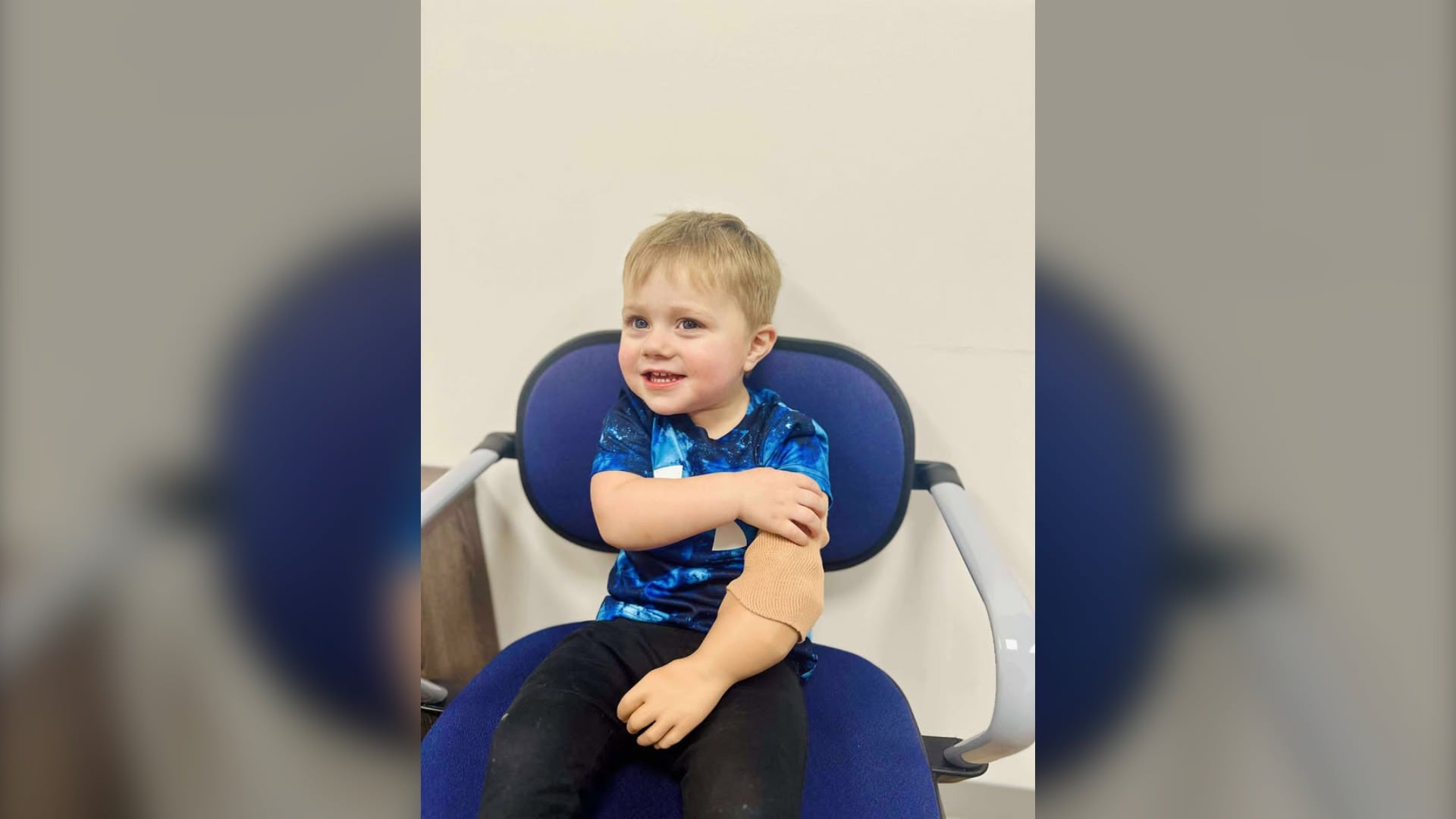
Two-year-old Tommy Darrach is learning to open and close the hand on his new prosthetic arm, practising everyday movements that help him do more on his own as he grows. His mother, Ashley Darrach, says the device was free through The War Amps Child Amputee (CHAMP) Program, which supports families with financial help for prosthetics and connects them with others who have lived through similar experiences. “He picked it up very, very quickly,” Darrach said. “Every day he sort of learns a new skill with it, and it’s just amazing.” The arm is myoelectric, meaning its sensors pick up electrical activity from muscles in his residual limb to control movements. Tommy also has another prosthetic he received through the program, which he can snap on and off the handlebars of his bike. Darrach says she learned about Tommy’s limb difference after her 20-week anatomy scan. She was called in to see her doctor and spent the drive bracing for the “worst case scenario.” “When I got there… I said, ‘is that it?’ I wasn’t really fazed by that, to be honest with you,” Darrach said. But after going home, her research began. “I did have a moment of ‘how will this change my son’s life?’ But I very quickly realized that children who are born with a limb difference are just as resilient. And he’s proven that time and time again.” The CHAMP program supports children in Canada under 18 who are born without a limb or lose one because of an accident or medical cause and helps cover costs for prosthetics and specialized devices. It also connects families with peer support, including seminars. Stephen Hann, a regional representative with The War Amps, said he understands the value of that support personally. He was born without his right arm and part of his left arm and enrolled in the program at three-years-old. “It’s realizing you’re not alone,” Hann said, adding he’s watched kids become more confident seeing others missing the exact same limbs. “Seeing how comforted they are, how they handle themselves. It gives you the feeling that ‘I can do that too. I can be that person.’” The organization’s programs are funded by donations and public support of its Key Tag Service, which was first launched to provide employment for returning amputee veterans from the Second World War. “Every child should have the opportunity to live life to the fullest,” Hann said. “Independent, able to do things on their own.” Prosthetic funding on Prince Edward Island can depend on eligibility and the program a family qualifies for. Back at home, Darrach said the goal is not to push Tommy into wearing a prosthetic full-time, but to give him options as he grows. “Getting used to one will give him the tools later on in life to decide if wearing one is for him,” she said. Every step of the way, Tommy has another support close by – Teddy, the family’s three-legged Golden Retriever. They’re now looking into a prosthetic that can help Tommy play hockey, so he can enjoy all his hobbies.