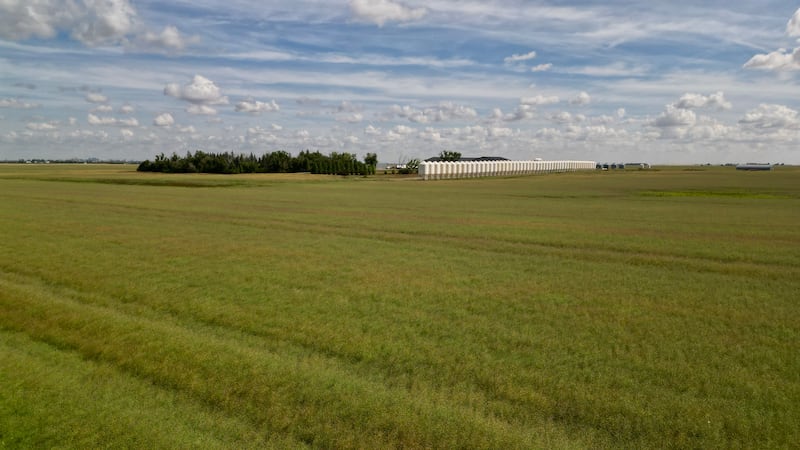
Southern Alberta’s agricultural sector is facing growing uncertainty after the United States imposed 50 per cent tariffs on key regional exports like dairy products, honey and vegetable seeds. The new round of tariffs was imposed on Canada after trade negotiations between the two countries broke down over the weekend. Farmers in the region say the timing couldn’t be worse with harvest now in full swing. “It’s tough because it’s hard to pay attention to what’s going on when you’re out putting 100 hours a week in,” said Stephen Vandervalk, who farms near Fort Macleod. “The uncertainty is the big thing. It’s just flat out — what is going to happen?” As farmers brace for economic fallout, the Lethbridge Chamber of Commerce is calling for a coordinated response to the latest duties on Canadian goods. “Trade uncertainty does not stop at the border. It works its way through supply chains and ultimately reaches local businesses making decisions about hiring, investment, expansion and growth,” said Cyndi Crane, president and CEO of the Lethbridge Chamber of Commerce. “Southern Alberta businesses need stability, predictable market access and the ability to compete.” A study by the Canadian Chamber of Commerce’s Business Data Lab suggests Lethbridge is the 10th most vulnerable city in Canada to U.S. tariffs. Annual exports from Lethbridge Census Metropolitan Area have a value of more than $2.2 billion with 91.7 per cent of those going south to the U.S. Those exports represent 19.4 per cent of the city’s annual gross domestic product of $7.1 billion. “It’s going to affect our local market here in southern Alberta because we are so strongly export-based,” said Peter Casurella, who is executive director of SouthGrow Regional Initiative. “There are going to be some companies here who are at risk.” Prime Minister Mark Carney has announced that Canada will retaliate with its own 50 per cent counter-tariffs on U.S. goods, which are set to take effect on Sept. 8. “It gives the United States time to recalibrate and think, ‘Do you really want to do this?’” said Trevor Harrison, a retired political scientist at the University of Lethbridge. “So, rather than an immediate response like the president continues to do, this is kind of giving them a chance for sober second thought.” While local businesses may feel the impacts of the trade war, Casurella believes Canada is choosing the best option right now. “Some short-term pain in order to maintain a good trade deal with Americans — access to their market and the freedom to trade with whoever we want — it’s probably the best option in front of us,” he said. The Lethbridge Chamber also supports a Team Canada approach that protects Canadian businesses, maintains critical North American supply chains and keeps Canada competitive as governments respond to the changing trade environment. “This is bigger than one tariff or one industry,” Crane said. “Canada needs to think strategically about the economy we want to build beyond this dispute. That means defending our access to the U.S. market, strengthening trade within Canada, diversifying where we can and ensuring Canadian businesses have the conditions they need to compete.” But it remains to be seen whether a deal is possible. “The only lesson out of this all in the last 18 months is you can’t really trust doing a deal because they might rip it up in another week anyway,” Harrison said.