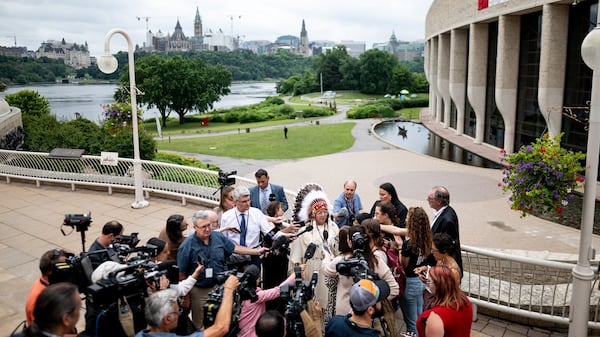
CALGARY — Parti Québécois leader Paul St-Pierre Plamondon says he sees possible areas of co-operation with Alberta Premier Danielle Smith if he becomes Quebec premier next year, adding that both provinces share frustrations with federal overreach. Speaking Thursday at the University of Calgary’s School of Public Policy, St-Pierre Plamondon said his province’s future depends on self-determination, both financially and culturally. “I think it’s pretty obvious for Quebec, that from a linguistic and cultural standpoint we can’t stay in the current regime the way it behaves,” he said. “It’s also difficult from a financial standpoint, because it’s the same for Alberta. If you send substantial amounts of your income to Ottawa and you get little services or anything useful in exchange, you’ll have difficulties with your public finance.” The PQ leader, who is preparing for an election next year, said Smith has “played her cards very well in representing Alberta, in Alberta’s interest.” “That doesn’t mean I agree with Danielle Smith on everything,” he added. “But the purpose of parliament is to give a voice and some coherence to your people’s will. Our people’s will might not be the same on certain topics, but we agree on that principle.” St-Pierre Plamondon also argued that Quebec’s finances would be stronger outside the federal equalization payment system, pointing to research by economists who found federal transfers can hinder growth. “Quebec independence, for me, has to be there for financial reasons,” he said. “Yes, Quebec receives equalization payments, but those payments are hindering our economy. Quebec will get back $90 billion every year in money sent to Ottawa. We’ll take care of health care and education and social services, and then we’ll be able to work with Alberta and other provinces on several topics where we agree.” The separatist leader suggested that while Quebec and Alberta may not see eye-to-eye on policy orientation, they could co-operate on issues such as economic development, entrepreneurship and respect for provincial jurisdictions. “It’s really important to understand that it’s the current framework that doesn’t work and leads to many abuses of power by a federal government that I find illegitimate,” Plamondon said. “Of course there’ll be collaboration from a PQ government.” Difficult conversations Martha Hall Findlay, director of the School of Public Policy, said hosting the PQ leader was part of the university’s role in fostering difficult conversations. Hall Findlay referred briefly to Wednesday’s horrific assassination of U.S. conservative activist, Charlie Kirk who was shot to death while speaking at an event in Utah. “We’re not here to endorse, we’re not here to promote anything other than the ability to talk about things that might be controversial,” she said. “To actually be a place where views can be put on display, debated, discussed is so important and it was a real honour for us to host this event and have those discussions.” Hall Findlay notes that she was particularly struck by the similarities in frustration between Alberta and Quebec and that St-Pierre Plamondon’s remarks on equalization echoed concerns often raised in Alberta. “You give somebody a handout, it doesn’t work,” she said. “It ends up actually hindering entrepreneurship. It ends up hindering dignity. It ends up having other problems. So I found that very, very interesting.” St-Pierre Plamondon stressed that sovereignty for Quebec, like any debate on Alberta independence, must come through democracy. “If francophones exercise self-determination through their government instead of having a federal government deciding for them on many issues, it would just make sense in light of history,” he said. “And it would make sense for other regions.” St-Pierre Plamondon says if elected premier next year, Quebec will have to work with other provinces and Alberta would be a good choice., With files from Bill Graveland, The Canadian Press