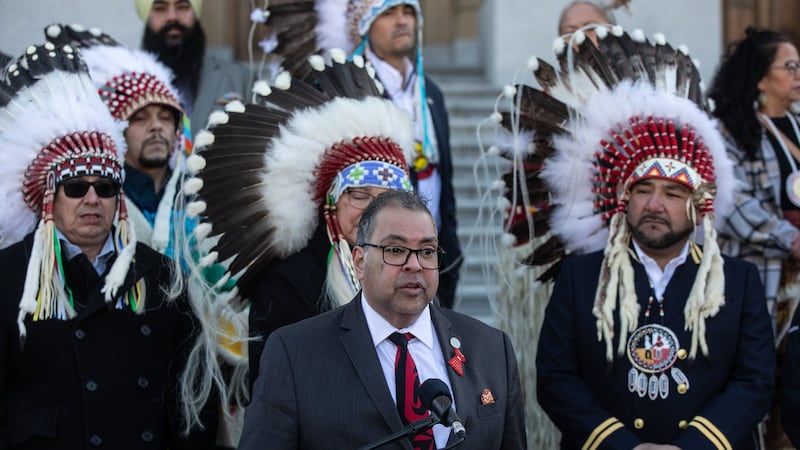
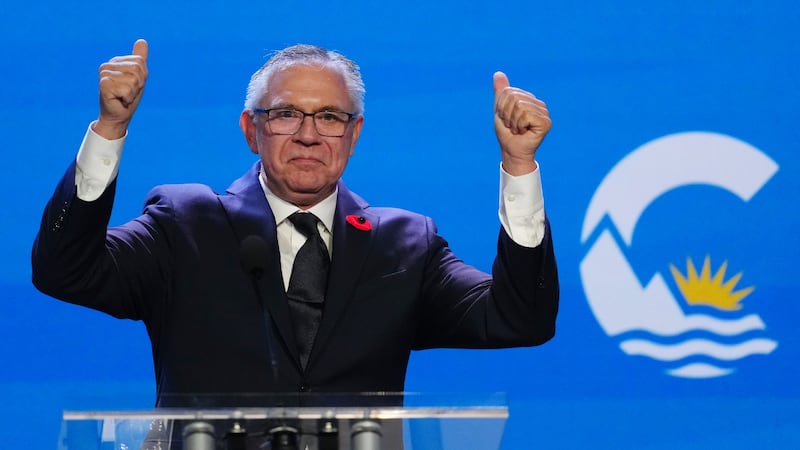
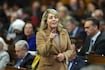
A minority report on electoral mapping exposes a governing party desperate to stay in power by ensuring rural voters get unfair sway at the ballot box, the Opposition leader told reporters last week. Naheed Nenshi said the take on remapping — which is part of an appendix to the full 2025-26 Electoral Boundaries Commission Report — is at odds with how such commissions typically operate. The minority report includes a “hopelessly gerrymandered” map reflecting UCP wishes, Nenshi said, singling out proposed Calgary boundaries as an example. “If you don’t live in downtown Calgary, then you’re sharing your vote with rural people 50 kilometres away,” said Nenshi. The UCP aims to dilute the votes of urbanites with the votes of rural Albertans. “The only reason to do this is because the UCP is scared and they think they have to cheat to win,” said the member for Edmonton-Strathcona. “This is what Donald Trump has done in the U.S., and they’re taking a play right out of his book.” Non-city voters historically make up the base of support for right-of-centre parties in Alberta. The NDP swept Edmonton proper in the last election, winning all 20 seats. The split in Calgary proper is 14 NDP seats to 12 UCP seats. Also speaking to reporters last week, the justice minister called NDP accusations of gerrymandering “a ridiculous assertion.” Mickey Amery, the UCP member for Calgary-Cross, said: “This is a typical tinfoil-hat positioning from the NDP leader.” Responded Nenshi: “The only option is to accept the independent commission’s report, and if (Amery) were to say that, I would happily doff my tinfoil hat.” The Hybrid Assertion The two UCP-appointed members of the five-person commission wrote that their proposed boundaries reflect the rural-urban hybrid nature of much of Alberta. “Hybrid divisions are not new in Alberta,” they said in their appendix to the full report received last month by Speaker Ric McIver. “They are a principled and practical response to Alberta’s growth patterns, particularly in regions where urban expansion and rural service are deeply interconnected.” The commission “did not adequately incorporate this fact” in making the actual recommendation, continued the UCP appointees. “Their approach tends to privilege population parity and a rural/urban divide over functional community linkages and the lived realities described repeatedly in submissions” to the commission, they said. Established on March 28, 2025, under the Electoral Boundaries Commission Act, the independent commission was tasked with redefining the electoral map for two election cycles by proposing new riding boundaries and names. Included in its scope was increasing the legislative assembly by two seats to 89 to accommodate population growth. The commission process spanned a year and concluded with the report’s March 26 delivery to the Speaker. It accepted more than 1,000 written submissions and conducted 28 public hearings around the province between May and June 2025. After submitting an interim report in late October, the commission held 19 further hearings in January to review public feedback before crafting a final draft. The commission relied on July 2024 provincial data estimating the population of Alberta at about five million, meaning the target average was almost 56,000 people per riding. Its methodology allowed most ridings to vary by up to 25 per cent above or below the target average, with up to four allowed to exceed that threshold to protect remote or sprawling districts. Majority Response The majority portion of the report says it achieved effective representation — a constitutional imperative — by weighing proposed riding populations with factors like sparsity, transportation routes, community location and the need to make borders understandable. The main report leveled a sharp rebuke at the minority position. Its maps are “procedurally unfair” and “substantively unreasonable as an exercise” of the commission’s statutory mandate, the overall report said, calling the minority maps “likely to offend” Section 3 of Canada’s Charter of Rights and Freedoms. The Supreme Court of Canada interprets the section as a guarantee of effective representation and not strict parity. Section 3 isn’t one that can be overridden by a province’s invoking of the notwithstanding clause. The maps “radically change the interim report in ways that are neither a response to public feedback nor a cascading consequence of public feedback,” said the majority. They use hybrid ridings in “an incoherent way” in a handful of cities. Charter Challenge Harbinger? In the legislature, Premier Danielle Smith said members need time to review the commission report, its findings and its recommendations. Responding to questions from Nenshi March 31, she said: “It’s an independent process, and I did not have any influence on the commissioners. I think this is an issue for the members of the legislative assembly to decide.” Smith, the member for Brooks-Medicine Hat, continued: “This is not a decision for me. It’s not a decision for government. It’s going to be a decision for the honourable members in this chamber.” Nenshi said there’s only one recommendation from the actual commission. “The UCP-appointed members, having supported that recommendation, did a stunning about-face and, for the first time in Alberta history, issued a different report with different maps. This is obviously the result of political pressure from somewhere,” he said. If the government redraws commission-approved maps, “we’ll see you in court,” he told the legislature. George Lee, Local Journalism Initiative Reporter, The Macleod Gazette