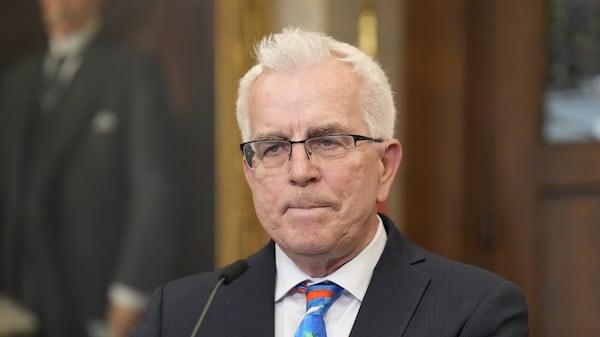
The current Israel and U.S.-led attack on Iran is wading into unprecedented territory, and could shift complex geopolitical alliances, according to one expert. Sajjan Gohel, an international security director at the Asia-Pacific Foundation, told CTV News Channel on Saturday that the current strikes in the region are unlike anything seen before. “We’ve gone into unprecedented territory,” Gohel said. “We’re looking at the goal of regime change by the United States. There has not been a change in regime in Iran since the 1979 Islamic revolution that brought down the Shah of Iran and instituted the theocratic regime, which has remained in existence since then.” Gohel went on to say that the current strikes are an abandonment of “sanctions policy, of proxy containment, of nuclear, non-proliferation frameworks.” The goal, now, by the U.S. and Israel is to impose a strategy to remove both the theocratic regime, as well as the Islamic Revolutionary Guard Corps (IRGC), which he said, “acts as the Praetorian Guard for that regime itself.” Gohel stressed that the strikes won’t end today, as Israeli and American jets will need to be refuelled and resupplied. “This is just the beginning of a strategy that’s been implemented, and the outcome of which, and the end stage of which, we do not know,” he said. “There are a lot of concerns as to how far this is going to escalate.” Early Saturday, the U.S. and Israel launched a major attack on Iran. Some of the initial strikes seemed to be at areas surrounding the office of Iran’s Supreme Leader, Ayatollah Ali Khamenei, as well as military targets. However, the Iranian media reported that areas all around the nation were targeted in the strikes, and smoke was seen rising from the capital. What complicates things further is how other countries in the region will get involved, Gohel said. Retaliatory strikes have hit Bahrain, the United Arab Emirates, Qatar and Jordan - which has had to use its defence system to bring down missiles. He predicts that countries like Saudi Arabia, that have already criticized Iran’s action, will also be brought in. Gohel noted that Saudi Arabia, which he described as a “strategic rival to Iran”, has a defence pact with Pakistan, that has condemned the U.S. operation. However, Pakistan has also previously nominated U.S. President Donald Trump for a Nobel Peace Prize. Gohel said that Israel and Saudi Arabia currently don’t have diplomatic relations, further complicating the situation. Saudi Arabia will be concerned about what moves Iran makes next, particularly when it comes to the Strait of Hormuz and the Red Sea, two waterways that could be targeted and cause massive disruption to global supply chains, he added. There is a high probability that Iran may utilize its proxies, such as Hezbollah and the Houthis, which could be used to create further regional instability, said Gohel. He also warned that the IRGC could use its connections to organized crime groups in Western countries like Canada, the U.S. and the U.K. to do “targeted operations, clandestine operations against Iranian dissidents that have been opposed to the regime.” “Iran is now having to fight for survival and its existence. So, in many ways, they have nothing to lose but to cause harm and inflict damage,” Gohel said, adding that Iran will likely target U.S. military installations as well as the U.S. naval fleet that is nearby. “This is an unprecedented moment that we are witnessing,” he added. With files from the Associated Press