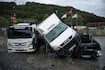
A Vancouver police officer’s decision to use his SUV to ram a suspect’s pickup truck during an October 2024 incident was “questionable,” according to a report from the office that investigates police use of force in B.C. Jessica Berglund, the chief civilian director of the Independent Investigations Office of B.C., issued her report on the matter on Thursday, concluding that the officer’s questionable decision was a “potential conduct or training concern,” but not a criminal matter. What happened The incident in question transpired on Oct. 8, 2024. Around 10:15 p.m., Vancouver Police Department officers encountered a Ford F-350 parked on a side street in “circumstances they considered suspicious,” according to the report. The officers queried their database and found that the vehicle had been reported stolen, so they began following it when it left the area. The report indicates a supervising officer approved the use of a “box and pin” manoeuvre, which “involves positioning police vehicles around a subject vehicle in traffic and then driving them up against its front and rear when it is stationary or nearly so, to pin it in place before it can move off again.” Witness officers who spoke to the IIO described the suspect vehicle as travelling at “normal speeds” and not driving dangerously, though one officer did say he saw the truck drive through stop signs on a side street. Roughly 10 minutes after the truck started moving, a witness officer radioed that the vehicle had driven north on Renfrew Street and turned right onto East Hastings Street, near the PNE. The subject officer, or “SO” in IIO parlance, was approaching the intersection on Hastings at the time. “Calling ‘takedown, takedown,’ he drove across the intersection and used his police SUV to disable the truck by impacting its right rear, causing it to spin 180 degrees,” the report reads. “The force of the impact caused one of the police vehicle’s wheels to be partially torn off.” Four other police vehicles converged on the truck, blocking its path, according to the report. The driver—referred to throughout the report as the affected person, or “AP”—continued revving the truck’s engine, attempting to break out of the pin. Officers fired rounds from a beanbag shotgun at the AP and deployed a police service dog, eventually securing his arrest. He was taken to hospital for treatment of injuries caused by dog bites and beanbag strikes. Officer made ‘questionable’ choices The IIO is tasked with investigating all incidents involving police officers in B.C. that result in death or serious harm to a member of the public. In this case, the affected person’s injuries met the Police Act definition of serious harm. Berglund found the officers’ use of force when arresting the affected person to be justified, noting that he “could have chosen to surrender” after the collision and police efforts to block him in. “His actions in trying to force his way out of the pin between police vehicles led to further uses of force against him,” the report reads. “They were reasonably proportionate and justified in the circumstances.” The subject officer’s decision to initiate the takedown in the location and manner in which he did, however, receives additional scrutiny in Berglund’s report. “It is debatable whether the ramming of the truck by the SO was consistent with VPD policy (which states that the ramming of a suspect vehicle must only be carried out in ‘the most exigent circumstances’),” the document reads. “The evidence suggests that when the truck was moving relatively slowly after its turn onto East Hastings Street, the SO saw an opportunity and made a split-second decision to engage and ram the truck. Fortunately, that decision, although it caused the SO’s police vehicle to be badly damaged, did not cause anyone, including nearby civilians or the AP, to be injured during the course of the ramming itself.” Subject officers are not required to provide evidence to the IIO, and the subject officer in this case chose not to provide an account of his actions. “The police response to what was a suspected property offence (theft of the truck) was significant, and the use of force choices were questionable,” the report reads. Despite this assessment, however, Berglund did not recommend any charges against the subject officer. “I believe any question about the SO’s driving manoeuvre to be potential conduct or training concerns rather than criminal,” the report reads. “In British Columbia, the Office of the Police Complaint Commissioner has jurisdiction over the conduct of municipal police officers.” The report does not say whether the IIO has made a referral to the OPCC. In an email to CTV News, an IIO spokesperson said the office’s “standard procedure” is to notify the OPCC of all files involving municipal police forces. The office does so at the conclusion of each investigation, the spokesperson said. The IIO spokesperson also elaborated somewhat on the rationale for determining that no criminal offence had been committed in this case. “While the fact that the AP’s injuries were not directly caused by the officer’s decision to ram the vehicle was relevant, the (chief civilian director’s) conclusion was based on the evidence as a whole and the applicable criminal-law threshold,” the email reads. “Conduct or training concerns do not necessarily amount to a criminal offence and may be addressed through separate oversight or disciplinary processes.” In its own statement to CTV News, the OPCC said there are “strict confidentiality provisions” in the Police Act that prevent it from “disclosing that an investigation has been or may be initiated.” “However, we are able to provide you with limited information at this time,” the office said. “Any time a member of the public is seriously injured or dies as a result of police conduct, our office must order a mandatory external investigation into the matter. In this case, our office was notified by the Vancouver Police Department at the time of the incident and we ordered an investigation that was immediately suspended while the Independent Investigations Office investigated the incident.” Now that the IIO investigation is over, the OPCC will investigate to assess “whether any officer committed misconduct in relation to the incident,” the office said.