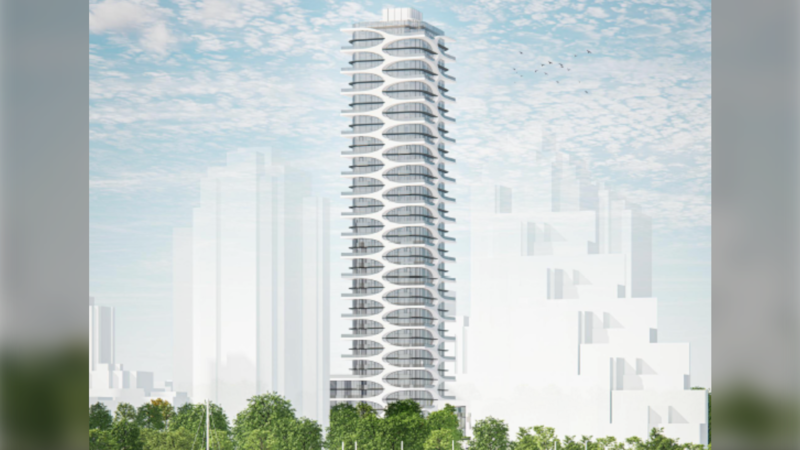
A major Vancouver developer has not been paying its bills for a cancelled condo project in the city’s West End, according to a recent B.C. Supreme Court decision. In the decision, which was issued Wednesday and published online Thursday, Justice Kevin D. Loo appointed a receiver for four companies: 700 Bidwell Holdings Inc., 700 Bidwell Limited Partnership, 700 Bidwell Property Inc. and Westbank Holdings Ltd. Westbank, which describes itself as “Canada’s leading luxury residential and mixed-use real estate development company,” will be subject to the receiver’s oversight only with respect to its interest in a single project. The company’s overall finances are not part of the receivership order, and Westbank says it plans to appeal the ruling. The project in question is not named in the decision, but the 700 Bidwell companies have been listed as proponents of a redevelopment proposal at 1668 and 1684 Alberni St., on the corner of Bidwell Street in Vancouver. Rezoning for the development—which was slated to replace two small condo towers with a single, 40-storey tower containing 128 condo units—was approved in May 2022, but a related development permit application was cancelled in September 2025. According to Loo’s decision, that’s also roughly when the developer stopped paying Bank of Montreal under a credit agreement put in place to finance the project. “The respondents owe the bank more than $36 million,” the decision reads. “The respondents have failed to make interest payments when due since at least September 2025, and they have failed to repay the outstanding debt following a demand on Jan. 26, 2026. Since issuance of that demand, the bank debt has increased by over $914,850 in accrued interest, plus costs.” BMO applied to the court for appointment of a receiver, which was its right under the terms of the loan agreement. The companies opposed the application, arguing that the bank had not proven that it faced any financial risk or expected to have any difficulty working with the debtors. The companies suggested that foreclosure would be preferable to the appointment of a receiver. While Loo agreed with many of the companies’ submissions, he ultimately sided with the bank, noting that the presence of the receivership clause in the agreement weighed heavily in its favour. A complicated potential sale The judge also noted that the potential sale of the property is unlikely to be simple. The existing buildings are subdivided into strata units, but are currently being operated as rentals, according to the decision. The City of Vancouver’s referral report for the project’s rezoning application describes 1668 Alberni St. as a 13-storey strata building with 11 residential units. The other building is described in that document as 14 storeys tall and home to 12 strata units. Loo noted that there was no evidence of the current market value of the property before the court. BC Assessment lists 11 addresses in 1668 Alberni St., valuing the penthouse at more than $2.7 million and the rest between $1.2 million and $1.4 million. Assessed values at 1684 Alberni St. range from $1.9 million to $2.2 million. Adding these totals up suggests a market value for the properties as they currently exist, leaving aside any redevelopment potential, would be in the vicinity of $37.5 million. The court decision indicates that rents collected from tenants currently residing in the building have not been paid to BMO “as required.” “At the end of the day, it is clear in this case that the debt is not being paid,” the decision reads, summarizing the judge’s thinking in granting the receivership. “The respondents concede that they have made no proposals to pay the debt, despite earlier promises to that effect. The respondents concede that the bank has provided opportunities to them to resolve the defaults, and that the respondents have been unable or unwilling to do so. Interest is accruing at a rate of approximately $5,150 per day. More than $300,000 in interest has accrued since this petition was filed on Aug. 12, 2026.” Westbank’s response Loo granted the order appointing a receiver, “effective immediately,” but added that the receiver would not have the authority to conduct a sale of the properties until Feb. 13, 2027, allowing a four-month redemption period for Westbank and the other companies to refinance and pay off their debt, if possible. The judge also concluded that the receivership order should apply to Westbank in the narrow way sought by the bank. Westbank opposed its inclusion, arguing that “any receivership order in respect of Westbank may be highly prejudicial to it.” “A receivership order in respect of any of Westbank’s assets may constitute a default under security documentation on other projects,” the decision reads, summarizing the company’s argument. “However, there is no evidence before the court in this regard.” Offered the opportunity to comment on the case, Westbank sent CTV News a brief statement, via email. “There is no basis for this filing and we will be submitting an appeal,” it reads. “We have no further comment.” Questions about why the development application was cancelled and why the 700 Bidwell companies stopped paying their debts were left unanswered in Westbank’s response.