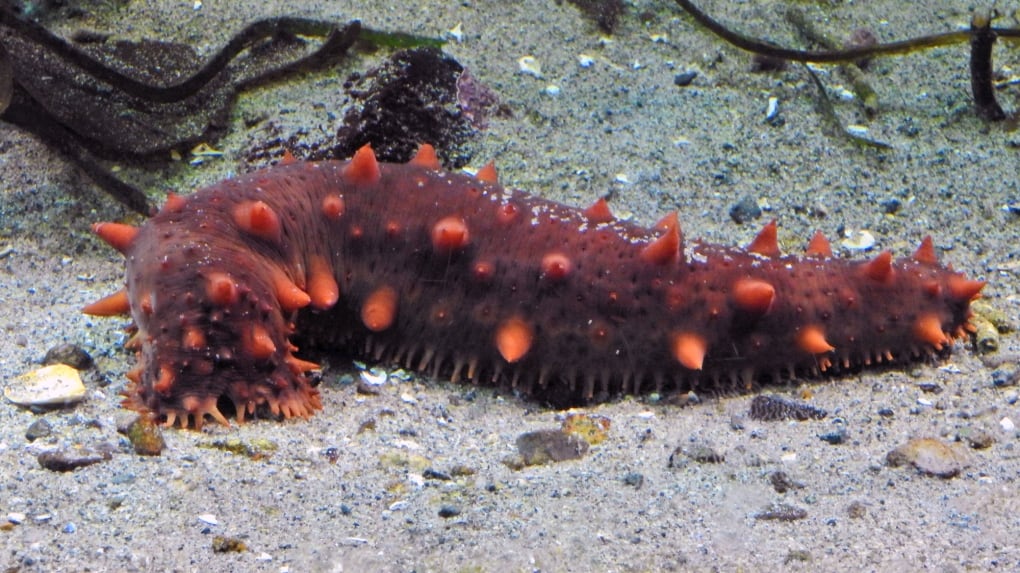
A British Columbia Supreme Court judge has sentenced a notorious fisherman to six years behind bars, ruling the only way to stop the prolific marine poacher from “ravaging the ocean” was to “move him far from the sea for a long period of time.” Earlier this year, Scott Steer was found guilty of multiple charges related to illegally harvesting and selling sea cucumbers, including while legally prohibited from possessing or acquiring fishing gear due to earlier violations of the federal Fisheries Act. At his sentencing hearing last week, Crown prosecutors told the court that the Gabriola Island man’s past infractions constituted “the longest record of Fisheries Act violations in Canadian history.” His wife, Melissa Steer – identified in court as the sole director of a numbered company involved in the criminal operation — was also found guilty of illegally selling sea cucumbers. Wife ‘fully involved’ in scheme Writing in his sentencing decision Friday, Justice David Crerar called the numbered company a “sham” that was incorporated primarily to evade earlier fishing prohibitions and “insulate Mr. Steer from the criminal and other consequences of his illegal fishing activities.” Under the guise of the company, the fisherman acquired multiple vessels and vehicles, recruited a crew, falsified Fisheries and Oceans Canada records and directed several sea cucumber fishing expeditions in closed areas and without licences, according to court documents. “Mr. Steer actively orchestrated every aspect of the entire illegal sea cucumber operation of harvest and sale,” the judge wrote, concluding the numbered company “served at all times as an alter ego” of the offender. “The evidence also establishes that Melissa Steer was fully involved in this deceptive and evasive plan.” Dozens of prior violations Court documents indicate Scott has 34 convictions from 13 prior cases dating back to 2008, with multiple administrative warnings and violation tickets for Fisheries Act infractions predating those charges. According to the ruling, those prior offences included illegally harvesting crabs from Vancouver’s harbour, defrauding a vessel owner, breaching conditions in an intimate partner violence case and multiple probation violations. “As Mr. Steer has shown, it is impossible for the DFO, with its limited resources, to actively patrol every bay and fjord on the vast British Columbia coast for marine poaching,” the judge wrote. “It is clear that past lesser sanctions, including multiple shorter periods of incarceration, over his long record of violations, have been wholly ineffective in changing Mr. Steer’s behaviour.” The judge described the prolific poacher as “wholly unrepentant,” saying “rehabilitation is highly unlikely” in his case. “On the contrary, his actions over the past 17 years indicate that he will almost certainly return to marine poaching as soon as he is released from prison.” Court records show that between September and December 2019, the numbered company established by the Steers harvested and sold more than 45,000 kilograms of sea cucumbers to seafood wholesalers and exporters, garnering more than $1 million in the transactions. Documents were forged to give the appearance the sea cucumbers were legally harvested, the court heard. Sea cucumber exports The judge found “compelling evidence” that the company continued to violate the Fisheries Act even while the six-week trial was underway. Scott described the trial as “pointless” and a “waste of time” in voicemail messages he sent to one seafood wholesaler during the trial, updating him on the legal proceedings and arranging future sales, the judge noted. China is the largest export market for Canadian sea cucumbers, according to Fisheries and Oceans Canada, with the animal’s dried skin and muscles processed into separate products for human consumption. While the domestic market in Canada is comparatively small, sea cucumbers are also harvested by B.C. coastal First Nations for food and ceremonies. The Crown sought a seven-year prison term and a renewed lifetime fishing ban for Scott, along with more than $1.5 million in fines to be split between the couple. The defence argued a jail sentence of 18 to 24 months was appropriate, with a $500,000 fine against the numbered company. Both sides agreed to the forfeiture of all vessels, vehicles and fishing gear used in the offences. ‘Unbound by laws’ “Mr. Steer considers himself unbound by laws,” the judge wrote, sentencing the fisherman to six years in prison and ordering the couple to pay $1,105,718 in fines. “His deliberate deception and illegal fishing shows contempt for the fragile and finite marine resources and ecosystems. He shows contempt for the fishermen who follow the rules. He shows contempt for the laws of Parliament and the orders of the court. He shows contempt for the efforts of past courts to steer him towards an honest path through less severe sanctions that rely on his honesty and compliance.” “Only a very significant step up in incarceration has any hope of effecting rehabilitation, denunciation, and deterrence,” the judge continued. “Only incarceration will prevent him from inflicting further harm on the scarce public resource of the fisheries.”