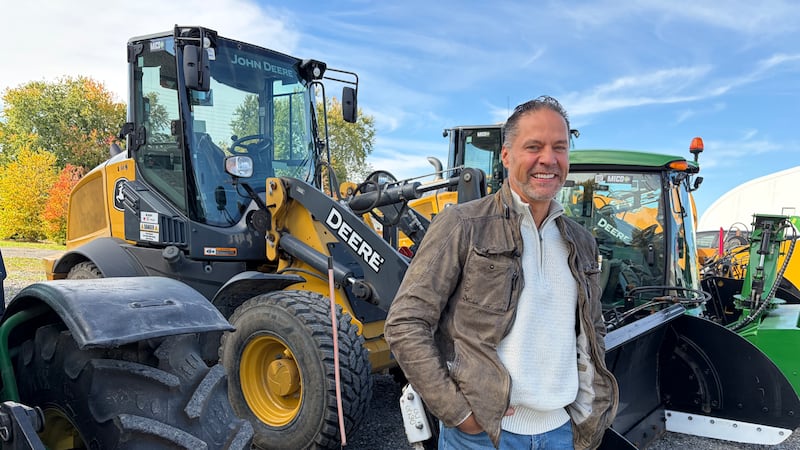
When soccer fans watch a World Cup match at B.C. Place stadium they’re focused on the speed and strategy on the pitch, but there are a handful of people keeping a close eye on the turf itself and how it’s holding up. The two foremost are a veteran sod farmer in Abbotsford and the Englishman in the venue responsible for patching up any wear and tear between games. In fact, when CTV News went to the venue to speak with Dale Frith, he had a long-handled garden fork he was using to tap the turf where ball strikes or players’ cleats had dented the blades, essentially fluffing the grass one coin-sized area at a time. “There’s been a lot of research work done into the pitch and the construction of it and all that work has come off well,” said the FIFA pitch manager for B.C. Place, revealing it’s the first time he’s worked in a soccer venue with a retractable roof. The agronomist is based in Manchester and typically manages pitches for professional soccer leagues, but always makes time when FIFA comes calling. This is his third World Cup tournament and Frith praised the turf as “(coming) through the first game in excellent condition.” A small army of PavCo staff manoeuvre special lights to encourage grass growth, reposition fans as needed for ventilation, and ensure the daily mowing is done between games. Family cheerleaders, year-long growing The thick and vibrant turf was lauded by Türkiye’s captain who called it “the perfect condition” after Saturday’s match, with Australia’s goalkeeper describing it as “great quality.” The praise was a source of both pride and relief for Bert Bos, a longtime turf farmer in the Fraser Valley who spent more than a year researching, planning, and growing the playing surface to FIFA’s rigorous standards. “Hearing that really makes it worthwhile,” Bos told CTV News at his Abbotsford farm, where acres-long corridors of grass in varying colours, densities, and textures are growing for golf courses, sports fields, and top-tier landscaping projects. At the urging of his children, who also work at Bos Sod Farms along with a handful of dedicated staff, Bos took the plunge and applied to be the supplier as a challenge to himself. His parents started farming turf when he was 12, so he’s been around it for more than four decades. “I knew it was going to be a lot of work, and a lot of detailed work, but it turned out to maybe be a bit more (than I was expecting),” he said with a smile, adding that he planted the seeds almost a year to the day before removing the turf in strips to take to the venue in downtown Vancouver. International travel and ‘hybrid turf Despite his varied experience supplying customers across North America, Bos hadn’t experienced anything like FIFA’s hybrid turf, requiring an Australian-made compostable base with synthetic fibres sewn into the material. He spent weeks searching western Canada for the right kind of sand, ultimately trucked over from Vancouver Island, that he had to lay in two-millimetre-thick layers until it reached a thickness of 38 millimetres; then he was able to add the 50-50 mix of Kentucky bluegrass and perennial ryegrass seeds to start growing. Accompanied by his kids, Bos took several trips to Europe and the US to make sure each step was carried out perfectly, sourcing specialty materials and equipment from the Netherlands. FIFA inspectors were pleased with his turf’s hygiene, which is their term for tidy and free of grass clippings, and CTV News can confirm the synthetic fibres—comprising five per cent of the overall turf and designed to reinforce the blend—were totally indistinguishable from the real thing. “The quality needs to be just at the very best it can be being on the world stage for the world to see so, there’s a lot of pressure,” said the Dutch-born father of six, who co-founded the company with his wife. His children and staff joined PavCo employees to install the turf last month, giving the maintenance workers plenty of time to get used to caring for it before the first World Cup game last Saturday. Bos was glad FIFA trusted his family business, about an hour east of the venue, with the responsibility of making sure the field of play would bring out the best in the world’s soccer stars. “It’s an international event and the more Canadian content we can have in this event, the better it is,” Bos said. “I think it’s a reflection of the turf industry, the agricultural industry, our province, our country.”