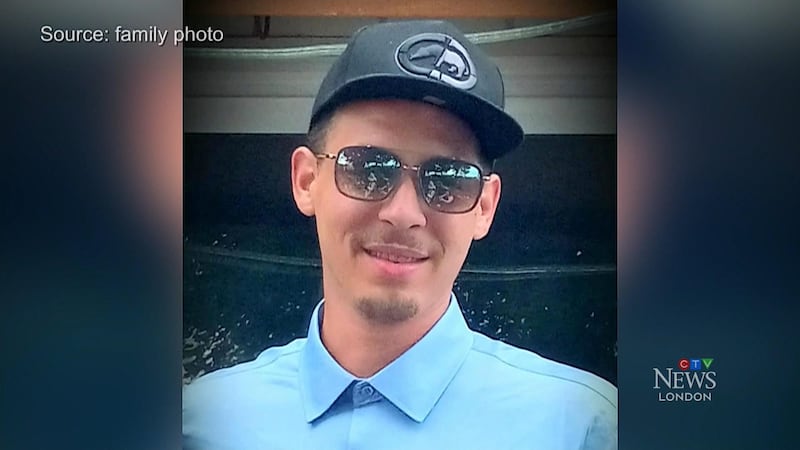
Warning: This article contains discussion of suicide and recordings of a teenager experiencing an acute mental-health crisis. Some readers may find the content distressing. Crisis support resources are available at the end of this article. For the first time, the public can hear the final 911 call made by Chase De Balinhard, a 15-year-old autistic teenager who was fatally shot by police in Surrey, B.C., on Feb. 9, 2025. The approximately 19-minute recording, along with police radio communications documenting the response, was played during a coroner’s inquest examining the circumstances of Chase’s death. CTV News is publishing the complete recordings in accordance with the coroner’s direction that audiences be given access to the full audio when excerpts are broadcast, allowing them to hear the exchanges in context. Together, the recordings offer a revealing account of what Chase told emergency responders, what information was communicated to police and how the encounter unfolded. A teenager in crisis Chase called 911 from a wooded area behind Clayton Heights Secondary School, telling the operator he was considering ending his life. For much of the call, the teenager spoke calmly and politely, often apologizing when he struggled to answer questions. Asked for his home address, Chase replied: “I’m sorry. I’m autistic. I don’t know, unfortunately.” He described experiencing depression for approximately two years and feeling increasingly isolated from his peers. “Honestly, I don’t have any friends anymore. They just ignore me now,” he told the operator. Chase also discussed his mental-health treatment, explaining that he attended therapy but sometimes felt his concerns were not being taken seriously. “I don’t think they take it seriously,” he said. The teenager told the operator he had taken what he described as a revolver from his father’s office. He said the weapon was normally kept in a locked drawer, but he knew which key opened it. Chase initially described holding the weapon but later clarified that he had placed it beside him, within arm’s reach. He told the operator he was unsure whether it was loaded. Police later determined that the weapon was a realistic-looking .22-calibre CO2 pellet pistol containing six pellets and a full CO2 cartridge. Questions about communication A central issue explored during the inquest was how the emergency call-taker communicated with Chase after learning he was autistic. Surrey Police Service call-taker Michael Peteers testified that his initial training included approximately one hour specifically devoted to mental-health crisis calls. He said he had received no autism-specific training. Under questioning from J.A. Pankiw-Petty, the lawyer representing Chase’s family, Peteers acknowledged that he had not been trained in how compound questions, ambiguous language or unfamiliar terminology might affect some autistic callers. The recording captures several instances in which Chase asked for clarification or struggled to understand what was being asked. At one point, Peteers asked about his ethnicity. Chase apologized and said he did not know what the word meant. The operator then explained the question using more familiar terms. One exchange, near the end of the call, attracted particular attention during the inquest. Peteers asked Chase how he felt about police, including whether he was afraid of them or respected them. “To be honest, I really don’t trust any cop pretty much,” Chase replied. The call-taker followed up by asking whether that distrust extended to wanting to harm police, or whether Chase simply did not trust them. “Both,” the teenager answered. Peteers testified that he took the response seriously and entered the information into the police dispatch system. The family’s lawyer questioned whether Chase understood the compound question as intended. The testimony did not establish that Chase misunderstood it. Peteers told the inquest he had tried to keep Chase calm and engaged throughout the call. He also expressed support for additional practical autism-specific training for emergency call-takers. The call ended shortly after an officer approached Chase near the school. What police were told Separate police radio communications, also played during the inquest, document the emergency response as officers searched for Chase and attempted to contain the situation. The recordings show that officers were informed Chase was suicidal, carrying what he described as a revolver and located near a school. They were also repeatedly advised of his developmental disability, autism and attention-deficit/hyperactivity disorder. Those details were communicated in part through Car 67, a specialized mental-health response team pairing a police officer with a psychiatric nurse. At one point, a dispatcher advised responding officers that Chase had put the gun down beside him, although it remained within arm’s reach. The transmissions also document efforts to obtain protective equipment, explore the availability of a drone, establish containment and identify Chase’s home address. A dispatcher identified his father, Richard De Balinhard, and a possible family address, asking whether officers should be sent to the home. Whether Chase’s parents could have provided information that might have assisted responders has been another focus of the inquest. As the encounter progressed, police radio traffic became increasingly urgent. Officers reported Chase leaving the school grounds, moving through nearby trails and residential areas, and pointing what appeared to be a firearm toward police. The final transmissions document reports of shots fired, urgent requests for an ambulance and efforts to provide medical assistance. Chase died at the scene. Could anything have been done differently? The recordings have been examined alongside testimony from the emergency call-taker, responding officers, mental-health professionals and Chase’s family. Officers who testified described an exceptionally dangerous and rapidly evolving situation involving a suicidal teenager carrying what appeared to be a real firearm in a populated neighbourhood. Several witnesses acknowledged the potential value of additional autism-specific training and better access to individualized information about people experiencing mental-health crises. However, responding officers also emphasized that the apparent firearm threat significantly limited their options and that protecting the public remained a priority. The inquest heard that a safety plan had previously been developed for Chase, outlining strategies intended to help him regulate his emotions during a crisis. That document was not located by the psychiatric nurse assisting the police response, despite being contained in historical medical records available to her. The nurse testified that she had limited time to review extensive records during the emergency. She agreed that making such plans more accessible could be helpful. Why the recordings are being published CTV News joined other media organizations in requesting access to the recordings after they were played publicly at the inquest. The media consortium argued that allowing the public to hear the evidence directly would promote transparency and provide context that written transcripts and summaries could not fully convey. Inquest counsel initially opposed releasing copies of the 911 call, citing concerns about the consequences of distributing audio of a vulnerable teenager experiencing an acute mental-health crisis. Counsel for Chase’s family took no position on whether the recording should be released, but urged sensitivity toward Chase and others living with autism or experiencing suicidal thoughts. CTV News is publishing the complete 911 call and police radio recordings in accordance with the coroner’s direction to make the full evidence available alongside the excerpts used in its television reporting. The recordings are being presented so audiences can hear the exchanges in their full context, rather than relying solely on selected portions. An investigation by B.C.’s Independent Investigations Office previously concluded the police shooting was legally justified and found no reasonable grounds to believe an officer committed a criminal offence. The coroner’s inquest does not determine criminal or civil liability. Its purpose is to establish the circumstances surrounding Chase’s death and consider recommendations that could prevent similar tragedies. Chase’s parents have emphasized that they hope the proceedings will lead to improvements in how first responders communicate with autistic people and those experiencing mental-health crises. If you or someone you know is struggling with thoughts of suicide, help is available 24 hours a day, seven days a week. In British Columbia, call 1-800-SUICIDE (1-800-784-2433) for confidential crisis support. You can also call or text 988 anywhere in Canada to reach the Suicide Crisis Helpline. If someone is in immediate danger, call 911.