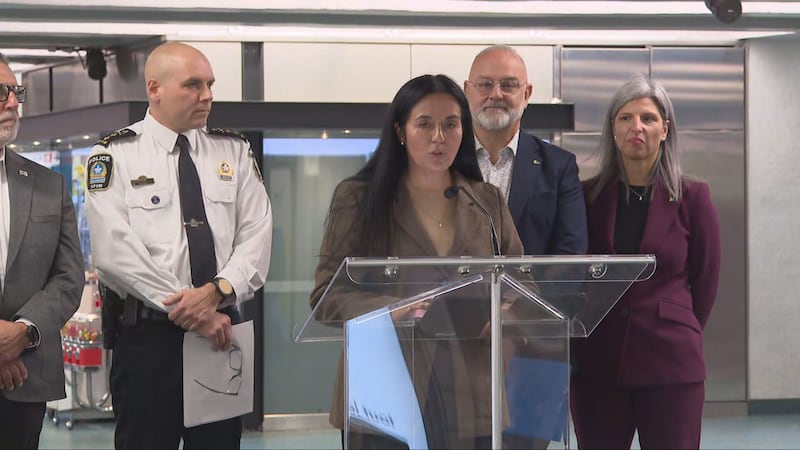
OpenAI has refused to share the Tumbler Ridge mass shooter’s chatbot history with the B.C. government, Attorney General Niki Sharma said Monday while announcing the province’s lawsuit against the tech company has been filed in California. Sharma said the lawsuit, which was first announced back in July, will focus on OpenAI’s “failure to notify law enforcement” of shooter Jesse Van Rootselaar’s concerning ChatGPT use prior to February’s devastating attack. “The conversation between ChatGPT and the shooter was so alarming that it triggered an internal review by OpenAI employees,” Sharma told reporters at a news conference in downtown Vancouver. “We owe it to the families, survivors and everyone whose life was changed by this tragedy to get answers and accountability.” The artificial intelligence giant has previously acknowledged Van Rootselaar’s ChatGPT communications were concerning enough for her account to be banned. That ban was bypassed when the shooter opened a second account. The details of what was said—and how the chatbot responded—have never been revealed. Sharma confirmed the government has asked for those records to be disclosed, but was refused. “We should all be asking them why,” she added. Call could have prevented tragedy, lawsuit says B.C.’s lawsuit, filed in U.S. District Court in San Francisco, alleges OpenAI’s review team recommended that Van Rootselaar’s account activity be referred to the RCMP, but that company leadership refused that advice. “One telephone call to the RCMP could have prevented the tragedy,” the filing reads. “Instead, OpenAI stayed silent and assumed the risk of anything that transpired as a result of management’s decision not to notify the RCMP.” The government also argued OpenAI “proudly represented that ChatGPT was safe” and that and the company “protected both minors and the general public from the product’s known dangers.” “These protections were inadequate and unenforced,” the lawsuit reads. “OpenAI’s own product had a documented history of disregarding such instructions by continuing to mirror and validate users in crisis, and continuing to produce prohibited content.” None of the allegations against the company have been proven or tested in court. OpenAi declined an interview request Monday, but responded to B.C.’s lawsuit in a brief statement to CTV News. “What happened in Tumbler Ridge was an unspeakable tragedy, and our thoughts remain with the victims, their families, and the entire community. OpenAI remains committed to working collaboratively with government and law enforcement officials, and continuing to advance our ongoing safety work,” a spokesperson said in an email. Should the lawsuit be successful, officials have said the proceeds will go towards supporting the Tumbler Ridge community, including the building of a new school to replace the one where the mass shooting unfolded. The teardown of Tumbler Ridge Secondary School began over the summer. Why file in California? Similar claims have already been filed in California, where OpenAI is headquartered, on behalf of the victims and families of the Tumbler Ridge tragedy. Last week, OpenAI filed motions to dismiss dozens of the claims, arguing the matter should be tried in B.C. instead because the shooting “implicates British Columbian institutions, law, and public policy, including local law enforcement, mental-health treatment, firearms regulation, and schools.” The company also said because many witnesses and records are located in B.C., evidence can be more easily compelled if the lawsuits proceed in the province. Asked why the government chose to file its lawsuit in the U.S. as well, Sharma said the decision not to report Van Rootselaar’s ChatGPT use happened south of the border. The attorney general said the province’s lawsuit is “running parallel” to the previously filed claims, and that B.C.’s lawyers are in close contact with Rice Parsons Leoni & Elliott LLP, the Vancouver-based law firm representing the shooting victims and their families. In a statement, the firm said it welcomes the government’s involvement. “On behalf of our clients, we are glad to see that the Province of British Columbia has joined the fight against OpenAI and Samuel Altman,” the statement reads. “We look forward to the Province’s resources and cooperation in seeking justice and accountability for the victims and the survivors of this unfathomable tragedy, which we allege would have never happened if not for the defendants’ conduct” B.C.’s lawsuit comes amid heightened scrutiny of artificial intelligence services, particularly after several major AI companies call on the U.S. government to impose stronger regulations on the industry. Sharma said she’s recommended the Canadian government consider updating the Criminal Code so there can be “human and corporate accountability for the dangerous actions of AI.” “The changes I’m asking for would ensure ai providers are placed on an equal footing with other companies and industries,” she said. “These amendments would send a clear signal to ai providers to design their products safely or face the consequences.”