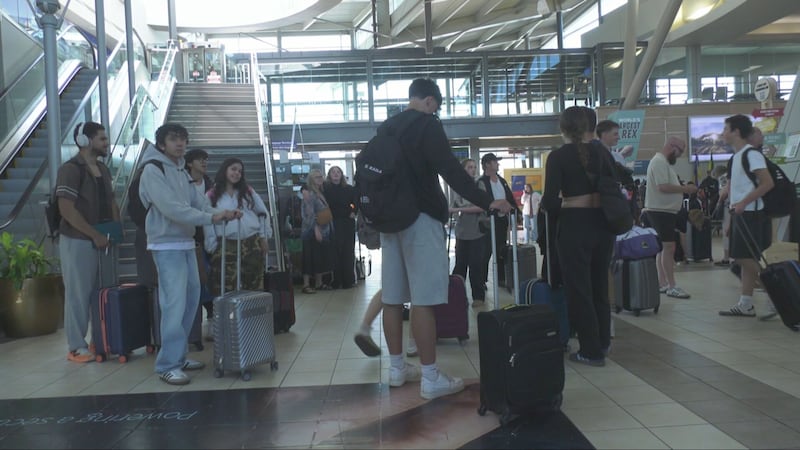
From watch parties at Rogers Centre creeping into the early morning hours to catching Blue Jays games with friends at a bar, Toronto baseball fans are watching their team play in the World Series by any means necessary—even if it means losing a few hours of sleep. While many Torontonians walked into work a bit bleary-eyed on Tuesday morning—when the Blue Jays and the Los Angeles Dodgers finished a marathon game at around 3 a.m. EST—some fans overseas did not even sleep at all. Julian Barbosa, a 34-year-old from Toronto currently living in Manchester, U.K., told CTV News Toronto that he’s used to watching his hometown teams play late at night, pointing to frequent three to four o’clock in the morning bedtimes. But Monday’s game, which spanned 18 innings, ended at around 7 a.m. local time. “I say, maybe about the 14th, 15th inning, when it went to like 6 a.m. here, that’s when I started counting the clock. I’m like, ‘I gotta shower and get ready. This is ridiculous,’” Barbosa recounted. “Half an hour before the game ended, didn’t know (it at) that time, but I just said, ‘Screw it. What am I gonna sleep for 30 minutes?’ So it was brutal.” Instead of taking a glorified nap, Barbosa got ready for work and walked to his office, which took about 40 minutes. “Which (was) pretty dumb in retrospect,” Barbosa said, though he didn’t want to shell out money on an Uber ride. About two to three hours later, the lack of sleep started to get to Barbosa, who said he had to take a break for a power nap. Similar to Barbosa, 34-year-old Daniel Listi stayed up to watch the Blue Jays play in Amsterdam, noting the World Series games have been starting at around 1 a.m. there. “I doze off for a bit in the middle innings and kind of wake up and get energized again when I see the score,” Listi told CTV News Toronto in an interview on Thursday. “I’ve been sleeping a lot on my couch the last few weeks and have been exhausted, been trying to find time to sleep and nap and during the day and in the afternoons, in-between work and everything.” But what happens when someone isn’t consistently getting a full night of rest? Most people need around seven-and-a-half to nine hours of sleep to be fully rested, Dr. Brian Murray tells CTV News Toronto. “There’s a fundamental level—we call this core sleep—if you get less than four hours, you feel really sick, you get an uneasy stomach and you’re sweaty and you feel ill,” the head of neurology at Sunnybrook Health Sciences Centre said. “Beyond (those) four hours, that extra sleep helps your brain function optimally and do your best work.” Not having enough sleep can make someone feel like they’re impaired, Murray said, causing difficulties focusing on tasks. “The neuropsychological effect of a full night of sleep loss is equivalent to having an impaired blood alcohol level when they do driving test simulations,” Murray said. “So, people have to be careful driving the next day.” How long does it take to bounce back from a lack of sleep? If someone lost some sleep over a short period—like during the week of the World Series, for example—it doesn’t take a long time to bounce back. But for some fans staying up late to a certain extent for three straight road games in California is bound to have an effect. “The next night, you probably sleep a little longer—couple extra hours—and you’ll be 90 per cent back to where you would have been,” Murray said. “So, the recovery can be pretty quick.” Acute, chronic sleep loss, typically spanning years, can have an impact on a person’s cardiovascular health and their endocrine function, Murray said. “People worry about effects on the immune system and malignancy risk, so sleep is there for a reason. It’s fundamental for an organism to function properly, for a brain to work properly,” Murray said.