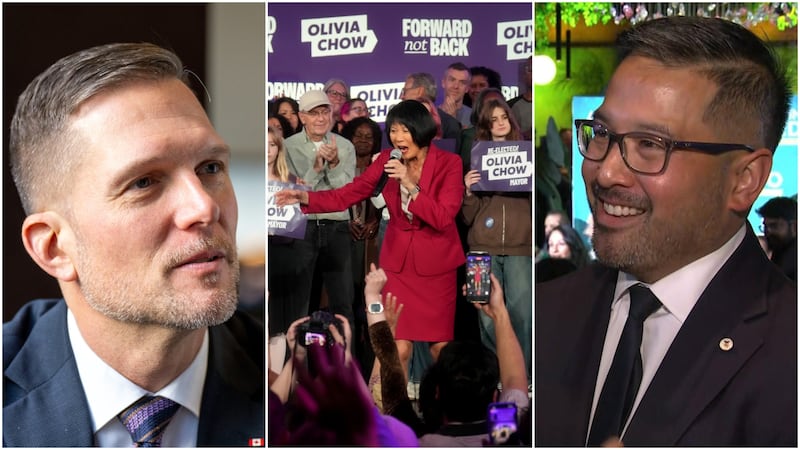
Toronto voters have decided to hand Olivia Chow a second term as mayor in a landslide win that saw challenger Brad Bradford finish with nearly 130,000 fewer votes. An incumbent mayor has never lost an election in Toronto, and Chow now has a full four-year term to carry out her mandate following a shortened runway brought on by the 2023 by-election. But what were the factors that contributed to her success, and what can be learned from notable council races and elections outside of Toronto proper? Here are five takeaways from Toronto’s 2026 municipal election: High voter turnout CP24-CTV News Election Desk data shows that more than 982,000 Toronto residents cast their ballot in Monday’s election, which represents more than 45 per cent of the electorate. That follows a historically-low 2022 election, when voter turnout failed to crack 30 per cent. Engagement was up in 2023, with 38 per cent of eligible voters taking part. Asked how much of Chow’s win he attributes to voter turnout, CTV News’ Political Commentator Scott Reid says: “All of it.” “The tale of this election night was turnout, and you had a large turnout for a municipal campaign, and Chow’s vote overperformed. That means that her campaign was tight, it was organized and it delivered,” he said in an interview with CTV News Tuesday morning. Reid went on to say that Bradford’s showing cant’ be overlooked, given that he secured more than 404,000 votes — more than Chow’s 269,000 in 2023 and former mayor John Tory’s 342,000 in 2022. “You can’t conclude that Bradford failed to capture his vote. His vote is there as expected in raw number terms, and particularly in the places where you would expect his vote to be. Chow’s vote is there and then some. The turnout is the first, second, and third explanation for why Olivia Chow is re-elected as mayor,” he said. Chow dominates in Scarborough, suburbs split Chow took all six of Scarborough’s ridings, a borough analysts had said would be key to her path to the mayorship. In Scarborough North, where her win was most pronounced in the east end, she took 56 per cent of the vote. West of there, Chow’s success in suburban ridings like Willowdale and Don Valley West was more muted, which CTV News’ Political Commentator Scott Reid said was not surprising. “I think that’s driven by the Jewish vote. And if I was Chow, one of the lingering concerns after this smashing success would be the near uniformity of the Jewish community and how they voted,” he said. Chow has faced criticism from Toronto’s Jewish community in the years following the attack on Israel on Oct. 7, 2023, specifically for not attending the one-year anniversary of the event and her response to the rise in antisemitism that has followed in the city. Bradford, who was vocal on the latter point throughout the campaign, garnered more votes than Chow in the riding of Eglinton-Lawrence, which houses one of the city’s largest Jewish populations. “So, I would think, if I was her, that would be near the top of my list of things that I want to address and friction points that I would like to smooth. But the results look like not wholly, but heavily, driven by voters in the Jewish community,” Reid added. Chow has ‘a ton of allies’ on new-look council: Reid Not only did Chow win, several new progressive councillors will join her at city hall for her second term. Nate Erskine-Smith won the highly-contested riding of Beaches-East York with 46 per cent of the vote. The former Liberal MP had represented the ward in Parliament for years and revealed that Chow encouraged him to run after an unsuccessful bid at Ontario Liberal party leadership. Mike Layton, who won handily in University-Rosedale with 46 per cent of the vote, will return to council after four years away from municipal politics. Layton, the son of the late federal NDP leader Jack Layton and stepson of Chow, previously served as the ward’s councillor for 12 years. In Toronto Centre, Curran Stikuts, the former director of advocacy at The 519, a Toronto-based LGBTQ2S+ community centre, beat incumbent Chris Moise. In Parkdale-High Park, crisis worker and community advocate Diana Chan-McNally came away with 42 per cent of the vote. “She (Chow) doesn’t just get re-elected; she gets re-elected with the council she wants, she has a ton of allies,” Reid explained. Reid said while the progressive forces at council now compose a clear majority, Chow will face steep expectations from her supporters and critics to push through the platform she campaigned on. “She has the classic good and bad problem: that’s exactly the council that she wants in order to move forward with her agenda. That also means expectations for her to move ahead with her agenda will now be high, and there will be few excuses,” he said. Was Chow’s ground game better? Reid said he wasn’t surprised by which ridings voted for Chow or Bradford. “It’s not easy to look at anything that happened the final few days of the campaign and point to that and say it caused some general reaction among the electorate. Everyone voted as they were expected to vote, where they were expected to vote,” he said. What was surprising, in Reid’s eyes, was the volume of voters who turned out for Chow, which he said can only be attributed to her team’s efforts on the ground. “That has to be a credit to her organization and her ground game,” he said. Tough night for incumbents in the GTHA Outside of Toronto, three incumbent mayors were dethroned in the Greater Toronto and Hamilton Area. In Mississauga, Alvin Tedjo beat not only the incumbent, Carrolyn Parrish, but also former mayor Bonnie Crombie to take the city’s top job. Incumbent Andrea Horwath lost to Keanin Loomis in Hamilton. The former leader of the Ontario NDP placed third with 14.5 per cent of the vote. In Milton, George Minakakis defeated 89-year-old incumbent George Krantz, who had served as mayor since 1980. Although reluctant to draw a universal truth from those results, Reid said one clear implication is that voters in all three of those races were looking for some “generational change.” “Take Mississauga, for example. Rather than pick between the two scorpions in a bottle that have been going at each other for a decade, voters opted for the younger alternative, the third option,” he said, adding that the results in Milton, “speak for themselves.” “You know, I think it’s a truism in politics, and it’s a truism in local politics that name recognition is 90 per cent of the game, but it is also true, at some point, people can wear out their welcome, and I think you see evidence of that in a few instances.”