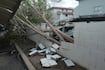
Any plan to fix the Toronto stadium that was severely damaged in last week’s storm in time for next week’s AC/DC concert could be a complicated and risky venture, several engineers told CTV News. But, replacing the stands entirely could be an option. A major complicating factor is that it’s difficult to know which pieces of the damaged grandstand at Rogers Stadium can be reused without examining each of them closely, said Doug Perovic, a professor at the University of Toronto’s Materials Science and Engineering department. “One of the issues is how do they identify what was damaged? Some of it is obviously going to be very visible, but you can have micro cracking that isn’t visible to the naked eye,” he said. “Are they going to be ready in a week’s time for AC/DC? I don’t see it personally. They’re going to have to be super careful.” There could be a path forward if the stadium operator demolishes the damaged grandstand – designed initially as a temporary building – and constructs something new in its place, said Ken Mashke, an engineer with Thornton Tomasetti. “Sometimes the best solution is to start over. That could be the case here,” Mashke said in an interview with CTV News. “I can see a scenario where, in a week, large sections could be demolished and removed from the site, and a simpler frame, or simpler structure could be erected. Something modular.” Such a solution would avoid the problem of identifying which pieces of the stands were damaged in the storm, and which were unaffected, Mashke said, noting that identifying pieces which are fatigued may not be obvious. Fans are still in limbo as they wait for word from the organizers of the AC/DC concert, set for next Sept. 16. They are now in doubt after the storm wreaked havoc through Toronto last Wednesday. No one could be seen working at the site as CTV News’s helicopter recorded footage Wednesday morning. Concert promoter Live Nation has handed in the first of several engineering reports required by City of Toronto officials, said city councillor James Pasternak. The next report, a progress report, is required to be handed in by Friday, he said. “This is all very tight. And I think there is an undercurrent to meet the AC/DC concert date. I think that’s somewhat unrealistic. Everybody should take a deep breath and look at the long-term viability of the stadium and make sure any kind of repairs are done properly. Safety is key,” Pasternak said. Live Nation has said it is also prioritizing safety, but has not yet responded to questions from CTV News with a plan for next week. “Wednesday’s storm was a severe and significant weather event that City officials have deemed a ’100-year storm’. The inspection, assessment and remediation of structures affected by significant weather events, like a red-level storm of this nature, is a standard process, and we remain engaged with the City as that work continues,” the company said in a statement Friday. Perovic said he wasn’t surprised when the stadium was damaged, pointing to the wrap that surrounds the structure and magnifies the impact of the wind. “That’s a thin material that acts like a sail. When you have wind that is hammering away you have a whole lot more stress than if the wind was just flying through the underlying structure,” he said. That would explain why some of the structure appeared as if it was moved backwards, Perovic said, and another piece stayed where it was, with the sheer force between the two upending seat panels and seats. He said he would like to see the building code changed to include higher standards for temporary structures. Rogers Stadium was built as a 50,000-seat stadium, designed to last five years. The example, in 2012, of the stage collapse at a Radiohead concert that killed one technician and injured several others should be considered, Perovic said. In that case, Live Nation was charged, though the charges were later dropped. Another instructive case is a stage collapse in 2011 of a stage in Ottawa where the band Cheap Trick were playing, he said. In that case, the band hastily left the stage when a storm clouds and winds rolled in, and the stage collapsed, injuring several fans.