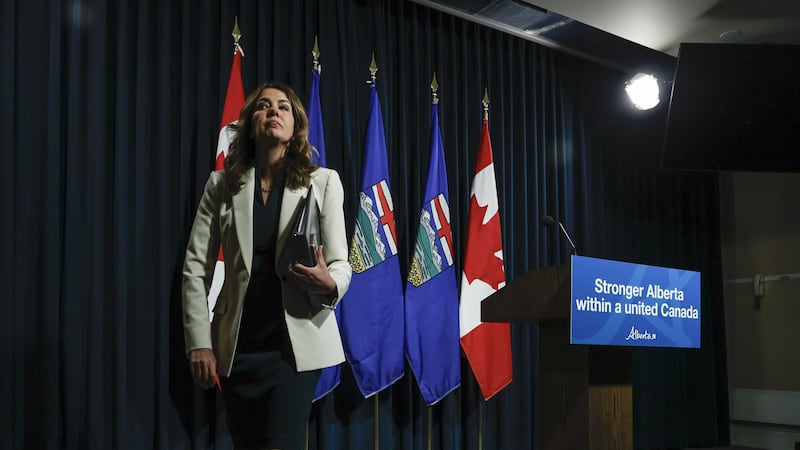
As Alberta Premier Danielle Smith recalibrates in the aftermath of a politically consequential referendum, some critics say her slim mandate on immigration control leaves the province with more questions than answers. University of Lethbridge professor Bronwyn Bragg, for example, wonders where Smith intends to go with her “clear mandate.” “What are the specific policies that we’re talking about here? What does it mean for the province to have increased control over immigration?” she told CTV News Edmonton. Five of the 10 ballots Albertans cast on Monday had to do with immigrants’ access to health care and education, proving their citizenship to vote and whether the province should prioritize economic migrants. With 95 per cent of the polls reporting so far, each question has received a slim “yes” – with the exception of Question 5, which saw staunch support in favour of requiring residents to provide proof of citizenship to vote. Bragg notes that the breakdown of those votes tells a story she’s yet to decipher. In urban areas like Edmonton and Calgary, where the majority of immigrants move, most voters were against each of the government’s immigration questions. Support for more immigration control was gleaned most strongly from rural areas – where, Bragg notes, immigrant populations are lower. “It’s possible it’s falling along partisan lines. It’s possible it has to do with the political geography of Alberta. It’s still too soon to say,” she said. “But I think it’s interesting that we do have a fairly distinct urban-rural response.” Who isn’t at the table? Missing distinctly from the conversation, Bragg noted, was the voices of temporary migrants who live in Alberta. Non-permanent residents in Canada include temporary foreign workers, students or asylum claimants. Most Ukrainian refugees came into Canada as non-permanent residents, or are family members of other non-permanent residents with work or study permits. The vast majority of these temporary residents in Canada as of July 2026 were workers or students. In Alberta, 88 per cent of temporary residents were work and study permit holders, while 12 per cent were asylum claimants, according to an annual population report from Open Alberta. “They are not able to vote. They’re not able to participate in this process. They’re marginalized by their status as temporary residents, yet they are profound contributors to the province,” Bragg said. “They’ve been represented by the government in various ways, and they’ve been represented by people, including myself, like academics and others speaking about their situation. But in general, we have not heard enough from those communities.” Shiza Wasi, who runs the non-profit Yeg Muslim Vote to mobilize underrepresented voters during elections, says the driver of that silence is often fear or disillusionment. “It was disheartening to see that nearly half a million Albertans voted to strip away the rights of immigrants and migrant workers,” she told CTV News Edmonton. “So much money and resources were put towards pushing a ‘yes’ to these questions by the current government, and these are taxpayer dollars that, once again, immigrants and migrant workers pay as soon as they get into Canada and work. Nearly 90 per cent of them pay taxes. “It’s their own money going towards stripping their own rights.” She said the next step for concerned Albertans is to organize ahead of the next provincial election. “I think it’s quite selfish of people to use us, then disregard our rights,” she added. Future legislative changes? Bragg says those who watch immigration policy expect faster changes to services and imposing fees for health care and education on temporary residents because “they can make those changes without a referendum.” “I heard a lot more caution (during Smith’s press conference), and I heard things today that we haven’t heard during the referendum campaign,” she said. “I think perhaps it demonstrates that the questions were not necessarily really connected to policy, they were connected to politics, and communicating a particular story to voters.” Smith said Wednesday she intends to “proceed with caution,” citing results from Calgary and Edmonton where support for immigration mandates is so far polling much weaker. “I think we’re about to have a very honest discussion about returning to the kind of immigration system that worked and served us well for many years, which is prioritizing economic migrants, and then we’ll do some consultation on some of the other issues,” Smith told reporters on Wednesday. Meanwhile, Prime Minister Mark Carney has said he would take a collaborative approach on immigration levels with Alberta. Speaking to reporters Wednesday, he did not rule out a Quebec-style immigration deal. “But it’s important to understand that Quebec has very unique immigration needs specific to its language,” Bragg noted. Smith says her government intends to implement changes by the spring legislative session. With files from CTV News Edmonton’s Nahreman Issa and Brittany Ekelund