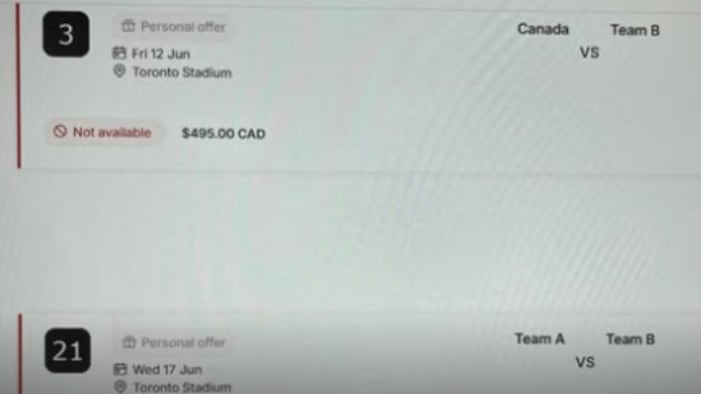
Some soccer fans looking to cheer from the stands at Toronto’s BMO Field during the FIFA World Cup next year have had difficulties snagging tickets, even after getting the email that they were selected in a lottery and would have a chance to buy tickets at box office prices. John Ouellette has coached his children in soccer for years and was excited to try to catch a World Cup game on Canadian soil. The Ottawa resident said he signed up for a number of draws that were held by FIFA as part of its ticket sales process for the 2026 World Cup. He was unsuccessful in the first draw that was held for Visa card holders earlier this fall but managed to snag a window to purchase tickets through FIFA’s Early Ticket Draw, where those living in one of the three host countries—Canada, Mexico and the U.S.—would get their domestic priority time slot starting Nov. 12 for 72 hours. Those successful in getting into the draw received confirmation at least 48 hours before their time slot, according to FIFA. For Ouellette, he learned he was chosen on Friday, notifying him of his time slot on Monday morning at 11 a.m. “I was pretty excited,” Ouellette said. “They allocate tickets to the different slots so that there was a likely opportunity I’d be able to get a few tickets and make my way to Toronto.” He says he logged on shortly before his window opened, and it took about two to two-and-a-half hours before it was time to scour for tickets—though Ouellette wasn’t really concerned about how long it took. “The issue was the fact there were not availability of tickets in this portal,” Ouellette said. For the six matches Toronto is hosting, Ouellette said there was not a single one available for purchase. “Nothing at all,” Ouellete said. “There were a few in Vancouver … and in the U.S. some fairly expensive tickets. My wife and I made a choice not to travel to the U.S. because of the current political situation, so that was unfortunately not an option for us at this point.” While the group matchups have not been announced for all of the games, Canada is guaranteed to play in Toronto on June 12 in what will be its first ever World Cup game on home soil. “I mean, to see the home opener would have been wonderful, but, you know, as most soccer fans know, there are communities that really support their football and their soccer in all (of) the major cities and so I was prepared to go to any game in Toronto,” Ouellette said. Ouellette’s experience is not uncommon, about half a dozen readers wrote in detailing hours-long waits in the online queue without any tickets available for one of Toronto’s six matches next June. Meanwhile, one Torontonian managed to get into three presales, copping tickets to one of the matches in Boston and two matches in Toronto. Malcolm Webster scored tickets to a Boston game on June 16, with four tickets costing around $450 each, $250 tickets for the Toronto game on June 20 and then $80 tickets for June 23. While CTV News Toronto could not access FIFA’s resale webpage, a pair of resale tickets on Stubhub for Toronto’s first match on June 12 is starting at $1,257 per seat. “I was really, really fortunate,” Webster told CTV News Toronto, saying he jumped at the bit to buy tickets to the game in Boston to ensure he saw a World Cup game next year, not thinking he would end up with more tickets. “My family’s like, ‘You should go and buy a lottery ticket.’” How does FIFA’s ticketing system work? FIFA releases its tickets in batches, offering a limited number of stubs in each draw. One million tickets are being made available in the Early Ticket Draw and fans can buy up to 40 tickets split evenly across 10 matches. A final draw will begin on Dec. 5, at which point team matchups and where they will be playing will be determined. Forty-two teams will have qualified by this time, with the remaining six teams competing in the playoffs in March 2026 to fill the final slots. There will be two other windows to follow, where fans can vie for a specific match after the group-stage matchups have been revealed, and then the last-minute sales phase where a final batch of tickets will be up for grabs on a first come, first-served basis. Vijay Setlur, marketing instructor at York University’s Schulich School of Business, explained to CTV News Toronto that FIFA’s unique ticketing system has been in place for years, having experienced the lottery first-hand during the last World Cup, when it was held in Qatar. “I remember there were four stages then where I think it was a lottery, then a first-come, first-served sale,” Setlur said. Cheri Bradish, professor at Toronto Metropolitan University, says it is likely the soccer organization implemented this kind of ticketing as a way to manage fans in terms of how many people can buy up a batch of tickets at a time. “I think that we’ve learned, in Ontario in particular, we’re all very aware of what happens to Jays and people trying to get tickets and inflated tickets—tickets for these prestige properties—have some challenges with execution and processing, etcetera,” Bradish said in an interview with CTV News Toronto. “I believe they’ve (FIFA) tried to implement a system and a process that they feel is best for executing arguably the world’s biggest sporting event.” Why Toronto tickets might already be unavailable The level of demand around World Cup tickets has previously been likened to trying to nab a ticket for Taylor Swift, Oasis and Toronto Blue Jays all at once. Matchups for all of the teams have not yet been announced, except it is guaranteed Canada will play on June 12 in Toronto, which could be a contributing factor to the increased demand. “In this case, because the first part of this current phase is the domestic exclusivity that pretty much gave Canadians a chance to buy tickets for Canada’s matches,” Setlur said. “So, those are probably the matches that went first over anything else.” Also trying to get a seat in the stands at the biggest sporting event in the world, Setlur says it is likely more challenging to get more tickets this year because there are more teams participating in the upcoming tournament. “We have 48 (teams) instead of the 32 now, you automatically are bringing more fans into the fold,” Setlur said, adding more people from around the world are likely vying for the chance to follow their team to North America. Outside of the addition of teams, Setlur says demand is increased because the tournament is being held in a much larger market than in the previous editions, as this is the first-time three countries are hosting the World Cup. CTV News Toronto contacted FIFA and will update the article as soon as we hear a response.