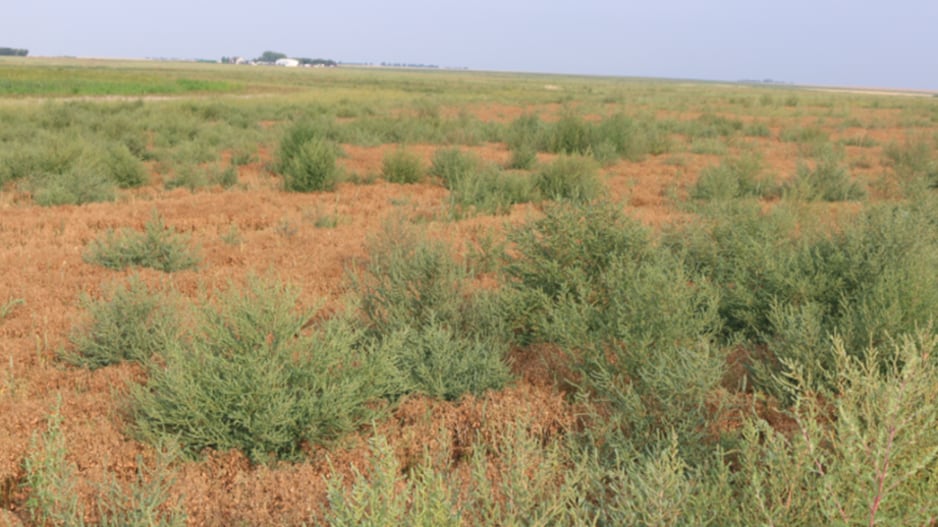
Weed control on Saskatchewan farms is growing more costly and complex. Kochia is a fast-growing, invasive tumbleweed that has been a problem for farmers in the southern part of the province for decades. But the problem is getting worse, according to farmer Jake Leguee. “It’s become resistant to a few different herbicides, and unfortunately, there aren’t a lot of new ones on the horizon to solve that problem,” said Leguee, who farms about 110 km southeast of Regina. Kochia is fast-growing and can spread quickly. It thrives in poor quality soil and can tolerate drought. The weed tends to grow in patches with plants that can be six inches to six feet tall. “It’s large and it’s bushy,” Leguee said, and it typically targets his lentil and flax fields. “Some of these patches might be the size of a pickup truck. Some of them might be several acres in size.” Smaller patches of kochia don’t normally hurt Leguee’s yields, because they grow in areas that he already considers “poor production zones.” But if the weed spreads beyond those patches, it can take over large parts of the field. “It can be very damaging,” he said. “It’s not very often that it’ll really hurt yield on a large scale in a crop like wheat or canola. But in the specialty crops like lentils and flax, it can cause a lot of yield damage.” The third-generation farmer says the last few dry, hot years have made the weed even worse. Now that the weed is becoming resistant to certain herbicides, Leguee has resorted to “more complex and more expensive” solutions. He puts a lot of herbicides on in the fall, post-harvest, that are meant to control the kochia throughout part of the next growing season. “Those are not a silver bullet, and if we continue to use them to a high degree then kochia will become resistant to them as well,” he said, adding that the herbicides can cost two to three times more than normal in-crop herbicides. Aside from herbicides, Leguee purchased a seed control unit that mounts on the back of a combine to help with his weed control. Combines are notorious for spreading weed seeds, he said. But this attachment captures the seeds and destroys them before blowing them out the back. “As we continue to go after these patches again and again, hopefully we can bring that seed bank down so that there are less seeds germinating in the soil every year,” Leguee said. Searching for solutions Sean Sharpe, a research scientist with Agriculture and Agri-Food Canada, estimates kochia and wild oats, another pesky weed, cost Saskatchewan farmers $300 million each year in crop loss and weed management. He’s trying to prevent kochia from spreading and evolving, while finding ways for growers to manage the problem. “I do get the opportunity to talk to a lot of growers and the stories that they’re telling me are essentially that (kochia) is moving northward,” Sharpe said. “It’s able to blow in the wind and tumble across the landscape, and that’s its primary vector for spreading.” Through research, Sharpe has found pre-emergent herbicides, which are applied to the soil instead of the plants, are one of the best ways to control kochia. To complement that, Sharpe recommends establishing a crop canopy as quickly as possible. The canopy on fields will build carbon and vegetation, which will force kochia weeds to “fight for their lives” once they emerge. Sharpe said he is “hopefully optimistic” that his team can come up with effective strategies to control the weed. “There’s going to be a bit of learning, but I am hopeful,” he said.