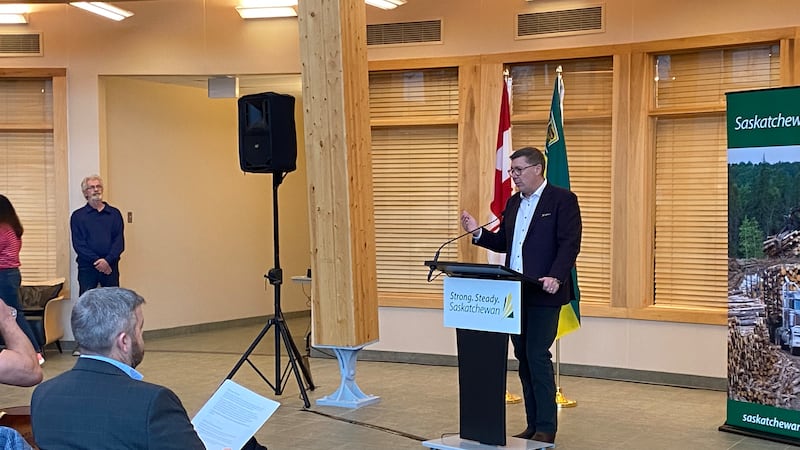
Saskatoon Mayor Cynthia Block spoke to business leaders during her first State of the City address at TCU Place on Wednesday with a message of finding a new path forward. “We can’t keep doing the same thing over and over again and expect a different result,” she said. When speaking to Greater Saskatoon Chamber of Commerce members during its annual mayor luncheon, Block said the current way of doing things isn’t working, and if modern cities are expected to pay for more things, like homelessness or green initiatives, then old systems need an update. “We simply don’t have all the tools,” Block said during her question-and-answer sessions. “Which is why, as I said previously, I think we need a new fiscal framework for cities in order to make it more affordable for all of us who live here.” Currently, the province operates on a four-year reassessment cycle, meaning that property assessments are updated every four years to reflect contemporary market values. Block says those assessments are often outdated by the time funds are distributed to municipalities and that delay doesn’t reflect what’s happening in real-time. For example, if the cost of a fire truck rises by $200,000 because of inflation since the reassessment, a city has no choice but to raise property taxes to cover the difference. “Asking for a different fiscal framework for the things that cities do that are simply financially unsustainable for property tax,” Block said. Block said it’s well within the rights of the federal government to make those changes and partners at the Federation of Canadian Municipalities will continue to advocate for those changes. Chamber of Commerce CEO Jason Aebig supports Block, but he wants to see these large ideas become reality. “It’s pretty clear that we have got to shift from ambition to action on these files,” he said. “What keeps us up is watching other cities and other municipalities eat our lunch when it comes to business attraction. “My predecessor called it the Saskatoon disease — and it goes ready, aim, aim, aim, aim — and you never get to the point where you actually fire.” Aebig says cities like Winnipeg, Calgary and Edmonton are all doing more to attract businesses and make it easier for them to flourish. While Saskatoon has grown by more than 30,000 people in the last two years, he says that doesn’t measure GDP, productivity or employment. He wants to see the city slash red tape and help create more incentives before Winnipeg, Edmonton and Calgary eat our supper too. “We are just on the cusp of becoming one of those sort-of-bigger-cities,” he said." “In this transition phase, we’ve got to get moving on some of the key files that the mayor was talking about.” Until national and provincial legislation changes, Block warned the crowd gathered about the potential for more property tax hikes. “I think I’d be super surprised if we don’t see another, you know, not small increase based on the kind of inflationary pressures that we are experiencing (and) based on the homelessness fight that we face,” Block said. Aebig agrees municipalities should have more tools, and better processes to handle more issues. While property taxes aren’t everything a new resident or business owner interested in the city has an eye on, he says it’s economic opportunity that attracts someone to a new place. “The minute Saskatoon gets branded a high-tax jurisdiction, it will not help,” Aebig said. Block hopes to help Saskatoon’s business community by creating a business forum. On Wednesday, she had a QR code at each table where chamber members could start the process by responding to a city survey. She also has put her support behind a Saskatoon Regional Economic Development Authority proposal that recently went to Saskatoon about the launch of Accelerate Saskatoon, which is touted as a concierge-style service designed to streamline business expansion and relocation efforts. “I spend a lot of time bragging about our city. I just could not be more proud of how we are growing up,” Block said.