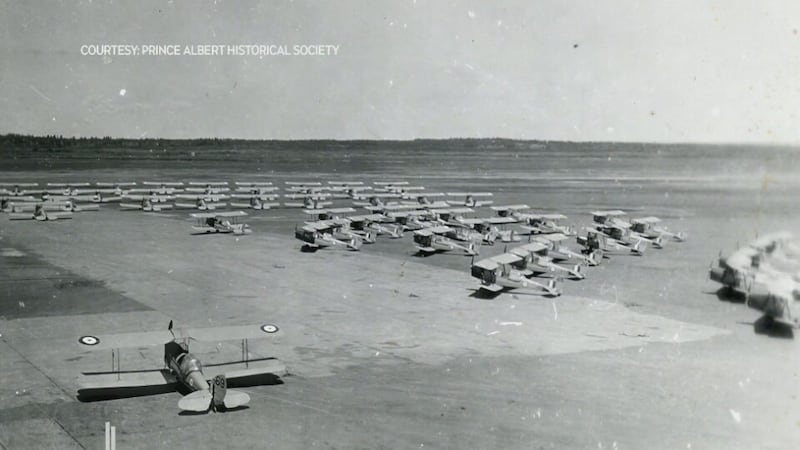
In the aviation industry of Saskatchewan, the legacy of Floyd Glass looms large. Swept up in the war effort as a flight trainer, Glass piloted the airfield that now bears his name from a small civil airfield into a bustling military training post, and later into a vital hub for the northern economy over the course of decades. To fully understand the impact of Floyd Glass on the aviation industry in Saskatchewan, we go back to the origins of Prince Albert’s airport in 1929 when the City of Prince Albert first bought the land. “It was a civil airfield at first,” said Dan Glass, president of Mitchinson Flight Centre and son of Floyd Glass, the namesake of the Glass Field Airport. On July 22nd, 1940, the airfield was repurposed as the Number 6 Elementary Flying Training School. Glass had been a pilot for around three years before he was thrust into the role of preparing pilots from all over the British Commonwealth for war. “And then it became very busy,” he said. Thrust into the spotlight “The way it was explained to me by my dad was: anyone who was a licensed pilot in Canada was pretty much made an instructor right off the bat because they had experienced flying and they were a licensed pilot,” Glass said. “So they were made instructors, and a lot of guys wanted to get overseas and get into the fight. According to my dad, he said ‘it’s probably a good thing I didn’t, because a lot of my friends that did get overseas didn’t come back.’” Every day, Floyd Glass would train pilots who came from all corners of the world how to fly the scrappy and cheap-to-produce Tiger Moth biplane. “The stories I heard from my dad was the pilots came from all over the world, anywhere within the British Commonwealth,” he said. “So there were pilots from New Zealand, Australia, I believe some came from India,” he said. But Glass says the majority of new recruits came from Canada. “A lot of these guys were in their late teens or early 20s and again, being put into a fighter plane or a bomber and going overseas. My kids are already in their mid to late 20s, and I can’t imagine them being put into that. But that was the way it was back in the 1940s.” Rush to battle The new recruits were eager to get through training and into the action, says Glass, and there was pressure to push them through. Occasionally, that drive contributed to training accidents. “They were flying old aircraft that weren’t entirely reliable all the time. And there was a pressure to get students finished in bad weather. They’d have to get up and train and get people pushed through.” Local mechanics were kept busy getting the planes airworthy as pilots honed their skills on dozens of Tiger Moths. “I know they were cheap and fast to build, easy to repair if they could be repaired,” Glass said about the biplane designed by the de Havilland aircraft company. “But they were also sort of a disposable airplane in that, if it was damaged a little too much and it would take too much to fix it, they just push it off to the side and roll another one out.” Some of the components were even manufactured right in Prince Albert, he says. “I believe it was called the PA foundry ... There was infrastructure all across Canada to help manufacture these airplanes.” The scrappy Tiger Moth biplane While the Tiger Moth was known as a relatively forgiving trainer, pilots found flying in Saskatchewan came with its own unique challenges. “Landings would be especially tricky, anything with a high wind,” said Glass. He says the museum conducts flights with the Tiger Moth as a a demonstration. Because of its wind-sensitive construction, they have to implement strict limits on what conditions they’ll operate in. “They really limit any kind of, wind speed with the airplane because it just gets more and more challenging, especially with a crosswind on takeoff or landing, it becomes more challenging to fly it,” Glass said. “The fact that it’s a tail dragger, the tail wheel sits back on its tail wheel versus a more modern tricycle gear airplane where there’s a nose wheel. They get a little ropey on a windy landing or takeoff; gets a little more challenging.” Changing flight training standards Glass says the requirements to pass training in wartime were far lower than they are now. “I believe pilots would be cut loose within 20 to 30 hours of basic training, and then they’d move into an advanced trainer and then into either a fighter or a bomber from there,” he said. “Nowadays to get a private pilot license, it’s 45 hours, bare minimum. The average is 55 to 60 hours to get a pilot’s license right now. So guys were going overseas with maybe 40 hours and they’re being put into a fighter airplane that flies at 400-plus miles an hour, or a heavy bomber carrying explosives and expected to fly over the channel and do damage.” A post-war pivot north Glass says his father also managed a seaplane operation at the airfield, which would eventually position the airfield to become a pivotal service point to the north. “I don’t think that was as busy until after the war when the north started to open up and there was more exploration for minerals and mining and everything going on,” he said. “Fishery was a big part of it too, so that developed on its own as well.” But ultimately, Glass says, it was the momentum from the war boom that really helped the airfield take off. You can watch the other parts of this story on CTV News Prince Albert.