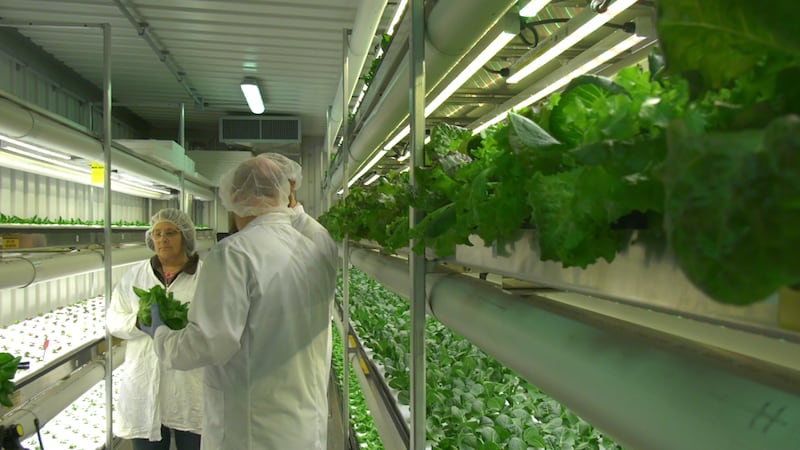
Food security is a growing concern of the Regina Food Bank. More people than ever are registering for its services and donations are not increasing to match the need. This issue has been growing for several years, according to the Food Bank, but one potential solution is now actively contributing for the food bank: a vertical modular farm from Canadian company Growcer. The unit cost around a quarter of a million dollars to produce and install and provides an indoor farm 24/7 every day of the year. Unlike conventional farming, it uses hydroponics to grow produce. It’s a method that, instead of using soil, circulates a constant flow of nutrient rich water through the tiered system of tubes. It’s an advantage that CEO of Regina Food Bank Mary Weimer says bridges a gap. “It just means that consistently week to week we know that we are going to have some supply of fresh produce available,” she said. “So, the fact that we’ll be able to just, whether its minus 30 or plus 30, have fresh salad is just incredible.” The unit can grow 115 different vegetables and fruits, but only five were selected to be focused on for this farm, namely leafy greens like lettuce. “The plan for this project was, can we grow it here in Regina at a less expensive cost than it costs to buy it year-round? And so that is what we have been able to achieve. Hopefully one day as we scale this project, there may be a little bit of surplus that the food bank can sell in the community,” explained Growcer CEO Corey Ellis. The project took multiple years of planning, acquisition, and installation. Farm Credit Canada (FCC) was a key partner in funding the effort, seeing the program as an important investment in food security in their own community as their corporate headquarters are in Regina. “The ability to do and play our part and be able to bring fresh produce to the food bank networks and to families that really need it will always be part of what we are trying to do,” said FCC CEO Justine Hendricks. The Regina Food Bank currently has plans in place to make a quadplex of farms with three more units on the way in the future. The next farm is expected to be operational in spring of 2027.