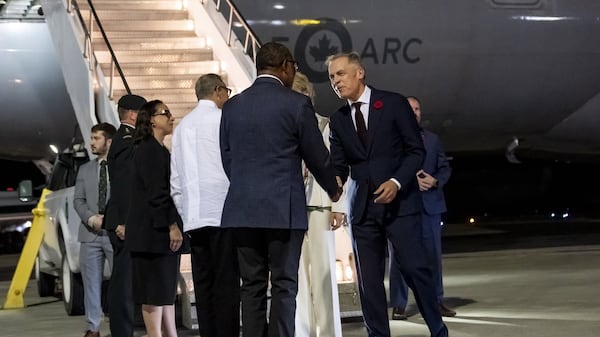
OTTAWA – The Conservatives have asked Canada’s ethics commissioner to examine the connections between Prime Minister Mark Carney and a CEO whose company received a multibillion-dollar government contract in August. In a five-page letter obtained by CTV News, Ontario MP Jamil Jivani details the longstanding friendship between Carney and Dan Goldberg, the CEO of Telesat. Jivani argues that an ethics screen should be in place to prevent any conflicts of interest between Carney’s work as prime minister and the private interests of his friend. Jivani also asked Ethics Commissioner Konrad von Finckenstein to review whether the prime minister has breached the Conflict of Interest Act in relation to Telesat. The Prime Minister’s Office has previously said Carney has not had any role in the discussions and decisions connected to the company or Goldberg. Telesat is a Canadian satellite operator that the prime minister and federal government have publicly championed as an alternative to Starlink and an avenue to bolster Canadian sovereignty. Elon Musk’s SpaceX owns and operates Starlink, which Telesat would compete with once its low-earth-orbit satellite network is launched. Telesat relies on SpaceX to launch its satellites. The Conservatives have steadily increased their scrutiny of the federal government’s work with Telesat. Over the summer, the Defence Investment Agency awarded Telesat a $2.3 billion contract with options to increase it by an additional $432 million. The 15-year contract is for military satellite communications capabilities in the Arctic. The Prime Minister’s Office did not answer a question from CTV News about the Conservative’s request for a review, nor did it say whether Carney has previously disclosed his relationship with Goldberg to the ethics commissioner. Instead, spokesperson Sofia Ouslis defended the Canadian company and said that the federal government’s work with it dates back to 2017. Separately Telesat spokesperson Lynette Simmons pointed to past comments from Goldberg in which he “unequivocally” said he’s never asked Carney for government money, government contracts “or for special treatment of any kind related to Telesat, either before or after he took office.” At a House of Commons Ethics Committee meeting last week, the ethics commissioner appeared to be unfamiliar with the connection between Carney and Goldberg but said the Conservatives could send him a letter requesting a review. “Telesat is one of the largest recipients of federal loans, contracts and capacity commitments in the space sector,” Jivani writes in his letter. “At a minimum, an ethics screen is required to mitigate against the potential conflicts.” While Carney does not have an ethics screen with Telesat, one already exists to shield him from government decisions and discussions connected to companies with which he previously held management or oversight roles. According to Carney’s ethics filing posted online, the screens “seek to minimize the possibility of conflicts arising between the public duties of the public office holder and their private interests or those of their relatives and friends.” The ethics commissioner has not explained why a screen is not already in place between Carney and Goldberg. A spokesperson for the office said it can’t comment due to confidentiality rules. AI Minister Evan Solomon is also friends with Goldberg and is subject to an ethics screen covering both Goldberg and Telesat. Goldberg’s relationship with Carney dates back nearly two decades, when the two had kids in the same soccer league, according to the Ottawa Business Journal. Along with Solomon, they became running buddies and remained close even when Carney became governor of the Bank of England, with Goldberg visiting him in London. Since Carney launched his political career in 2025, Goldberg has frequently been in his corner: attending a leadership campaign event and both swearing-in ceremonies in March and May of last year. This year Goldberg was also appointed to the federal government’s strategic exports advisory council and was invited to speak at the Canada Investment Summit. In December 2025, Telesat was made a strategic partner with the federal government “to develop and bolster” the Canadian Forces’ military satellite communications capabilities. Carney also regularly promotes the company, for example in an interview with the New York Times and in his official statement at the NATO Summit. The Prime Minister’s Office on Monday said Carney “was not involved nor consulted on the decision to enter into a strategic partnership with Telesat.” In September, Carney told the New York Times Canada will “diversify away” from Starlink by relying on the new Telesat LEO constellation that is expected to launch in early 2028. The company is building a network of low-Earth-orbit satellites, called Lightspeed or LEO. Carney’s office in October told the Globe and Mail that the prime minister “has not participated in any decisions or discussions related to Telesat or Dan Goldberg.” Asked on Monday whether the Prime Minister’s Office still stands by that statement, his spokesperson did not reply. Jivani said in his letter to the ethics commissioner that an “informal assurance” given by Carney’s office is not sufficient and should not replace formal compliance measures under the act. “It is not published on your registry, it has no named administrator, and the public cannot verify how it operates,” he wrote. Goldberg said on an earnings call last week that the contract Telesat struck with the government “is a major validation” of the Lightspeed Network and suggested that he expects to strike more contracts with the Canadian Armed Forces. While the Lightspeed network has growth potential, the company’s legacy business of geostationary satellites (dubbed Telesat GEO) is in decline and has US$1.7 billion in debt coming due within five weeks. The company has said it can’t repay that debt and is hoping to refinance it. Telesat is also facing a lawsuit with its creditors. Goldberg said on the company’s earnings call last week that Telesat is looking to refinance the debt either through a new deal with the debtholders or through undisclosed “alternatives.” In his letter to the ethics commissioner, Jivani said the debt clock puts added urgency on his request for a review because he believes it is “highly likely that the Government of Canada will need to take actions to keep Telesat solvent.” Asked about that comment on Monday, the company did not directly respond. Instead, it said it is focused on refinancing its debt and its goal is “reaching an outcome that is fair to all stakeholders.”