ADVERTISEMENT
These are some of the most famous shipwrecks in Canada
A small team of explorers led by the Royal Canadian Geographical Society have become the first people to lay eyes on Sir Ernest Shackleton’s last ship since it sank in the Labrador Sea in 1962. Meanwhile, thousands of ships lay submerged in Canadian waters, some found after decades and even centuries, while others have yet to be discovered.
Updated:
Published:
Image 0 of 50

Thousands of ships lay submerged in Canadian waters, some found after decades and even centuries, while others have yet to be discovered. One of the most famous shipwrecks in history – the Titanic – was lost more than 600 kilometres off the coast of Newfoundland for 73 years.
Sank: 1962
Where: Labrador Sea
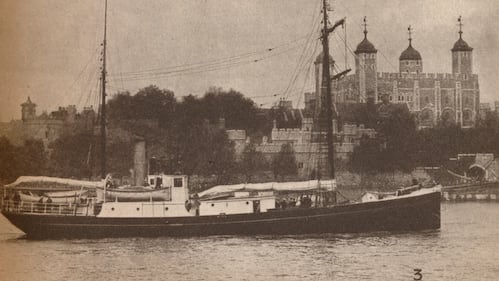
Quest, Sir Ernest Shackleton's last ship, was heavily damaged when it slammed into the sea floor, but it has since become a “biological island,” home to many fish and other life forms.
The Quest, in which Sir Ernest Shackleton set sail in September 1921, on what was to prove his last expedition to the Antarctic, circa 1922, (1935). (Print Collector / Getty Images)
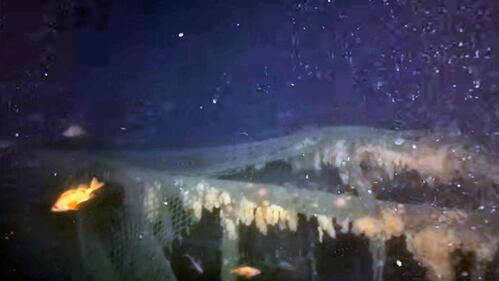
A small team of explorers led by the Royal Canadian Geographical Society have become the first people to lay eyes on Sir Ernest Shackleton’s last ship since it sank in the Labrador Sea in 1962.
An expedition led by the Royal Canadian Geographical Society (RCGS) has captured the first images of the wreck of Quest on the bottom of the Labrador Sea
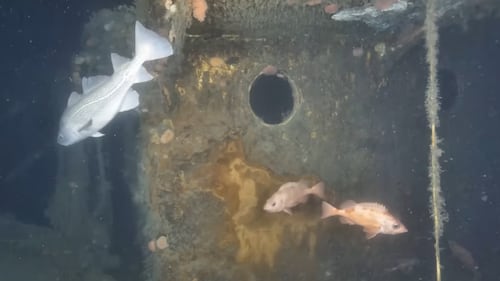
Quest now sits on the sea floor at a depth of 390 metres, about 80 kilometres off the coast of southern Labrador.
The Royal Canadian Geographical Society captured the first real images of the wreck of Sir Ernest Shackleton's Quest ship.
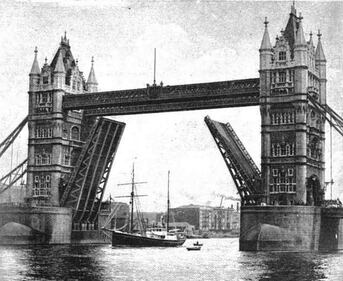
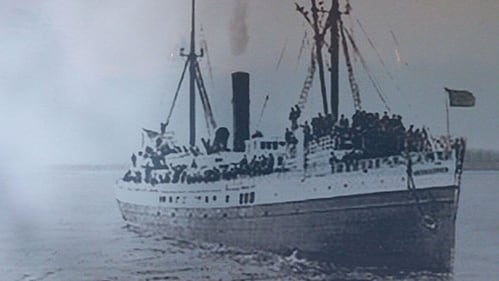
Quest passes under the Tower Bridge in London in 1921 before setting off on Shackleton’s final voyage. (Library Royal Canadian Geographical Society)
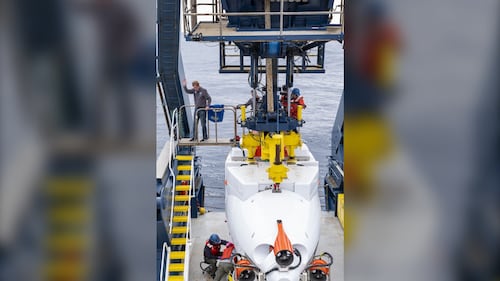
John Geiger, chief executive of the Royal Canadian Geographical Society, is shown in this undated handout photo waving after a dive to the Quest shipwreck off the south coast of Labrador. THE CANADIAN PRESS/Royal Canadian Geographical Society
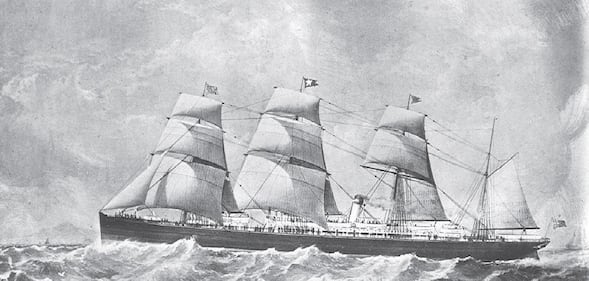
Sank: April 1, 1873
Where: Nova Scotia
The largest North Atlantic marine disaster prior to the Titanic occurred on the shores of Nova Scotia.
The SS Atlantic was making its way from Liverpool, England, to New York City when it was diverted to Halifax due to low coal supply.
(Source: SS Atlantic)
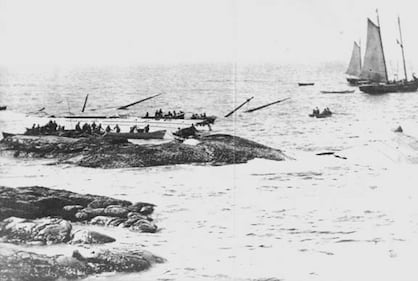
However, the ship was swept about 25 kilometres off course and, at 3:15 a.m. on April 1, 1873, smashed full speed into rocky shores just outside of Halifax.
More than 550 people were killed and another 370 people were rescued from the half-sunken ship and from a rock.
(Source: Nova Scotia Archives)
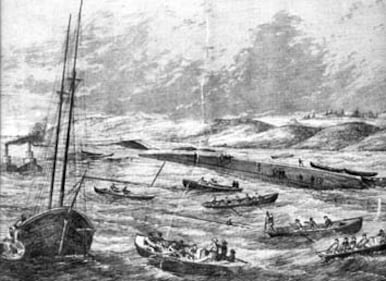
The Atlantic's captain, James Agnew Williams, remained in Halifax for about three weeks after the disaster.
(Source: Nova Scotia Archives)
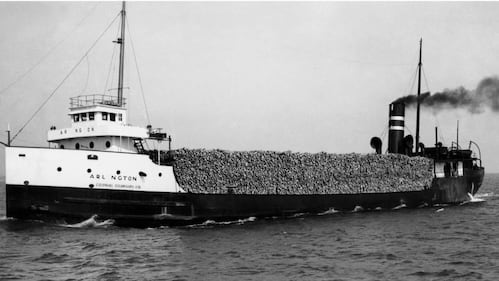
Sank: May 1, 1940
Where: Lake Superior, Ont.
A Second World War-era shipwreck was found in over 183 metres of water in Lake Superior, about 56 kilometres north of the Keweenaw Peninsula, on Feb. 12, 2024.
A WWII-era shipwreck was found in over 183 metres of water in Lake Superior. (Credit: Great Lakes Shipwreck Historical Society)
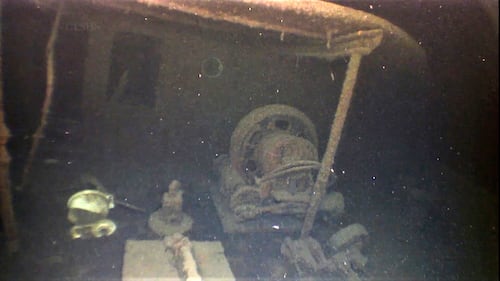
According to the Great Lakes Shipwreck Historical Society, the ship was the SS Arlington, a 74-metre bulk carrier that left Port Arthur, Ont., on April 30, 1940. It was carrying wheat and heading for Owen Sound, Ont., before it started to sink on May 1.
This image provided by the Great Lakes Shipwreck Historical Society shows the wreck of the bulk carrier Arlington, a merchant ship loaded with wheat that sank in Lake Superior during a storm on May 1, 1940. (Great Lakes Shipwreck Historical Society via AP)
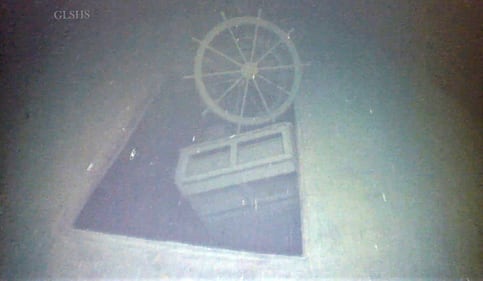
All crew on board made it off that ship and onto the Collingwood, which was also on Lake Superior that day. The Arlington’s veteran captain, Frederick 'Tatey Bug' Burke, did not make it off the ship and no one knows why.
This image shows the wreck of the bulk carrier Arlington, a merchant ship loaded with wheat that sank in Lake Superior during a storm on May 1, 1940. (Great Lakes Shipwreck Historical Society via AP)
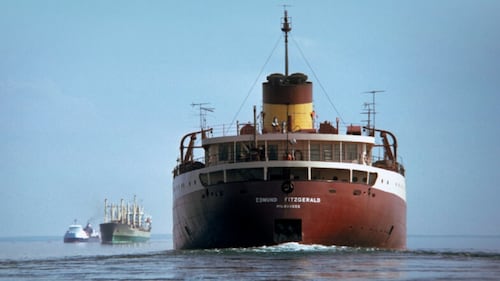
Sank: Nov. 10, 1975
Where: Lake Superior, Ont.
The SS Edmund Fitzgerald, an American freighter, sank during a fierce storm on Lake Superior north of Whitefish Point, killing all 29 crew aboard.
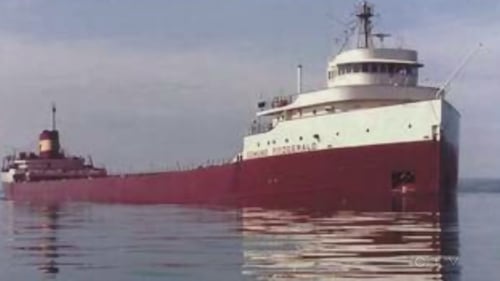
The ship was in radio contact with another ship, the SS Arthur M. Anderson. The Fitzgerald and Anderson were in relatively close proximity when the storm entered the Great Lakes, and they agreed to take a northerly course across the lake.
(Source: Great Lakes Shipwreck Museum)
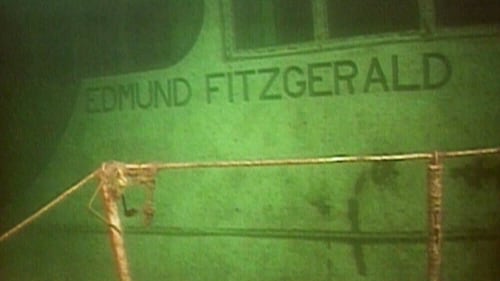
The Anderson, about 16 to 24 kilometres behind, kept watch on the Fitzgerald during the storm. The Fitzgerald never called for help, and the ship’s lifeboats were found badly damaged, indicating it sank very quickly.
Canadian music legend Gordon Lightfoot turned the tragedy into a hit song in 1976 called, 'Wreck of the Edmund Fitzgerald.'
Sank: March 4, 1911
Where: Thetis Island, B.C.
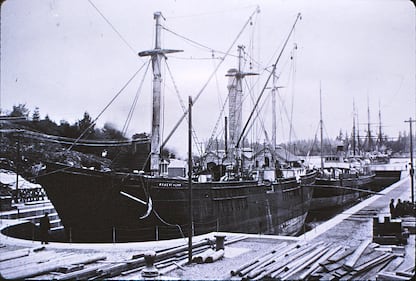
The 58-metre wooden ship was built in 1865 in Quebec and was originally called ‘Buffalo’, but renamed ‘Robert Kerr’ after trader Robert Kerr & Sons of Liverpool. It was involved in Anglo-Indian trade and trade from England to North and South America’s Pacific coast.
It was then towed to Vancouver in 1885, and was later dubbed the ‘ship that saved Vancouver’, when residents boarded the vessel amid a huge fire that tore through the city in 1886.
(Source: Underwater Archaeological Society of British Columbia)
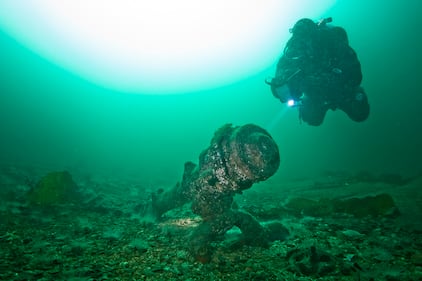
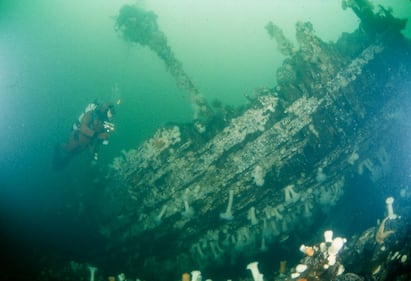
The Robert Kerr crashed into reefs near Thetis Island off British Columbia on March 4, 1911. It is now a popular dive site.
(Source: Underwater Archaeological Society of British Columbia)
Sank: May 29, 1914
Where: St. Lawrence River, Que.
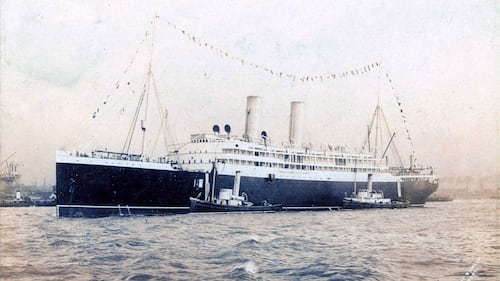
The RMS Empress of Ireland is often referred to as ‘Canada’s Titanic’. The 170-metre ocean liner provided passenger service from the United Kingdom to Canada until it collided with a Norwegian vessel near Pointe-au-Père, Que.
The Empress of Ireland is shown at its launch in an undated photo. (HO, Guy D'Astous, rms-empress-of-ireland.com / THE CANADIAN PRESS)
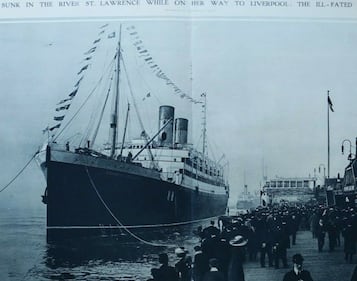
It sank in just 14 minutes in the St. Lawrence River on May 29, 1914, resulting in the deaths of 1,012 of its 1,477 passengers.
The Empress of Ireland at Liverpool, UK. SOURCE: Wikicommons
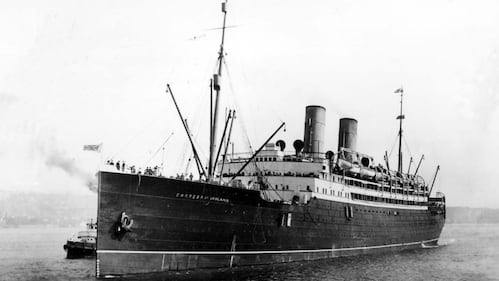
According to Parks Canada, the once-opulent vessel is relatively intact and is situated 8.3 kilometres offshore at a depth of 45 metres.
This is an undated file photo of the 'Empress of Ireland' (THE CANADIAN PRESS)
Sank: 1845
Where: Terror Bay, Nunavut
Led by Capt. John Franklin, HMS Erebus and HMS Terror set sail from England in 1845 to search for a Northwest Passage through the Canadian Arctic.
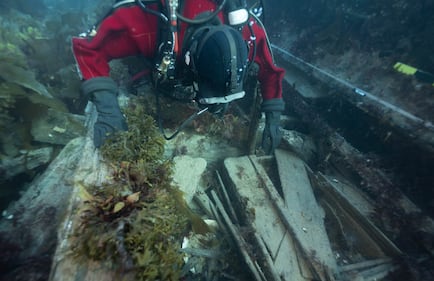
Parks Canada underwater archaeologist Jonathan Moore observes a washing basin and an officer's bedplace on the lower deck of the wreck of the HMS Erebus during a dive in this September 2022 handout photo in the Northwest Passage. (THE CANADIAN PRESS/HO, Parks Canada, Marc-Andre Bernier)
The ships eventually became trapped in sea ice near King William Island, which today forms part of Nunavut. Their 129 officers and crew members were never heard from again.
HMS Erebus
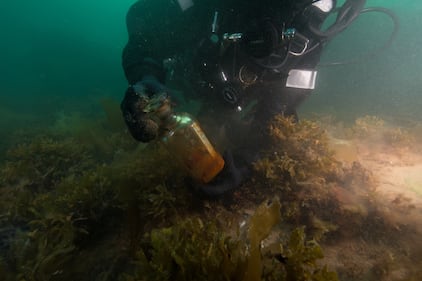
Parks Canada diver Brandy Lockhart picks up a decanter bottle recovered from the HMS Erebus during a dive in August of 2019 in this handout photo. (THE CANADIAN PRESS/HO, Charles Dagneau, Parks Canada)
Subsequent expeditions uncovered clues like equipment and graves, but the ships remained lost for generations. By combining Inuit oral history with new technology, the Erebus and Terror were finally discovered on the seafloor in 2014 and 2016.
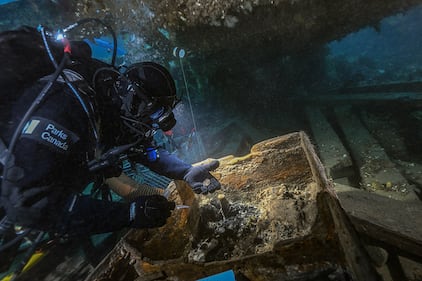
Parks Canada underwater archaeologist Marc-André Bernier carefully excavates a seamen's chest in the forecastle (crew living quarters) on the lower deck of HMS Erebus, September 17, 2023. (Brett Seymour/Parks Canada)
Sank: 1845
Where: Terror Bay, Nunavut
While the Erebus wreck is considered more vulnerable and has been the focus of recent dives, the Terror lies in water 48 metres deep and is better preserved.
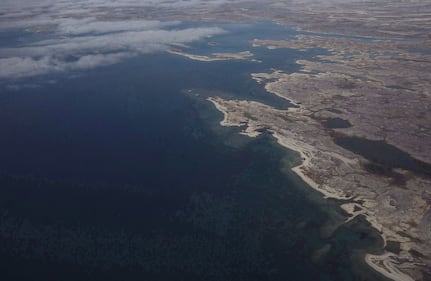
Terror Bay where the sunken ship the HMS Terror lies, near Gjoa Haven Nunavut, on September 3, 2017. THE CANADIAN PRESS/Jason Franson
Parks Canada manages and protects the Wrecks of HMS Erebus and HMS Terror National Historic Site with local Inuit via the Nattilik Heritage Society. Public access to the wrecks is currently prohibited.
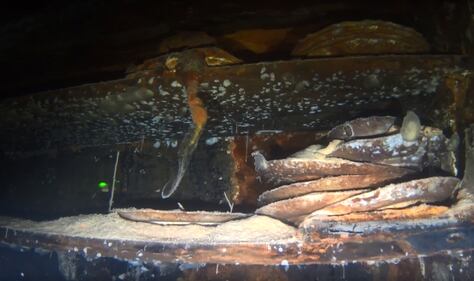
Flatware are seen on shelving in the interior of the HMS Terror shipwreck, in an undated handout still image taken from video footage, in Terror Bay, Nunavut. THE CANADIAN PRESS/HO-Parks Canada
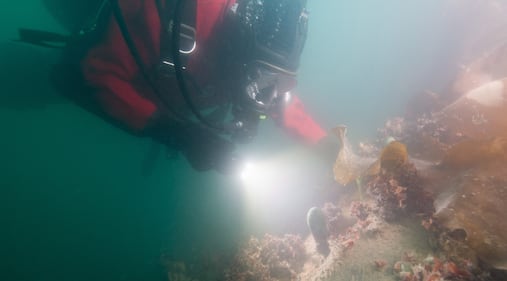
A Parks Canada underwater archaeologist examines the belaying pins still in place on the port side of the HMS Terror in a handout photo. THE CANADIAN PRESS/HO-Parks Canada-Thierry Boyer
Sank: 1853
Where: Mercy Bay, Nunavut
The Investigator, under the command of Capt. Robert John Le Mesurier McClure, had been dispatched from Britain in January 1850 on a mission to rescue the expedition led by Sir John Franklin, which had gone missing after setting sail from Britain five years earlier.
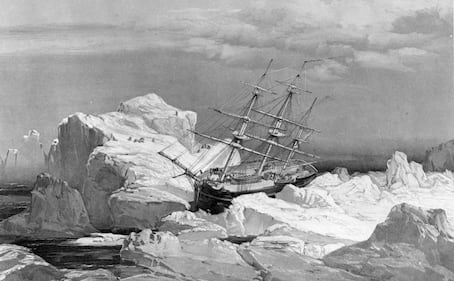
HMS Investigator is shown on the north coast of Baring Island in the Arctic in this 1851 drawing. THE CANADIAN PRESS/Public Archives of Canada
Like Franklin's ships, the 122-ton Investigator became stuck in the ice and the crew was forced to abandon it after two years -- though the expedition was later miraculously rescued.
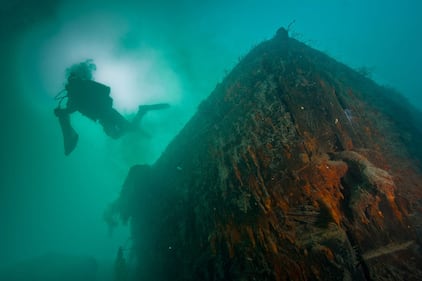
Parks Canada archaeologist swimming over the bow of HMS Investigator. The Canadian Press Images PHOTO/Parks Canada
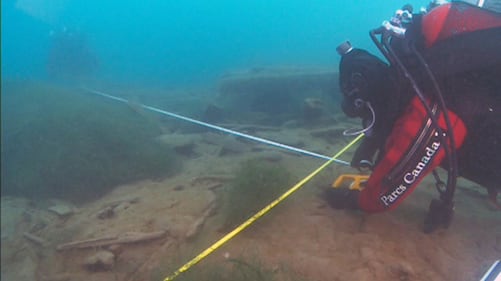
A nine-member Parks Canada team discovered the wreck of HMS Investigator after a sonar search of about 15 minutes in July 2010, when ice cleared temporarily on Mercy Bay.
Parks Canada divers analyzed the wreck of the HMS Investigator in great detail, taking measurements from stem to stern, as well as underwater notes of their findings.
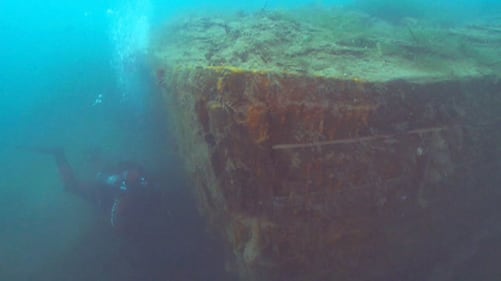
The Parks Canada team members have undertaken thousands of dives in Canadian and international waters, but none had taken part in a dive in a location as remote as the site of the sinking of the HMS Investigator.
Sank: 1912
Where: Atlantic Ocean, off Newfoundland
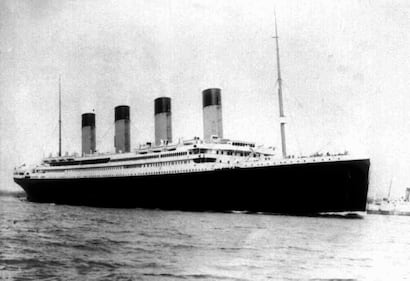
The Titanic is probably the best-known shipwreck in history, but you may not be familiar with its Canadian connection.
Built in Belfast, Northern Ireland for transatlantic passage between England and New York City, it was the largest and most luxurious ship of its kind at the time and was reported to be unsinkable.
The RMS Titanic is shown in a file photo. THE CANADIAN PRESS/AP
The Titanic left Southampton, England on April 10, 1912 with 2,240 passengers and crew on board.
On April 15, 1912, the Titanic struck an iceberg off the coast of Newfoundland. It broke apart and sank to the bottom of the Atlantic Ocean. More than 1,500 people died in the shipwreck, and the disaster was depicted in the famous 1997 movie, ‘Titanic.’
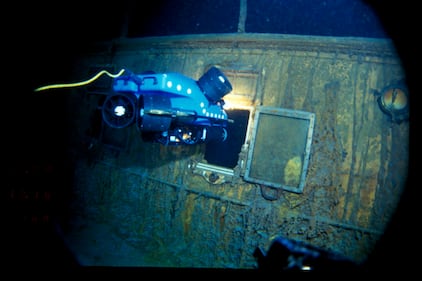
An underwater remote vehicle examines an open window of the Titanic 3.8 kilometres below the surface of the ocean, 640 kilometres off the coast of Newfoundland in 1986. (Woods Hole Oceanographic Institution via AP)
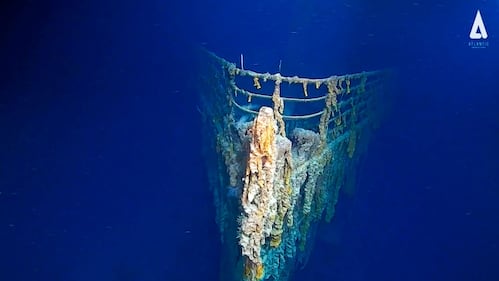
The notorious wreck lay undiscovered for 75 years about 3.5 kilometres below sea level, and around 650 kilometres off Newfoundland in international waters, until it was found on Sept. 1, 1985 by a joint American-French expedition.
Part of the wreckage of the RMS Titanic is seen (Atlantic Productions via AP)
Sank: 1918
Where: Niagara River, Ont.
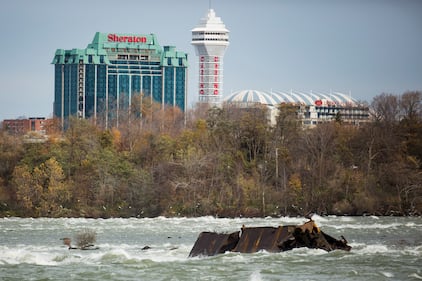
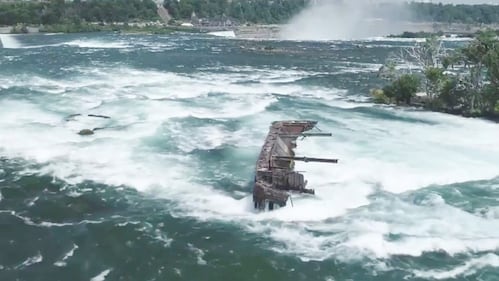
This unique shipwreck has sat near the brink of Horseshoe Falls in the Niagara River for 106 years.
In 1918, The Iron Scow broke loose from its tug boat and became grounded on the rocks about 600 metres from the iconic Falls.
A century old iron scow sits grounded in the upper rapids above the Horseshoe Falls after moving about 50 metres downstream following a storm last Thursday in Niagara Falls, Ont., Monday, Nov. 4, 2019. THE CANADIAN PRESS/Tara Walton
Two men were on the boat when it broke free, but were successfully rescued by emergency crews the following day.
A century old iron scow sits grounded in the upper rapids above the Horseshoe Falls after moving about 50 metres downstream following a storm last Thursday in Niagara Falls, Ont., Monday, Nov. 4, 2019. THE CANADIAN PRESS/Tara Walton
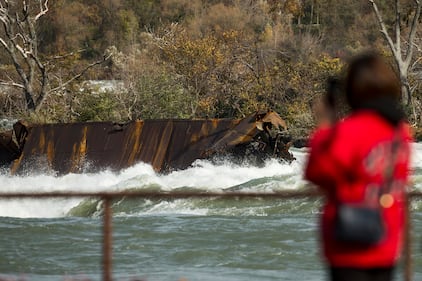
For 101 years, the boat remained lodged in the rocks and didn’t move, but in 2019, a strong Halloween storm pushed it 50 metres closer to the brink.
A century old iron scow sits grounded in the upper rapids above the Horseshoe Falls after moving about 50 metres downstream following a storm last Thursday in Niagara Falls, Ont., Monday, Nov. 4, 2019. THE CANADIAN PRESS/Tara Walton
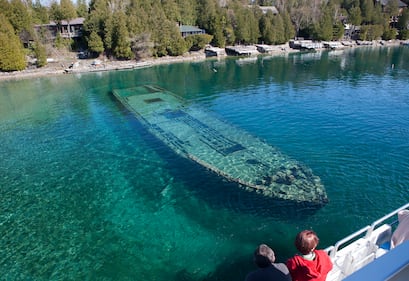
Sank: Aug. 23, 1885
Where: Tobermory, Ont.
The Sweepstakes is one of 22 shipwrecks clearly visible in waters off Tobermory, Ont., and is considered to be one of the most beautiful in the world.
The schooner was built in Burlington, Ont. in 1867, and measures 36.3 metres in length.
(Source: Blue Heron Cruises)
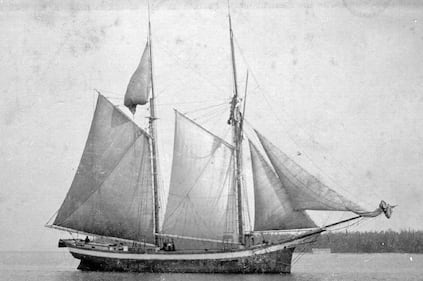
The Sweepstakes was damaged after hitting a rock off Cove Island in Ontario on Aug. 23, 1885. It sank in shallow water, and was then towed to Big Tub Harbour where it sank again in September 1885.
(Source: Blue Heron Cruises)
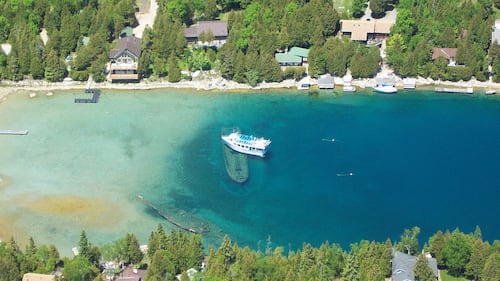
The hull of the vessel is still relatively intact and sits in just six metres of water in the Georgian Bay of Lake Huron.
Sweepstakes is a popular tourist attraction and is frequently visited by divers and glass bottom boat tourists.
(Source: Blue Heron Cruises)
Sank: October 1895
Where: Bruce Peninsula, Ont.
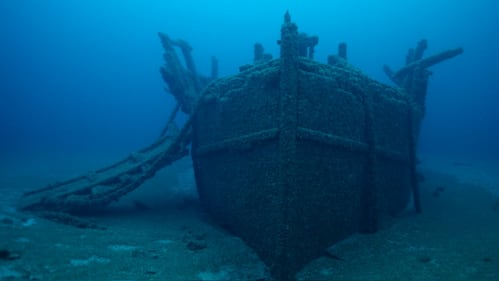
Canadian filmmakers Yvonne Drebert and Zach Melnick were looking for invasive mussels in June 2023 when they accidentally discovered the wreck of the Africa, 85 metres beneath Lake Huron.
The 'Africa' shipwreck, found accidentally by a pair of documentary filmmakers in June 2023 off the shores of the Bruce Peninsula. (Courtesy of Inspired Planet Productions)
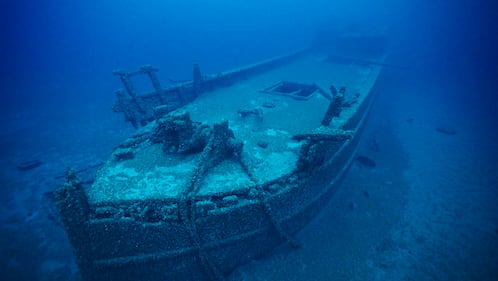
The 45-metre vessel was an American steamship that sank in October of 1895 while carrying coal from the United States to Owen Sound across Lake Huron.
Eleven people died on the Africa when it sank. Among them, Captain Hans Larsen who, in a coincidence, is the namesake of the village Drebert and Melnick call home.
(Source: Inspired Planet)
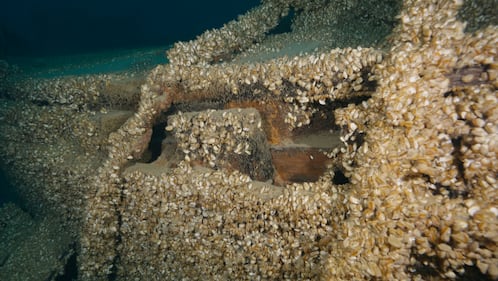
While the Africa is intact, it is encrusted in invasive quagga mussels.
(Source: Inspired Planet)
Sank: 1832
Location: Kingston, Ont.
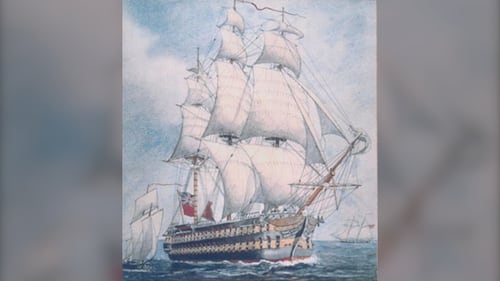
Constructed during the war of 1812, HMS St. Lawrence was built in Kingston, Ont. and launched in 1814.
It was the largest and most heavily-armed warship of its time serving on fresh water, but it didn’t leave Ontario waters and never went into battle.
Painting, by C.H.J. Snider, showing HMS St. Lawrence on lake patrol with two smaller ships, one on either side. (Source: Royal Military College of Canada)
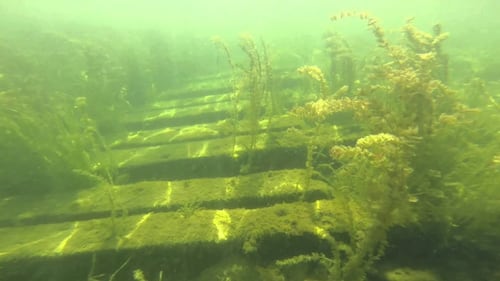
The ship was decommissioned after the War of 1812, and was sold off in 1832 to a brewery where it served a pier. It was later towed out to Lake Ontario and deliberately sank. It now serves as a popular dive site off waters in Kingston, Ont.
HMS St. Lawrence is one of three War of 1812 shipwrecks that lay today off waters in Kingston, Ont., and is a popular site for divers.
(Source: YouTube)
Sank: January 22, 1906
Where: Vancouver Island, B.C.
SS Valencia was an American iron-hulled passenger steamer that began operating in 1882.
On January 22, 1906, Valencia missed the entrance to the Strait of Juan de Fuca during stormy weather during a passage from San Francisco to Victoria. The ship struck a reef off Pachena Point on Vancouver Island's west coast.
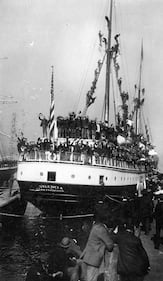
Capt. Oscar M. Johnson drove the damaged ship onto rocks and Valencia stayed afloat for 36 hours, but a rescue was not possible in the treacherous waters.
136 people died in the wreck, including all women and children on board. Only 37 people survived the disaster.
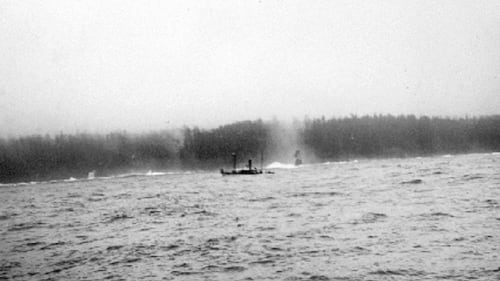
Valencia is considered to be the worst maritime disaster in the ‘Graveyard of the Pacific’, a dangerous stretch of water along the Pacific coast where thousands of wrecked ships lay.
Parts of the wrecked Valencia can be seen today along the shores of Pachena Bay, B.C.
(Source: British Columbia Archives)
Sank: Unknown
Where: Cape Ray, N.L.
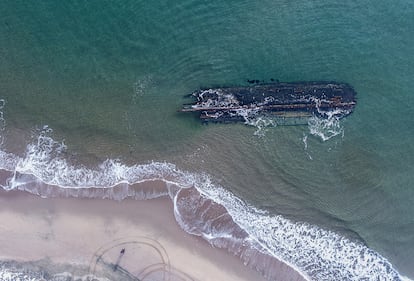
A massive, overturned hull of a seemingly ancient ship has appeared without warning along a sandy beach on the southwestern tip of Newfoundland on Jan. 20, 2024.
The massive, overturned hull of a seemingly ancient ship has appeared without warning along Newfoundland's southwestern tip, just off the beach in Cape Ray, N.L. THE CANADIAN PRESS/HO-Corey Purchase
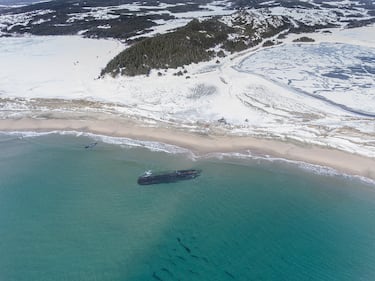
Not much is known about the vessel, but storm Fiona, which tore through the area in Sept. 2022, may have unearthed it if it was buried, according to the Shipwreck Preservation Society of Newfoundland and Labrador.
The ship is about 24 metres long and is not complete. It’s believed to be from the 1800s and was not built in North America.
The massive, overturned hull of a seemingly ancient ship has appeared without warning along Newfoundland's southwestern tip just off the beach in Cape Ray, N.L. THE CANADIAN PRESS/HO-Corey Purchase