ADVERTISEMENT
10 riots and protests in Canadian history
From the 'Winnipeg General Strike' in 1919 to the 'Freedom Convoy' in 2022, here are 10 major riots and protests in Canadian history.
Published:
Image 0 of 31


Where: Halifax
When: 1945
Riots erupted on May 8, 1945 on both sides of Halifax Harbour when the Allies declared victory in Europe in the Second World War.
Hollis Street looking south from Salter and Hollis intersection during V-E Day riots in Halifax, May 8, 1945. (CP PHOTO via National Archives of Canada / P.O.Harvey)

Liquor stores had been closed for the day, and the frustration of not having alcohol readily available only further contributed to the difficult relationship that many Halifax residents and military members had at that time.
V-E Day riots in Halifax, May 8, 1945. (CP PHOTO via National Archives of Canada)

The planned victory party turned volatile. Fires were started, windows were broken, people were out of control. Three people died in the chaos.
V-E Day riots at Grafton Park in Halifax on May 8, 1945. (CP PHOTO via National Archives of Canada)

Where: Toronto
When: 2010
More than 1,000 people were detained during the weekend of June 26 and 27, when protests against the G20 summit turned violent. By the summit's end, police had set a record for the largest mass arrest in Canadian history.
More than 700 of those arrested were released without charge within 24 hours.
Riot police walk by a burning police car in downtown Toronto during anti G20 protests on Saturday, June 26, 2010. THE CANADIAN PRESS/Frank Gunn
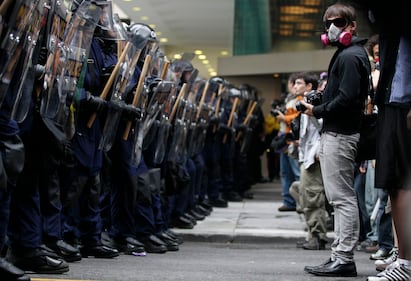
On June 26, as world leaders met well behind a specially constructed security cordon, thousands of peaceful protesters followed a designated march route through the downtown core. At one point, however, others engaged in so-called 'black bloc' tactics broke away from the main group, damaging buildings and burning police cars.
A protester with, gas mask and camera, participates in a stand off with a line of riot police on Bay Street during the G8 and G20 Summits, Saturday, June 26, 2010 in Toronto. (AP Photo/Carolyn Kaster)
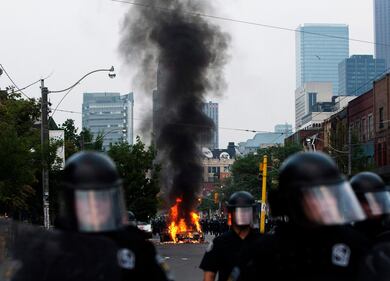
The next day, police charged a group of demonstrators at a so-called safe zone at the Ontario legislature and also clashed with protesters during what began as a peaceful demonstration at a temporary detention centre.
A police car burns as riot police stand guard along the streets of downtown Toronto during the G20 Summit on Saturday, June 26, 2010. THE CANADIAN PRESS/Nathan Denette
Where: Vancouver
When: 1994 and 2011
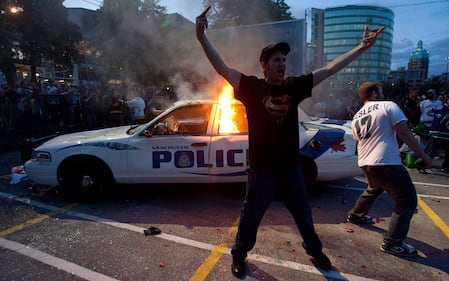
Riots broke out on the streets of Vancouver in 2011 after the Canucks lost 4-0 to the Boston Bruins in Game 7 of the Stanley Cup finals.
A police car burns during a riot in downtown Vancouver, Wednesday, June 15, 2011. THE CANADIAN PRESS/Geoff Howe

Hundreds of people looted stores, torched cars and assaulted police and bystanders. Hundreds of people were arrested.
Police on horseback move down a street during a riot in downtown Vancouver, Wednesday, June 15, 2011 following the Vancouver Canucks 4-0 loss to the Boston Bruins in game 7 of the Stanley Cup hockey final. THE CANADIAN PRESS/Ryan Remiorz

A riot also broke out in 1994 in Vancouver after the Canucks lost to the New York Rangers, also in Game 7 of the Stanely Cup finals.
Members of a large crowd gathered in downtown Vancouver disperse after being tear gassed by Vancouver police June 14, 1994. (CP PHOTO/Chuck Stoody)
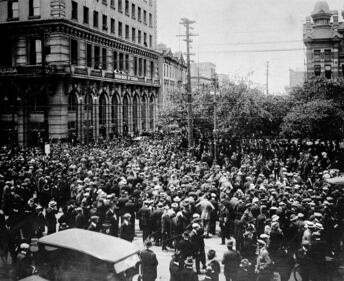
Where: Winnipeg
When: 1919
On May 1, 1919, Winnipeg's building and metal workers walked off the job. They were joined by 30,000 union and non-unionized workers from different sectors, and it became one of Canada's biggest and most significant labour strikes.
A crowd gathers outside the Union Bank of Canada building on Main Street during the Winnipeg General Strike on June 21, 1919. THE CANADIAN PRESS/National Archives of Canada
The workers protested low wages, poor working conditions and treatment from their employers.
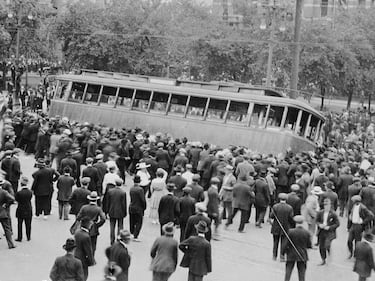
Strike leaders were arrested four days later, which then caused 25,000 workers to protest in downtown Winnipeg, a day which became known as 'Bloody Saturday.'
A crowd tips over a streetcar on ‘Bloody Saturday,’ June 21, 1919. (Source: Archives of Manitoba, Foote 1696)

Winnipeg's mayor at the time called in the Royal North-West Mounted Police, who charged in and beat the strikers with clubs. Workers returned to work on June 25.
'Special Police' ride into a crowd on horseback, June 10, 1919. (Archives of Manitoba)

Where: Quebec City
When: 2001
Police and protesters clashed at the Summit of the Americas, held in a fenced-off part of Quebec City in 2001. Protesters using 'black block' tactics smashed windows and hurled projectiles at police.
Protesters charge a line of riot police after breaking through a fence surrounding the site of the Summit of the Americas in Quebec City, Friday, April 20, 2001. (AP Photo/Ricardo Mazalan)

The summit ended with 463 arrests, more than $2.5 million in damage, and equally widespread complaints about police manhandling peaceful protesters.
Protesters pull on a security fence surrounding the Summit of the Americas in Quebec City, Friday afternoon, April 20, 2001. (AP Photo/Stephan Savoia)

A five-member panel appointed by then-Quebec public security minister Serge Menard concluded officers used abusive amounts of tear gas and were wrong to shoot rowdy protesters with rubber and plastic bullets.
An anti-free trade protester gestures as he faces a line of riot police during clashes at the Summit of the Americas in Quebec City, Friday, April 20, 2001. (AP Photo/Dario Lopez Mills)
Where: Estevan, Sask.
When: 1931
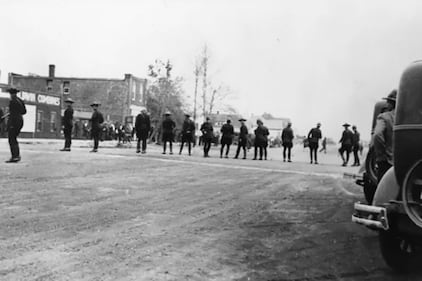
Non-unionized miners in the Bienfait-Estevan coal fields went on strike in 1931 over wages, working conditions and union recognition.
Street scenes during the Estevan riot of Sept. 29, 1931. (Provincial Archives of Saskatchewan)
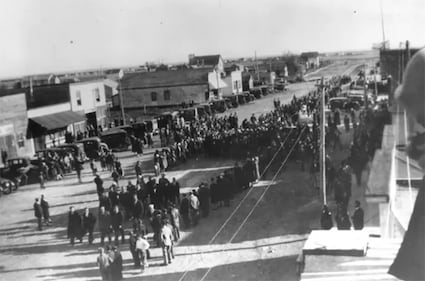
A riot erupted on Sept. 29, 1931 in the town of Estevan as miners faced off against local authorities and the RCMP. Three miners were shot and killed, and some other miners and officers were injured.
Funeral for three miners killed during the Estevan Riot, 1931. (Provincial Archives of Saskatchewan)
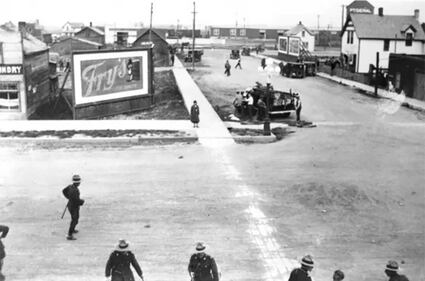
The miners continued on with their strike for another week until their employer conceded to better working and living conditions, and in turn, the workers gave up their fight for union recognition.
Street scenes during the Estevan riot of Sept. 29, 1931. (Provincial Archives of Saskatchewan)
Where: Oka, Que.
When: 1990
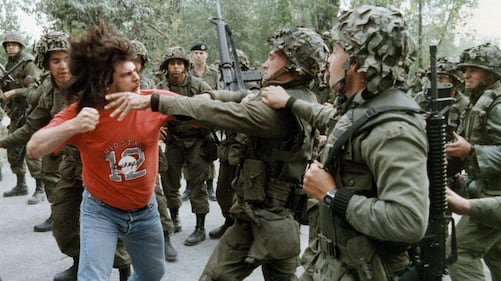
The crisis began when the town of Oka decided to allow the expansion of a golf course and development on Mohawk ancestral lands also known as 'The Pines'.
A Mohawk native winds up to punch a soldier during a fight that took place on the Kahnawake reserve on Montreal's south shore, Tuesday, Sept.18, 1990. (Tom Hanson / THE CANADIAN PRESS)
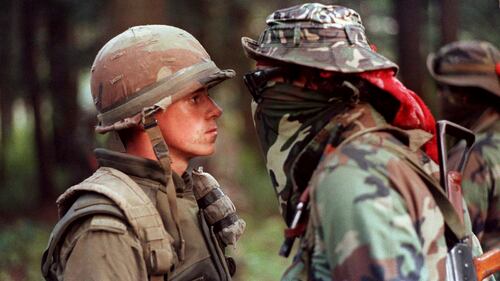
On July 11, 1990, Quebec provincial police moved in on a barricade erected by Mohawks that March to protest the planned expansion of a golf course and development on what is ancestral land.
Canadian soldier Patrick Cloutier and First Nations activist Brad Laroque standing face to face in Oka, Que., on Sept. 1, 1990 (The Canadian Press/Shaney Komulainen)
Provincial police officer Cpl. Marcel Lemay was killed and the situation escalated into a tense, 78-day standoff between Mohawks and Canadian soldiers.
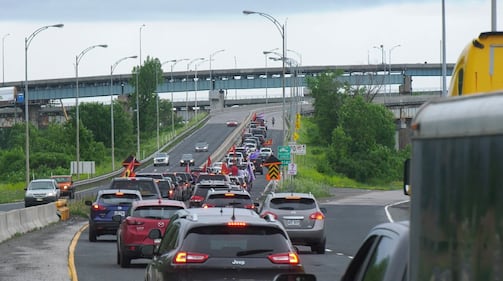
Rolling convoys in Kahanwake and Kanesatake commemorated the 30th anniversary of the Oka Crisis on July 11, 2020.
Where: Broad Creek, Ont.
When: 1842-1843
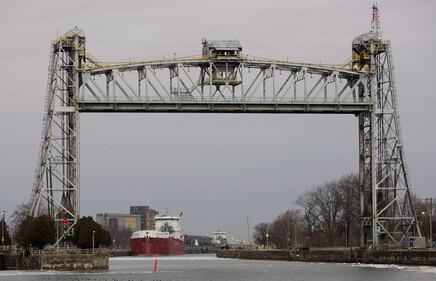
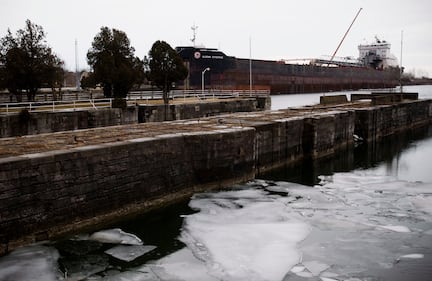
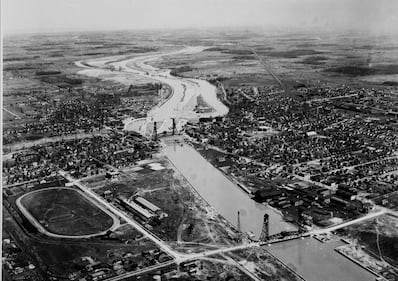
The first Welland Canal connecting Lake Ontario and Lake Erie was completed in 1829. The second Welland Canal was built between 1841 and 1845 and became a riot area from 1842-1844 mainly among by Irish immigrants protesting against low wages, employment instability and food shortages
Ice floats past ships in the Welland Canal near Lock 8 in Port Colborne, Ont., Friday, March 28, 2014. THE CANADIAN PRESS/Aaron Lynett
Between 1842-1843, two Irish groups, Corkmen and Connaughtmen, fought with one another with weapons such as pitchforks, pistols and swords at various points of the second canal.
Ice floats past ships in the Welland Canal near Lock 8 in Port Colborne, Ont., Friday, March 28, 2014. THE CANADIAN PRESS/Aaron Lynett
Eventually police were called in to dismantle the riots, and rioters were banned from public works projects.
The Board of Works then passed a public works act in 1845 as a means of controlling canal and railway workers throughout the nineteenth century and preventing violence around such sites.
Welland Ship Canal Bridges 14 and 13, looking North of Welland in 1999. (National Archives of Canada via CP Photos)
Where: Tyendinaga, Ont.
When: 2020
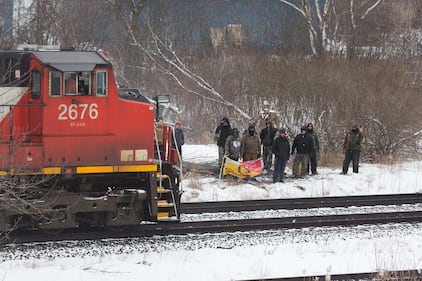
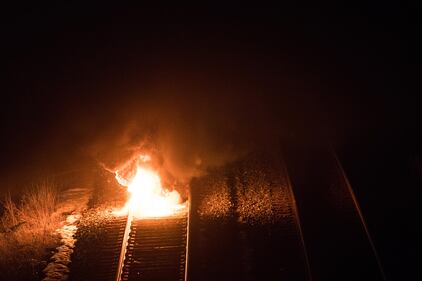
A rail blockade near Belleville, Ont., in 2020 crippled Canada’s rail network for weeks. In Tyendinaga, protesters set fire to the tracks at one point.
Protesters stand next to the tracks as a CN train moves through Tyendinaga Mohawk Territory, near Belleville, Ont., on Wednesday Feb. 26, 2020. THE CANADIAN PRESS/Lars Hagberg
Protesters blocked rail lines in solidarity with the Wet’suwet’en hereditary chiefs who oppose the proposed construction of a natural gas pipeline through their territory in northern B.C.
A fire burns on the recently-opened CN tracks in Tyendinaga, near Belleville, Ont., on Monday, Feb. 24, 2020. THE CANADIAN PRESS/Lars Hagberg
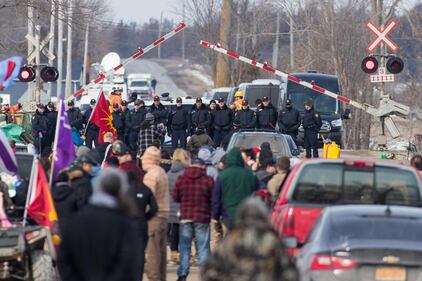
Eventually, police moved in and dismantled the blockade near Belleville, Ont., sparking condemnation from the Mohawk of Tyendinaga. Some demonstrators scuffled with officers before being taken away
The train signals are tested at the train crossing in Tyendinaga Mohawk Territory, near Belleville, Ont., on Monday Feb. 24, 2020. THE CANADIAN PRESS/Lars Hagberg
Where: Ottawa
When: 2022
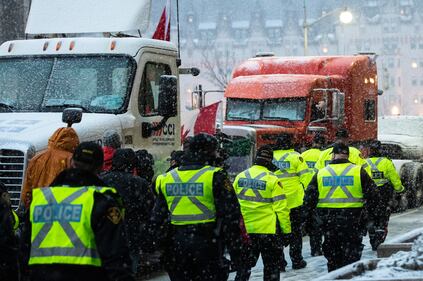
Thousands of demonstrators took over streets around Parliament Hill in late January 2022, blocking roads with big-rig trucks and other vehicles and refusing to move.
Police walk as heavy snow falls on the 21st day of a protest against COVID-19 measures that has grown into a broader anti-government protest, in Ottawa, on Thursday, Feb. 17, 2022. THE CANADIAN PRESS/Justin Tang
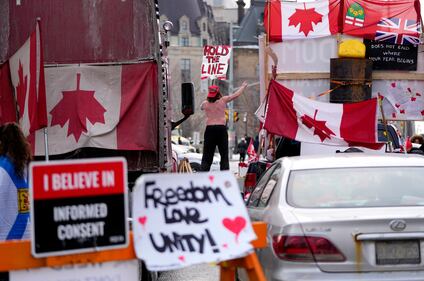
The initial movement began with protests against vaccine mandates at the U.S. border, especially for truck drivers. It then turned into a widespread demonstration against COVID-19 mandates in general and the federal government.
A protester dances on a barrier in front of vehicles and placards on Rideau Street, during a protest against COVID-19 measures, in Ottawa, on Wednesday, Feb. 16, 2022. THE CANADIAN PRESS/Justin Tang
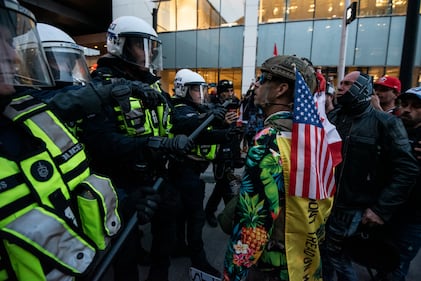
Prime Minister Trudeau invoked the Emergencies Act for the first time since it passed in 1988, leading to a large police operation to dismantle the blockade and make arrests.
The protest in Ottawa was mainly cleared out by Feb. 21.
A police officer holds their baton as they are confronted by a protester, as they work to remove people and vehicles from Rideau Street during a demonstration, part of a convoy-style protest participants are calling 'Rolling Thunder', in Ottawa, on Friday, April 29, 2022. THE CANADIAN PRESS/Justin Tang