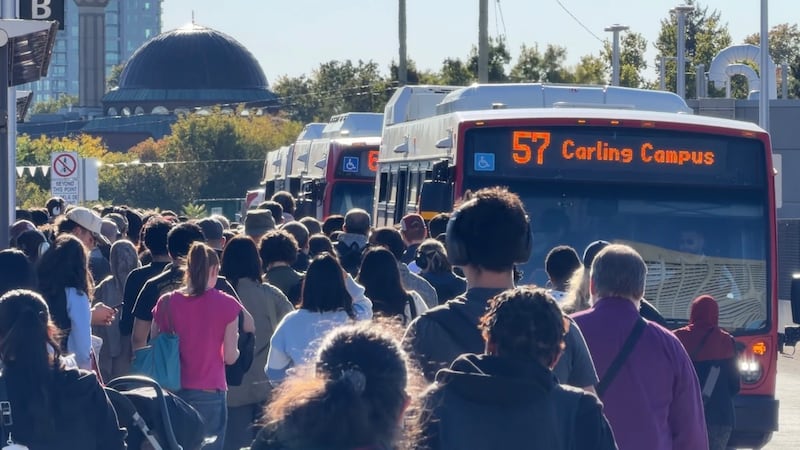
Councillors in Barrhaven are pushing the city to buy more diesel buses to help solve reliability issues as the city lags on its electric bus targets. Coun. David Hill says Barrhaven residents continue to experience frustrating transfer issues, especially at Tunney’s Pasture, and reliability issues on local routes. “There’s been continued frustration about reliability and that has been my focus for the last several years,” says Hill. Hill says this is because the city doesn’t have enough buses. “There has been a push to get as many buses over the next several months to get back on schedule, because they are behind.” In 2023, the city set a target to have 350 electric buses on the road by the end of 2027. Recent numbers obtained by CTV News show that as of Jan. 1, only 36 are currently in operation. In a statement, the city said out of the 350 zero-emission buses planned, 110 are “expected by April 2026 and 234 by the end of the year which is on track with our yearly delivery target. There have been delivery delays due to global supply-chain challenges, high demand, and the need to upgrade charging infrastructure.” Hill says the city needs to get more diesel buses on the roads to supplement the lack of electric buses. “We need to complement the e-bus procurement with diesel in order to get the reliability that we need across the whole city for all of our scheduling. But it’s an issue of complementing the current procurement plan,” Hill said. Coun. Wilson Lo, a former OC Transpo bus driver, has put motions forward to transit commission for the city to look into all options, including diesel buses. “This is an issue that’s not unique to Ottawa, but Ottawa’s in a uniquely bad position because in the early 2000s and mid-2000s, we placed two very large orders of buses. So that’s about 600 buses that we ordered in the 2000s that are all aging out at once. “Our issue now is that we have to retire some of those older buses without a replacement because of these delays,” says Lo. “Frankly, service delivery comes first,” says Hill. “If we are taking cars off the road by providing reliable service that does service our environmental goals.” The city electric bus procurement plan says “the full program, including infrastructure upgrades, will cost approximately $974 million. This project is funded in part by the Government of Canada. The Canada Infrastructure Bank (CIB) invested $380 million with the ZEB program. This will help finance up to 354 ZEBs through 2027.” Ottawa is also working alongside the Toronto Transit Commission (TTC) through coordinated procurement. The union representing OC Transpo drivers say they have warned the city about the bus shortages for year. “It was haphazard to put all of the eggs in the electric bus basket, and everybody, including us, are paying the price for that,” says Noah Vineberg, president of ATU Local 279. He says his drivers have no real complaints about driving electric buses. “Transit agencies all across Canada are struggling for busses at this point. It would have been impossible to predict how many we would have had at this point,” Vineberg says. “Obviously, there is a lag on the incoming. And then of course, all the logistical items that come with that. So, everything is falling behind and there’s always a need for more buses.” Vineberg says the city needs to do a better job at scheduling buses to reflect the lack of vehicles and needs to avoid overpromises to users. “More buses are the only way we’re going to be able to offer the service that’s been posted and promised, and we have the members that are willing and eager to operate those, work on those and get those out,” Vineberg says. “But we are at a bit of a standstill with getting buses into the system.” In November, OC Transpo purchased 50 new 60-foot diesel buses, which are expected to come online in the spring of 2026 and winter of 2027. A report for the finance and corporate services committee in November showed the city spent $74.873 million for the supply and delivery of the 50 new diesel buses from New Flyer Industries. With files from CTV’s Josh Pringle.