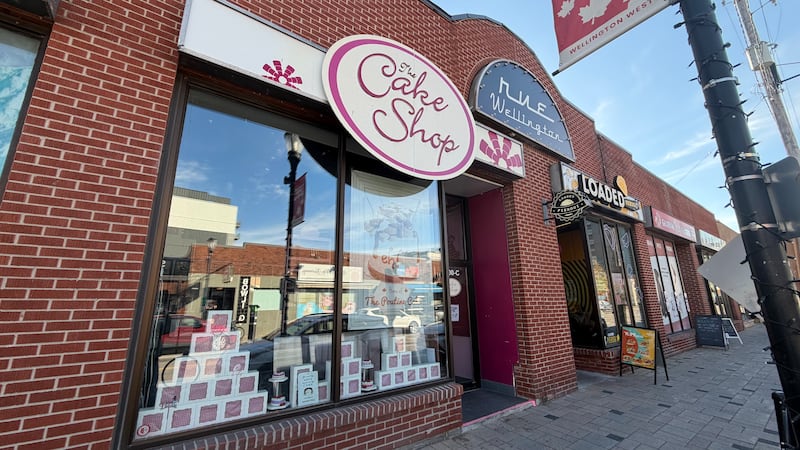
Alex Lawson is promising to turn off on-street parking meters and offer free parking on streets across the City of Ottawa if he is elected mayor this fall. The mayoral candidate unveiled his plan for parking on Friday, called “Stop feeding the meter.” Lawson says his plan for parking is that “every on-street meter comes out.” “A parking meter is a toll on shopping local,” Lawson said in his policy. “The big box store doesn’t charge you to park. The strip plaza with the giant lot doesn’t charge you to park. Pull over on an Ottawa main street to grab a coffee or pick up a prescription, and the city has its hand out before the shop does.” According to the 2025 City of Ottawa Parking Services annual report, the city managed 4,337 on-street parking spaces last year. The city collected $9.78 million in revenue from on-street parking spaces in 2025, while the on-street spaces cost $7.42 million to operate. Lawson says, if elected, every one of the 4,337 paid on-street parking spaces will go back to free parking. The candidate’s campaign said the first parking meters to be turned off will be the machines in Westboro and Wellington West, where paid on-street parking was issued one year ago. He is also promising to change posted time limits for parking on city streets to a minimum of two hours. “Where turnover matters, on main streets and in front of shops, the tool is a posted time limit, and no posted limit anywhere in the city will be shorter than two hours,” Lawson said. “There are streets today where one hour is all you get. That isn’t enough time to visit your mother, and it isn’t enough time for her to visit you. Two hours becomes the citywide floor.” Lawson says no-stopping zones, fire routes, rush hour areas, school zones, loading zones and accessible parking spaces will remain in effect. “Winter overnight parking bans stay, because the plows have to get through,” Lawson’s campaign said. “The city’s parking garages and surface lots keep operating and keep charging.” Lawson notes the City of Ottawa collected $19.62 million in revenue from on-street and off-street parking spaces in 2025, while it cost $17.13 million to operate it. Lawson says the city spent $7.4 million running the on-street meters and $710,000 to study parking. “Take out the meters and most of that spending goes with them: the pay stations, the collection contracts, the enforcement runs, the consultants,” Lawson said. According to his campaign, Bylaw Services officers will “stop walking the meters and spend time on the rules that protect people,” and will continue to enforce school zones, blocked hydrants, fire routes and accessible spaces. Bylaw Services officers issued 177,251 parking tickets between Jan. 1 and June 30, up from 171,467 tickets during the same period last year. Bylaw officers issued 476,000 parking tickets last year, including 33,950 tickets for parking in excess of posted time limits, 41,277 tickets for parking in excess of three hours and 126,286 tickets to drivers illegally parked on private property. “Parking fines are general revenue, not parking revenue, and fewer tickets means less of it,” Lawson’s campaign said. “Alex won’t budget a city on gotcha revenue. A fine should change behaviour, not fund a department. The tickets that matter, the ones for blocking a hydrant or parking in an accessible space, keep getting written.” Lawson says the city would continue to charge for parking at parking lots and municipal garages. Mayoral candidate Jeff Leiper says the funds that would be lost if paid on-street parking were eliminated would have to be made-up from other means, like taxes. “Nobody likes paying to park, and I hear that from shoppers watching every dollar and from business owners worried about losing a customer to a big box lot,” Leiper said. “Paid parking manages demand. It keeps spaces turning over so the person driving to the store at two o’clock can actually find a spot out front, and the fees fund the parking system, including garages, instead of putting that cost on everyone’s tax bill. I support it as the fairer approach, but I also support reviewing rates regularly so they are only in place where demand outpaces supply.” Incumbent mayor Mark Sutcliffe says the money raised from paid on-street parking goes back into important city services. “The money that’s raised goes back into plowing those parking spots and making them available for people and building more parking so people have places to go so it would cost a lot of money and it would be bad for taxpayers and bad for business,” he said. Meanwhile, candidate Neil Saravanamuttoo says Lawson’s proposal shows “that he doesn’t understand basic economics.” “When something like a parking space is in high demand, the only way to make it available is to put a price on it. No one likes to pay for parking, but this would mostly prevent customers from finding parking anywhere near the business they are trying to reach,” Saravanamuttoo said. “Lawson wants Ottawa to learn the hard way the high cost of free parking in high demand areas. A much better idea would be to take the parking revenue from each street block and reinvest that money directly back into improving the specific block.” “Encourage parking turnover,” city says The City of Ottawa implemented paid on-street parking in Westboro and Wellington West one year ago, the last area in the downtown core to have on-street paid parking. Bylaw Services Chief Jake Gravelle told CTV News Ottawa in July that the changes were “implemented to encourage parking turnover and better support local businesses by improving parking availability during peak periods.” According to a city report in 2024, the city looks at implementing on-street paid parking in areas where “peak occupancy levels” are over 85 per cent. “An occupancy level of 85 per cent is known as ‘practical capacity’ in the parking industry. Parking occupancy rates that exceed 85 per cent indicate a lack of available parking for people arriving to an area, causing them to search for parking and potentially go elsewhere,” staff said. “Parking occupancy rates that exceed 85 per cent also have negative implications towards businesses and the community as a whole due to increased traffic volumes, which can result in increases in emissions, congestion and safety-related issues.” Bylaw officers issued 14,525 parking tickets for violations in the areas of Richmond Road and Wellington Street West between Sept. 9, 2025, and June 30. The fine for parking in excess of the posted time limits is $70, with an early payment option of $50. The City of Ottawa also extended paid on-street parking hours in the ByWard Market, Little Italy, the Glebe and Centretown last year on evenings and weekends. With files from CTV’s Katelyn Wilson