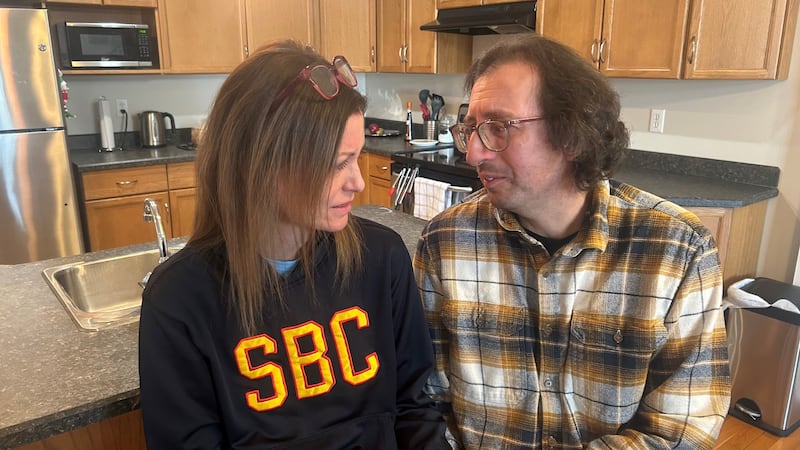
A Canadian man says he was denied entry into the United States just days before he was supposed to marry his American fiancée in a small ceremony in upstate New York. Devin Hayden, a Canadian citizen who lives near Brockville, Ont., says he and his partner, Bridget Ellis, have been in a long-distance relationship for four years, regularly crossing the border to visit one another. “It’s not a long drive,” says Hayden. “It’s about an hour and a half, including the border.” The couple had planned a June 14 wedding at a park in Kent, N.Y., with a handful of family and friends. But when Hayden attempted to enter the U.S. on June 2, ahead of the ceremony, he was stopped and questioned by border officials and ultimately turned away. “They asked me to go to the office to pick up a form, and I thought I was just picking up a form,” he says. “It turns out I had what they called an overstay, and I had to exit the country immediately.” Hayden says officers reviewed his travel history dating back to November and flagged him for spending too many days in the U.S. as a visitor. He disputes that claim, saying his time south of the border totalled just 154 days. Typically, a visitor to the U.S. can only stay to a maximum of 180 days per year in total. “Once I saw them all group up and stuff, I’m like, all right, something is about to happen. And then I kind of prepared myself,” he said. “But once they stood me up, and took fingerprints and stuff, I was like, okay, this is a little worse than I thought it would be.” Adding to the confusion, Hayden says his Canadian passport was nearing its expiration date at the time of his attempted crossing and the “reason” was left blank on the official denial of entry form he was given. Ellis, who lives in upstate New York and was with Hayden travelling across the border, says all she could do was sit and watch. “It was a little nerve-racking,” she said. “I had to turn around and come back to Canada and drop him off and then go back to the states.” The couple had envisioned a simple outdoor ceremony, something low-key but meaningful. “We were just going to be doing it outside, like at a park with the birds and everything,” Ellis says. “And live our life the way we want to.” Jennifer Behm, a U.S. immigration lawyer and partner at Berardi Immigration Law in Buffalo, N.Y., says denials like Hayden’s are not uncommon, especially when marriage is part of the reason for a visit. “They (US border agents) are inspecting every visitor for two things. One is, what is the purpose of your entry to the United States, and two, do you intend to depart the United States when you say you’re going to depart,” says Behm. “And so, if someone shows up and the scale is tipping a little bit more heavily towards really strong U.S. ties, that’s going to raise a red flag and they’re going to be asking a lot of questions,” she continued. “There is no law that says you can’t come to the United States and get married—they’re not breaking the law—it’s just all of these other factors and the compounded weight of not being convinced the individual has plans to return to Canada.” Behm adds this is a common occurrence at the U.S. Canada border, and that the border agent’s actions are “business as usual,” emphasizing this situation is not politically motivated and that an agent’s perception of intent to stay can often be enough for a denial. “I’d be shocked if he was permitted to enter as a visitor anytime soon,” says Behm. “Generally, we tell clients once you’ve been denied entry to the United State, you have to do the heavy lifting to re-establish really strong ties back to your home country֫—here, that being Canada—to show the officer that, in the future when you do request entry, you’ve got something to return back to Canada to.” For now, Ellis continues to travel to Canada to see Hayden. Both are trying to stay positive. “I’m hoping once the new passport arrives maybe I’ll be allowed back in,” Hayden says. “We’re working well through it, considering the circumstances. We’re making do with what we can right now. It’s hasn’t torn us apart.”