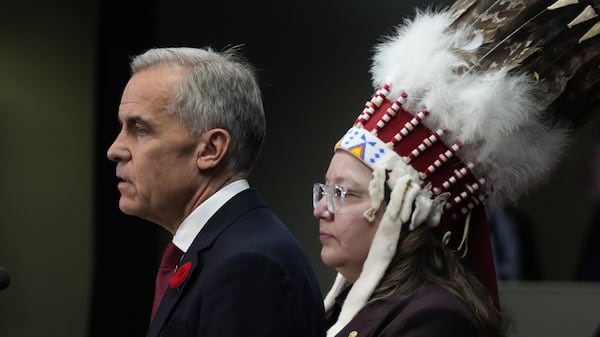
Premier Paul St-Pierre Plamondon met with the leaders of the Assembly of First Nations of Quebec and Labrador (AFNQL) in the provincial capital on Thursday. The meeting took place in the morning at a hotel and lasted about 30 minutes, but the media were informed later in the day by a government spokesperson. “First and foremost, I wanted to listen to and reach out to the chiefs and grand chiefs,” the premier said in a press release, noting that he was drawing inspiration from the tradition of Parti Québécois (PQ) governments dating back to René Lévesque. “The relationship our government will have with Indigenous peoples will be one of respect and collaboration,” he added. “The keywords will be partnership and mutual respect.” St-Pierre Plamondon was accompanied by his minister responsible for Relations with First Nations and Inuit, Simon-Pierre Savard-Tremblay, and by Quebec’s diplomat and chief negotiator, Pascal Paradis. The premier had already met last week with AFNQL Chief Francis Verreault-Paul. Discussions at that time had focused on homelessness, Indigenous languages, and prior consultation in the bill-drafting process, according to a brief statement. In the CAQ government’s forestry reform—which ultimately fell through in September 2025—there had been talk of co-drafting legislation in collaboration with Indigenous peoples. The relationship between the Parti Québécois and Indigenous peoples has experienced some turbulence. On Oct. 26, St-Pierre Plamondon refused to attend a meeting organized by the federal government between provincial premiers and Indigenous leaders in Ottawa. His team claimed that the timeline was too tight, since the cabinet of the new PQ government had only just been formed. But subsequently, the premier argued that “the Government of Quebec meets with Indigenous nations directly, nation to nation, on our territory,” and not “at a table organized by the federal government,” according to “its framework, its schedule, and its parameters, which remain very vague.” Furthermore, during the election campaign, the PQ leader had made it clear that the support of Indigenous nations would not be essential for a PQ government to adopt a provisional constitution for an independent Quebec. Under the Blue Book adopted by the PQ, a PQ government must establish “an itinerant commission for consultation and information on the adoption of a provisional constitution for the country.” This provisional constitution would take effect the day after a “yes” vote in a referendum on independence, which the PQ has pledged to organize. To justify his refusal to seek the consent of Indigenous peoples, St-Pierre Plamondon said that a “provisional constitution is the product of a law passed by the National Assembly” and that “we cannot set unanimity as a rule for the functioning of the National Assembly.” Rather, the obligation lies in consulting and hearing from each of the nations, he asserted. “Nor can we conceive of bills that would require the consent of absolutely all elected officials, all stakeholders, all nations, and all cities,” he added. This report by The Canadian Press was first published in French on Nov. 5, 2026. Patrice Bergeron, The Canadian Press