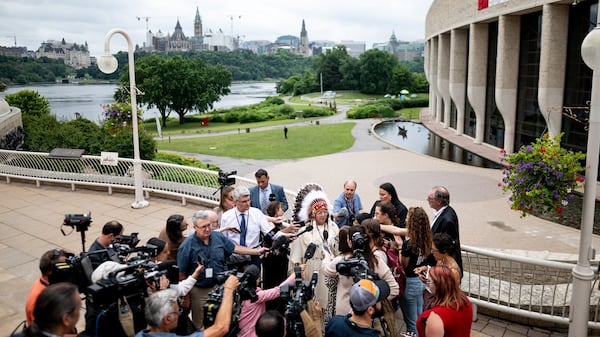
A Montreal tenant is calling on Quebec’s National Assembly to impose steep fines on landlords who try to illegally evict their tenants after he says he has been pressured to leave his unit through intimidation tactics. At a news conference Friday, Roger Fournier, along with Québec Solidaire housing critic Andres Fontecilla, told journalists his landlord has been trying to push him out of his unit by neglecting repairs, turning off the heat and refusing to cash his rent cheques. His story was first published in the Journal de Montreal earlier this week. Fournier, 59, says he believes his landlord wants to evict him despite a three-year moratorium and a ban on “renovictions” so the rent can be increased significantly before the next tenant moves in. “It’s ruining people’s lives,” he said. According to the Quebec Business Registry and city records, Roxbury Capital Holdings, which the Quebec Business Registries lists as belonging to Henry Zavriyev, sold the building to Laurent Cardinal in 2024. Zavriyev’s company still manages the building. Zavriyev has repeatedly made headlines for allegedly pressuring tenants to leave their units. Fournier says the landlord offered him $10,000 to leave his unit on three separate occasions, which he refused. Fournier says his rent is partly subsidized by the Office municipal d’habitation de Montréal (OMHM) and he wants to stay. He is speaking out in hopes to inspire other tenants to enforce their rights and to push for more government action. Fournier says his apartment was flooded and sustained heavy water damage in January 2025 and the proper repairs still haven’t been done. “I called the concierge who just handed me garbage bags and told me to clean it up,” he said. Then, he says, the landlord stopped cashing in his cheques and instead asked Fournier to send interact e-transfers, which Fournier says he has a hard time navigating. “I sent him four cheques, and he took six months to deposit them,” Fournier said. “The money was in my account the whole time, but they never took it.” In November, he says his landlord cut off the heat. He broke into tears as he told journalists he has been freezing all winter and the heat wasn’t turned back on even in minus-28-degree weather. “It’s inhumane,” said Fournier. “They want us to leave and that’s why they refuse to do repairs and cut the heat, to intimidate us.” Fournier told journalists he’s willing to fight back despite feeling vulnerable. “I hope you’re listening,” he told his landlord from the podium. “I hope you open your eyes because enough is enough.” A representative for Zavriyev refutes the tenant’s claims, saying the landlord never turned the heat off. They also said the tenant refused to allow the landlord and maintenance workers entry to his unit. CTV News spoke to Fournier and his friend and chaperone Dominique Boucher, who insist the heating had been cut for several weeks but was turned back on following the Journal de Montreal article’s publication. “He had to get a space heater,” Boucher said. “I can’t count the days I saw him wearing his winter coat inside.” Fournier says the city got involved and he opened a file at the provincial housing tribunal (TAL), but the landlord never showed up to hearings. “It goes to show he is not taking his responsibilities as a landlord seriously,” said Fournier. He is asking for $15,000 in moral damages, saying the situation has put him under constant stress. He said he stopped sleeping and his mental health took a dive because of the harassment. He is waiting for the judge’s decision to come in. Now he wants the government to impose “steep fines” in cases like his. Although Fournier says his landlord is acting illegally, Fontecilla says they are still getting away with it. Fontecilla says Zavriyev, while well-known, isn’t the only landlord to use such tactics. He says while former housing minister France-Élaine Duranceau increased punitive damages for abusive landlords, cases like Fournier’s show it doesn’t go far enough. “The landlords are not following the law that exist,” he said. Fontecilla says even with a moratorium on evictions, vulnerable tenants are still being forced out of their homes amid a housing crisis. It’s a public health issue, he adds, with homelessness being on the rise.