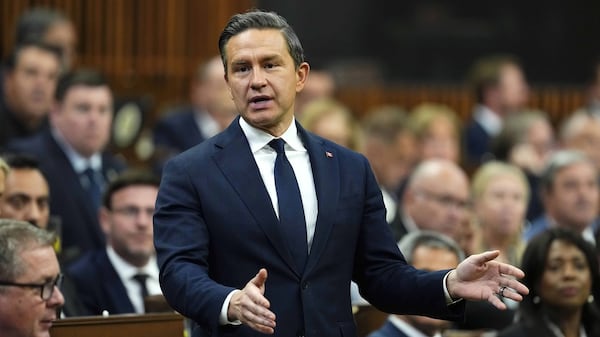
Marc Miller, the new minister responsible for official languages in Mark Carney’s government, says he is hurt by comments made by Quebec Premier François Legault, who accused him of being “a disgrace” and spreading “stupidity.” “It hurts me,” said Miller on Wednesday, who has just returned to the cabinet to replace Steven Guilbeault, who resigned from cabinet. Miller finds Legault’s comments surprising after he expressed reservations about the discussion on the decline of French in Quebec. “It’s also strange because I was part of a government that recognized the decline of French across Canada, including in Quebec, and amended the Official Languages Act accordingly,” he said on his way to the weekly Liberal caucus meeting in Ottawa. The man who also succeeded Guilbeault as Minister of Culture and Canadian Identity also touted the $4.1 million in investments planned in the 2025 budget. “I think it’s nice to talk, but, you know, I’ve proven myself, and that proof speaks for itself,” he added, before stating that he did not want to “personalize the debate.” “In my previous role as Minister of Immigration, I doubled francophone immigration to Canada and sent $800 million to Quebec specifically for francization,” Miller said. The day before, the minister had maintained the nuances he had been keen to express since 2023 regarding the decline of French in Quebec. “What I refuse to accept is the dogma that certain political parties want to promote, saying that French is in total decline,” he said. He argued that “the reality in all this is that there is good news, particularly the news from the past several decades thanks to Bill 101” and “thanks to the Canada-Quebec agreement” which gave the province several powers in the area of immigration, including the ability to prioritize French-speaking newcomers. “French, I will repeat, is immensely fragile in North America, and it must be protected,” Miller added. When asked to specify the extent to which he recognizes the decline of French, the minister replied that this is the case for the “language spoken at home” and, “statistically, at work.” “We need to make an extra effort,” he said. Miller showed signs of exasperation with “the politicization of the issue.” “I think it’s being used for identity reasons, and I think that, as a Quebecer, I’m pretty tired of this debate, which is generally quite identity-based,” said the representative for Ville-Marie—Le Sud-Ouest—Île-des-Soeurs. It was Miller’s comments that made Legault fly off the handle. “Marc Miller is a disgrace to all Quebecers,” he said on Tuesday as he headed to question period. “I don’t know how he’s going to show his face at a cultural event in Quebec after saying such stupidity.” On Wednesday, at almost the same time that Miller was revisiting the episode in Ottawa, Legault persisted and signed off from Quebec City. “I repeat what I said yesterday. It makes no sense for a federal minister to come and mock the decline of French in Montreal by saying he’s tired of hearing about it.” As for Guilbeault, he said he was “a fan of Marc Miller.” “He’s a friend. I think he’s an excellent minister. Just look at the departments he’s been in, particularly Indigenous Services. It’s quite rare in history that we’ve seen Indigenous groups saddened by the departure of a minister and praising his work. So I have complete confidence in Mr. Miller,” he said as he attended the weekly Liberal caucus meeting for the first time since his resignation as minister. Liberal House Leader Steven MacKinnon commented on Legault’s remarks, saying that the Quebec premier ”sometimes has interesting opinions." His view seems to echo that of Quebec Liberal Party House Leader André Fortin. “I also know a premier here who has spoken about the potential Louisianization of Quebec and who refuses to offer any (sufficient) assistance to newcomers to learn the French language. That is a disgrace,” Fortin said at a press briefing. Fortin also criticized Legault for citing “absolutely absurd data,” among other things, when he criticized Miller. The premier claimed on Tuesday that “from 2022 to 2024, the percentage of francophones in Montreal fell from 48 per cent to 43 per cent.” “He’s telling us that 43 per cent of people in Montreal speak only French at home,” Fortin lamented on Wednesday. “When he does that, he’s telling people who speak French and English at home, those who speak French, Portuguese, and Spanish, those who want to teach their children their mother tongue, that they are a problem in Quebec. In what world are these people a problem?” In 2023, Miller also lamented the use of certain statistical indicators at the expense of others. He was annoyed by the Bloc Québécois’ “excessive” use of data on mother tongue. According to him, this suggests that those who learned French later in life are less Quebecois than others. The leader of the Parti Québécois, Paul St-Pierre Plamondon, said he was “really offended by the behaviour of certain people” after sharply criticizing representatives of several cultural associations the day before for welcoming Miller’s appointment. - With files from Caroline Plante and Thomas Laberge in Quebec City This report by The Canadian Press was first published in French on Dec. 3, 2025. By Émilie Bergeron, The Canadian Press