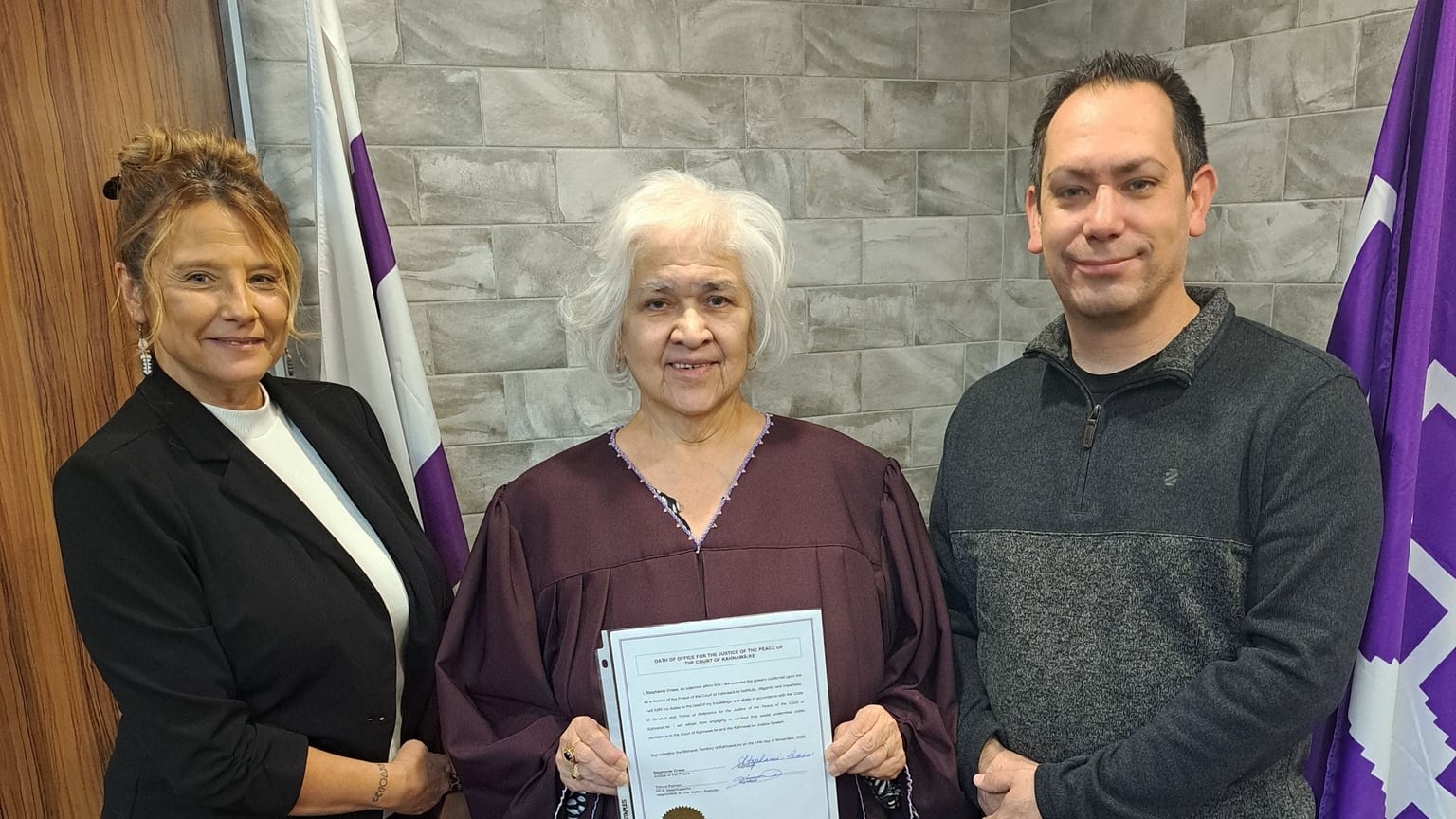
Judges appointed by the community will soon sit and hear cases at the Court of Kahnawake. The Kanien’kehá:ka (Mohawk) community south of Montreal continues to develop its unique justice system, which remains at the forefront among Indigenous communities. Recently, Justice of the Peace Stephanie Cross signed an oath of office, the first time a community-developed oath of office has been signed by a justice of the peace. It is also the final time. “We wanted to make her position really ours,” said Mohawk Council of Kahnawake (MCK) chief Tonya Perron. “We will be moving on and it will be judges now of the Court of Kahnawake.” Cross, and future judges will hear summary conviction criminal offences, contested traffic tickets and community law cases at the community’s court. It sits around 36 times a year. “So no matter where you’re from, if you get a speeding ticket or if certain criminal offences or what have you, would go before our court,” said MCK commissioner of justice Kevin Fleischer. “Our court is territorial; it’s territory-based.” Cross has been a justice of the peace appointed by the Canadian government since 1993. Fleischer explained that, by signing the Kahnawake-developed oath of office, her role is now based in the community. “Through these documents and the work we’re doing administering our own justice system, it’s as though her position has evolved into a true Kahnawake Justice of the Peace role,” said Fleischer. “It’s developed and evolved into something new, something that’s more ours.” Expanding jurisdiction Perron explained that, before the 1970s, Kahnawake’s court was officiated by the Indian agent. In 1979, the Court of Kahnawake was established, and justices of the peace were appointed to preside over the court. That process was based on Section 107 of the Indian Act. “Over the years in Kahnawake, we’ve slowly expanded our jurisdiction,” she said. “We started to operate a lot more independently from that, and we’ve evolved now to the point where the Indian Act will no longer apply to our local court.” In 2015, the MCK enacted the community’s Justice Act, which is being implemented now. The justices of the peace, who have served the community, have never officially been sworn in by the MCK before last week with official codes of conduct, confidentiality or terms of reference. “Now with these, the governance documents that we’ve developed, their internal governance documents, we created them, and those documents are code of conduct, confidentiality, terms of reference and oath of office,” said Perron. There is now a call out for judges who will be appointed within the coming months to preside over the Court of Kahnawake. In addition, the court will soon have a permanent home, with a complex being built to house the court and other legal offices. Currently, court cases are heard at the Golden Age Club. Though more serious cases are heard in Longueuil’s Palais de Justice, Kahnawake continues to break barriers in implementing its own justice system. “I know that we’re one of the leaders when it comes to Indigenous courts because our court is independent,” said Fleischer. “We’re not affiliated with a Provincial Court system like other communities are.” He added that Cross signing an oath of office is an exercise of Kahnawake’s jurisdiction and the “right to administer our justice system.” “It’s to help foster public confidence in the people presiding at our court, that they feel confident that when they go to the court of Kahnawake that the decision makers sitting there have sworn an oath to be fair and impartial, so they know that they’re getting a fair shake when they come to our court.” “It is a momentous occasion for us,” said Perron. “It’s another milestone that we’re reaching in the history we’re making with our system here, with our judicial system.”