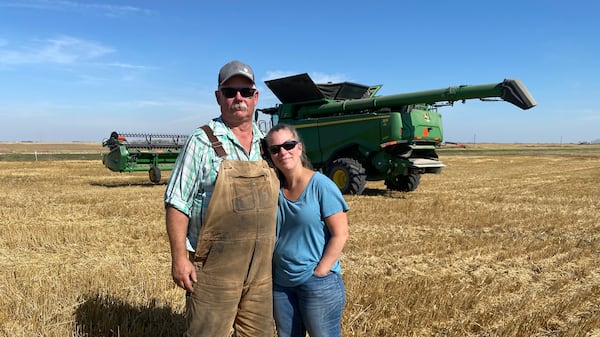
Marg and Bob Funston are preparing for Bob’s home dialysis treatment. As a team, they cycle and clean Bob’s blood three times a week from the comfort of their own home. “In the beginning, it was a bit scary. I had to learn not to panic when the alarm goes off and learn what the alarms mean. There are 19 different alarms, so I’ve read that manual many times now, from front to back,” said Marg Funston. The Funstons took on the challenge of learning to perform home hemodialysis at their Southampton home instead of travelling to dialysis clinics in Owen Sound and London. They said they did so because they could set their own schedule and not be told when they had to receive treatment. Travel was also a key consideration. “Some of the benefits of doing it at home were the disadvantages of not doing it. Travelling up here in the winter, having to go to London or Owen Sound, isn’t always feasible or practical. And in a clinic, they tell you when to come and that’s when you need to be there. So, the idea that we could have some flexibility was very appealing,” said Bob. It took eight weeks of training to learn the ins and outs of home hemodialysis. Until now, everyone receiving that training through London Health Sciences Centre had to go to London. But Bob and Marg were the first to complete some of that training in Owen Sound, saving them a significant amount of driving time. “After the first five weeks, they said, ‘Well, you can do the next two weeks in Owen Sound.’ That saved us 12 hours a week in travel time alone,” said Bob. The partnership is the first of its kind between London Health Sciences Centre and Brightshores Health System in Owen Sound. “For us here in Owen Sound, we have a satellite dialysis unit. It has six spots. Those spots fill up quickly. There are people on the waiting list. The people on the waiting list have to travel down to London, usually three times a week for three- to four-hour treatments, and then travel back. So, to have this as an option in our community, to take some of that travel burden away, and to feel the comfort of training within their own community, really allows for a more, I want to say more social experience, but it just makes it a lot more comfortable for the patient,” said Keri Aitken Toby, the home hemodialysis nurse for Brightshores who taught Bob and Marg how to perform home hemodialysis. Since starting in May, Bob and Marg are nearing 100 home dialysis treatments to manage Bob’s kidney failure. They said it is not for everyone, but they have enjoyed the flexibility and reduced driving, and very much appreciated being able to complete at least part of their training in nearby Owen Sound. “They deliver our supplies right here. We have a technician who comes in once a month to check the system. We just find that it’s really handy being able to do it at home. We’ve had to call London two or three times since we’ve been doing it, and the people have been very helpful in giving us step-by-step procedures on how to get things back on track,” said Bob. “Oh, it is a big deal. It’s huge in rural Ontario. It’s huge. And particularly up here in snow country, it is amazing. We have friends who go to Owen Sound for dialysis, and sometimes they pair up and go together, and they have some rough rides. Learning to do it at home wasn’t always easy. The learning curve was steep. You can’t disguise that. It’s the way it is. The learning curve was steep. It isn’t for everybody, but it works for us,” said Marg.