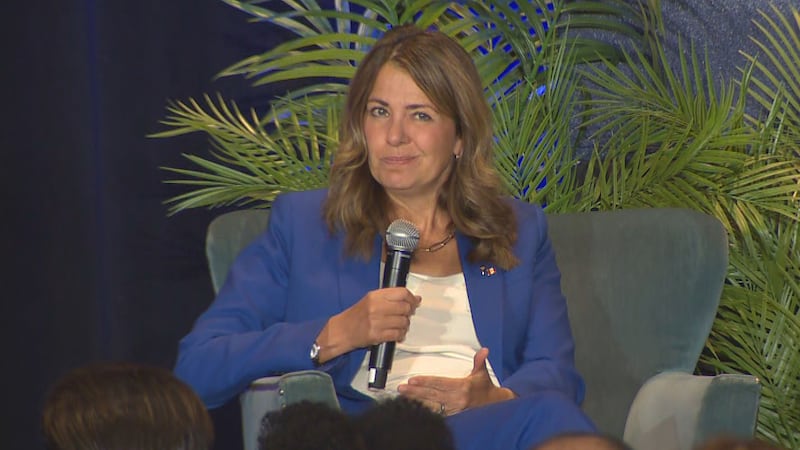
Alberta’s Budget 2026 puts more dollars toward health and education, but is projecting deficits in each of the next three fiscal years. President and CEO of the Calgary Chamber of Commerce Deborah Yedlin discusses the budget with Alberta Primetime host Michael Higgins. This interview has been edited for length and clarity. Michael Higgins: What is to be made of the financial position the government now finds itself in, especially given we’re not that far removed from being in significant surplus territory? Deborah Yedlin: The size of this budget deficit is not insignificant. It’s double what was expected in the shortfall of 2025-26, so what this really shows us is that we need to diversify our revenue streams, that relying on non renewable resource revenue – which is 20 per cent of the budget revenue target – is too much. We are price takers. We cannot control the price of oil or natural gas, so we need to figure out how to make sure that we have alternative revenue streams so that we’re not in this deficit position. MH: There is no plan being presented for a return to balanced budgets. How concerning is that from the perspective of the business community? DY: I think that’s very concerning because if you continue to stay in a deficit, and you need to continue to borrow, we know that the borrowing costs are already going to increase significantly to $3.4 billion, and that assumes you maintain your credit rating. If your credit rating starts to deteriorate, your cost of borrowing is going to go up even further. And so finding a path to black, so to speak, is very important. It is not articulated in this budget, and we need to see some more definitive business plans from the government to see where those investments are going to actually result in a return. MH: In the wake of the budget, there has been lots of talk in both Calgary and in Edmonton on the province increasing property taxes. What kind of pressure do you see that bringing to bear? DY: I think that could be the canary in the coal mine, so to speak. Even though Alberta’s growth is expected to exceed other provinces and Canada in 2026, it still doesn’t mean that there is uncertainty. You know, we have the Canada-United States-Mexico Agreement (CUSMA) that’s still on the table for renegotiation. We know that there is significant downward pressure on oil prices that is challenging, and so to have to add that burden to homeowners and business owners, as well, is going to be an unwelcome surprise to many Albertans. MH: What do you like about the budget where Alberta’s road forward is concerned? Are there elements there that strike the right note? DY: I don’t envy the finance minister at all. He had to figure out how to trod a very fine line. We know we needed increases investments in health care. We did see that. We knew that we needed increases in investment in education, and we did see that. So I think that’s really important. There is money that’s being set aside for infrastructure that’s also very important. We have more money going into attracting investment into Alberta. Those are positives, but those come with trade-offs. And when you have sort of a challenged fiscal environment, when you have, like I said, downward pressure on oil prices, it’s tough to figure out what those priorities are. MH: All the talk of separatism – the push, the petition, push for a referendum – how’s that landing with the business community at a time when provincial finances are as challenged as they are? DY: Anything that increases uncertainty from an investment standpoint will cause investment to sit on the sidelines. And at a time we’re facing global economic uncertainty, having any element of that inserted into the investment climate in Alberta is troubling. So let’s remember we compete for capital the world over. Anything that causes an element of uncertainty, the capital will go somewhere else, and that’s not what we need right now, neither as a province or as a country. MH: Is there anything to suggest this building separatism dialogue is already having an impact? DY: There are a lot of conversations that are happening behind closed doors. I think it’s on the risk register of every company, and we’re hearing people raising concerns about what this means from an investment standpoint. MH: What would you say the business community is then expecting of the provincial government and quarterbacking this referendum conversation? DY: What we have to remember is that it’s really important that we have an opportunity to grow our resource production, to increase our egress off the west coast. That requires both producers and the builders of a pipeline to risk multi-decade dollars in terms of capital and billions of dollars. So what we really need is policy durability and certainty that provide the assurances for companies to risk that capital. MH: Albertans have long had little appetite for talking about something like a provincial sales tax, but how much room is there in the here and now for a provincial conversation on tax structure to your earlier point, financial stability? DY: This is something we’ve talked about for a very, very long time. We can’t be beholden to natural resource revenues, the price of which we have no control. We live on this sort of sine wave of investment and austerity because of the oil price and the natural gas price. If we had some certainty that would be provided from a revenue standpoint through a provincial sales tax, that would be net of net benefit In terms of the government being able to continuously invest in programs, not having to catch up, which is what we consistently feel like we have to do if we pull back one year and then have to inject more expenditures the following year. We need some uncertainty from a revenue standpoint, and I think this has been a conversation that we’ve also had for a long time. From a business standpoint, too, I think you want to know that the jurisdiction that you’re investing in has a stable framework, so that if you are looking to invest in an area, that there’s no risk that other things could be underinvested in, and that could compromise your ability to attract labour to whatever you’re doing.