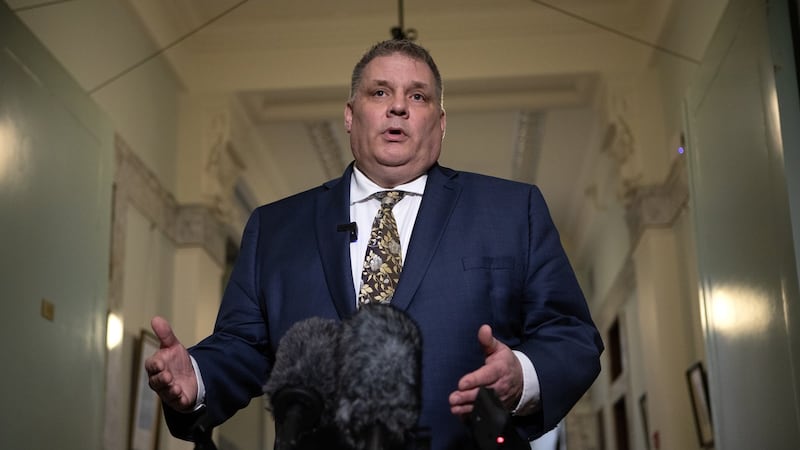
Despite a now-stabilized wastewater system in Edmonton following a heavy onslaught of rain, a number of communities in the surrounding area continue to contend with the impact of significant rainfall and overland flooding, including an ongoing water alert in the Town of Tofield. Alberta Municipalities president and Grande Prairie City Coun. Dylan Bressey joined Alberta Primetime’s Michael Higgins to discuss new financial avenues for municipalities outside of taxation. This interview has been edited for length and clarity. Michael Higgins: What are your member municipalities reflecting about the challenges of the past few days, and why were wastewater systems pushed to the limits? Dylan Bressey: This wasn’t a unique challenge, but it really is a great illustration of the challenge that municipal councils are facing every single day. That is, we’re in a changing world where our municipalities are having to deliver services they haven’t had to in the past, for example, this was a once-in-100-years storm, supposedly, but those seem to be coming a lot more frequently these days. At the same time, municipalities are also dealing with increased population growth, and often when we talk about people moving to our province, we talk about infrastructure like wastewater treatment plants, recreation centres, police services, fire services, but also more people in a metro area means a lot more hard surface, which means a lot more catch basins, storm flows, storm ponds, etc., are needed, and so this really is just an illustration, a very visible one, of the challenges municipalities are facing every single day, keeping up with evolving and increasing service needs, even while our population is growing, MH: What does it say when a city the size of Edmonton had to actually ask its residents to cut back on water use because of the storm water system being at capacity? DB: We have 264 cities, towns and villages in this province, and all of them have huge infrastructure needs. If you took all the pipelines that our cities, towns and villages ran in this province for water, wastewater and storm, and you stacked it end to end, you’d have a 54,000-kilometre line of pipe. That’s enough to go around the globe once and still build a pipeline from Calgary to Istanbul. Collectively, municipalities in Alberta are taking care of a huge amount of infrastructure, which they’re not just dealing with maintaining and replacing as it ages out, but also needing to expand that infrastructure services as we see new storm events, as we see new people move to this province, and as we see new economies push our infrastructure in new ways. This is a challenge that we’re seeing in our largest cities to our smallest villages of just keeping up with basic infrastructure. MH: What kind of conversation do you see municipalities now needing to have in the wake of this storm? DB: The big challenge that municipalities are facing is that our primary source of revenue is only taxes, and property taxes were put in place over 100 years ago when literally all municipalities were doing was building roads and building fire breaks. Well, now municipalities also need to maintain storm systems, run recreation centres, deliver social programs, run fire halls, run police stations, and so there’s this huge amount of municipal services that weren’t even contemplated when municipalities were first created, and we don’t think that property taxes alone are keeping up with today’s challenges and today’s opportunities. We really are excited about some of the conversations we’re having with our colleagues at the provincial and federal government, and even more so conversations we’re having with Alberta residents about what the future of funding municipal infrastructure and services should look like. Is it truly just property taxes that should be keeping up with this growth and these challenges, or are there other funding mechanisms that should be put in place to make sure that our residents, our businesses have the storm pipes, the roads, the rec centres, the fire stations that they need? MH: A lot of homeowners were left bailing out their basements. Had notifications gone out sooner to cut back on non-essential water use, might that have made more of a difference in the outcome? DB: I can’t tell you what the story in individual municipalities was in terms of what was going on, but I can tell you that our municipal staff across this province, they really are on top of their game in terms of giving residents the earliest possible warning they can give, even when there’s imperfect data out there. I do know that our communities work hard to get that message out as quickly as possible, but this is also why it’s really important that residents are following their municipality on social media, they’re subscribing to text message alerts where that’s available, they’re signing up for the email lists, and they’re doing their part to plug into municipal communication infrastructure, so that these messages can get out as quickly as possible when residents need to know something. MH: The (UCP) government today launched a minister’s council to discuss new ways of funding municipal infrastructure without raising taxes. I understand you’ll play a role here. What do you see this accomplishing? DB: This is a council that Alberta municipalities, along with mid-sized city mayors’ caucus and industry groups, are going to be participating in, and it really is looking at the two ways that municipal infrastructure is funded: property taxes or off-site levies. We’re looking at, are there alternative ways that we should fund this infrastructure, so that we can keep up with a growing population here in Alberta, and we’re excited for that conversation, because we really don’t think that property taxes and municipal debt alone are the only solutions that should be on the table when it comes to building the new roads, the new pipes, the new recreation centres that our residents and our businesses need. MH: Are there actually options? DB: That’s the work we’ll be doing over the next couple months. I know that I’ve heard a few ideas from both industry and various government colleagues about maybe there’s some options to find lower-cost borrowing for industry as it’s building roads and pipes, or maybe there are some new tools that could be put in the municipal tool belt in order to manage debt in a way that’s more equitable and more affordable for our, for our members. Right now we are very much in the early stages of this, and it is a conversation we welcome. However, as we’re having this conversation, it’s really important to us that it’s framed around, number one: getting new funding into the system. It can’t be about re-juggling who’s paying for what which would already get paid for anyways. This really needs to be about new capital injection to get new roads, new pipes, new infrastructure built, and it also does need to be about making sure that the people that are going to use these services in the future are the ones paying for them. We can’t just have existing taxpayers pay them more money to build up new neighborhoods as they develop. MH: What kind of door do you hope or see opening, where dialogue with the provincial government is concerned? DB: This is a conversation that’s great, because it’s not just us in the province, it’s also industry, and those are important conversations. At the end of the day, I also think that we can’t just be looking at debt and borrowing instruments in order to fund infrastructure. The reality is municipalities are an order of government that owns about 65 per cent of public infrastructure in Canada, and collects under 10 per cent of taxation revenue. Something in that equation needs to change, which means either new tax tools made available to municipalities or other orders of government kicking in larger and more predictable amounts of funding than they are right now, because you just can’t keep up with 65 per cent of the infrastructure on less than 10 per cent of government revenue.