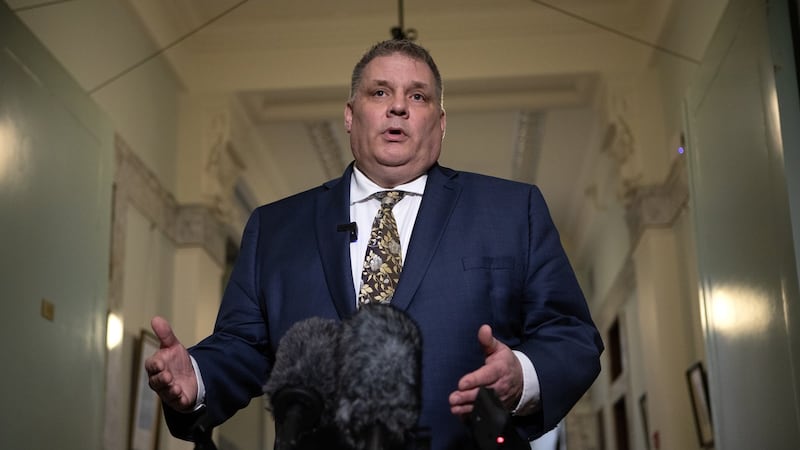
Prime Minister Mark Carney is facing reporters this week amid the countdown for the July 1 deadline to review a North American free-trade deal. Also on July 1, Premier Danielle Smith’s government is expected to submit a pipeline application to the Major Projects Office as part of the Canada-Alberta memorandum of understanding (MOU). Gary Mar, the CEO and President of the Canada West Foundation, joins Alberta Primetime’s Michael Higgins to discuss the upcoming deadline. This interview has been edited for length and clarity. Michael Higgins: While there hasn’t been much said about the application by either the provincial or federal governments of late, there is considerable anticipation of the July 1 timeline. How much of a make or break moment do you expect this to be? Gary Mar: I expect that there’s going to be an announcement on July 1, and I think that it is the culmination of a lot of work on the part of Premier Smith and the prime minister, and I might add the premier of British Columbia as well. There were a number of barriers to moving forward on this kind of project, including finding a proponent that would support it, but there may be some solution sets, as some of the barriers have been knocked down over the previous months of negotiations with two provincial governments and the federal government, and I wouldn’t be surprised to see if there was an entry of financing that comes from a proponent that is from outside of Canada. That wouldn’t surprise me at all. What remains to be seen is how you deal with the issue of the industrial carbon tax, for one, and two, pathways. The prime minister is insistent that pathways will be part of this, and we’ll have to see what kind of a financing arrangement may or perhaps may not have been done with respect to the $15-$20 billion that pathways would require, and what the timeline of it is going to be. Perhaps they stretch it out over a longer period of time, and that may be the solution to dealing with that sticky issue, but I am expecting to see an announcement on the July 1 deadline. MH: Today marks the one-year anniversary of the Building Canada Act legislation, giving the federal government sweeping powers to approve major projects of national interest. How much progress do you see being made these past 12 months, especially where our province is concerned? GM: What I’ve heard from people out in industry is that they are appreciative of the ambition of the prime minister. They’re appreciative of the messaging that he’s put out there most recently on three major projects that he wants to have go forward, two of them in the Arctic, being highways, and one in Northern Ontario being a repository for spent nuclear waste, but there remains to be done the action part of it, and that’s the part that I think Albertans are waiting for: To actually see work getting started on projects that have been deemed to be in the national interests, and so that’s something that that people continue to wait for. MH: We’re still a week away from the start of the Calgary Stampede. The Prime Minister’s Office has a new senior advisor in Morgan Breitkreutz on Alberta dynamics, be that the MOU or the October referendum. What are you watching for? GM: I think that the appointment of Morgan Breitkreutz is a good one. I think that he’ll need a lot of help, and certainly there are many people that are going to be willing to work with Morgan, but he, being from Alberta, I think has a reasonably good understanding of the west in general, and Alberta in particular. He recently was the chief of staff to Minister (Eleanor) Olszewski , who’s from Edmonton, and I think that this is a good sign. I would say that the Stampede has always been a remarkable event. For 10 days of the Stampede, Calgary becomes both the political and the business centre of Canada. A lot of people from outside of Alberta don’t really understand that, but it is a gathering of people that will come from all over Canada, be it premiers, be it the prime minister, be it members of his cabinet. It’s going to be an interesting time to watch the political dynamics, because I also expect that people from throughout Alberta, that may be part of the pro-separatist group, may descend upon the city as well and make their presence known, and then finally the business opportunities and the networking that goes on is pretty extraordinary. It’s amazing how many deals get signed in a rodeo suite by people that are coming from all over in order to be in the city of Calgary at that time, so it’s always been a great event for both politicians to gather and meet, and for businesses to gather and meet, but I think that what’s going on most recently on both the referendum front and on the pipeline front and on the CUSMA (Canada-United States-Mexico Agreement) front are all coming to a head for these 10 days of the Calgary Stampede, and hopefully good things can emerge from it. MH: Pete Hoekstra, the U.S. ambassador to Canada, told CTV News earlier this week that they aren’t anywhere close to announcing any framework or interim agreement. What will you be watching for July 1 when Canadian, Mexican and American officials conduct that trilateral meeting to review the agreement? GM: I think what needs to be understood in all of this is that there is a great deal of integration of our three economies, and that is what gives Canada and Mexico leverage vis-a-vis the United States. There are a number of trade irritants among and between these three trading nations, and I think that you know the people that are on the Canadian negotiating team have done much to knock down some of those trade irritants, but many still remain to be dealt with, and so this is what Pete Hoekstra, the ambassador of the United States to Canada, has referred to, but I believe that a whole host of people that are supporting them are making real progress with the negotiating side for the Americans, and there’s no magic to July 1 in this particular instance. I expect that the negotiations will continue beyond July the first, and you know, I think that Ambassador Hoekstra has laid out a pretty compelling lesson for Canadians, and that is that negotiations are not being done really in the traditional sense of diplomats and trade representatives negotiating, the president is a businessman, and so it’s more like a business transaction to him than it is like a national trade negotiation in the traditional sense. So when Ambassador Hoekstra says, ‘You’ve got to stop saying we have to have your oil,’ what he’s saying is, ‘Look, Canada used to make up 11 per cent of oil imports, the U.S., now it’s about 60 per cent. So we don’t need your oil, we can drill our own, we can get it from Venezuela, we can get it from Mexico, but there’s a reason why Canada has gone from 11 per cent to 60 per cent and that’s because, while you’re not the only place to get our oil, you’re the best place to get our oil.’ So we need to make the business case as to why that is so, and make that clear to the president, and so rather than saying, ‘Mr. President, you need our oil,’ we should be making the case, ‘Mr. President, this is why we’re great partners and why it’s good for us and it’s good for you.’ Make it a business case, not a traditional trade negotiation case.