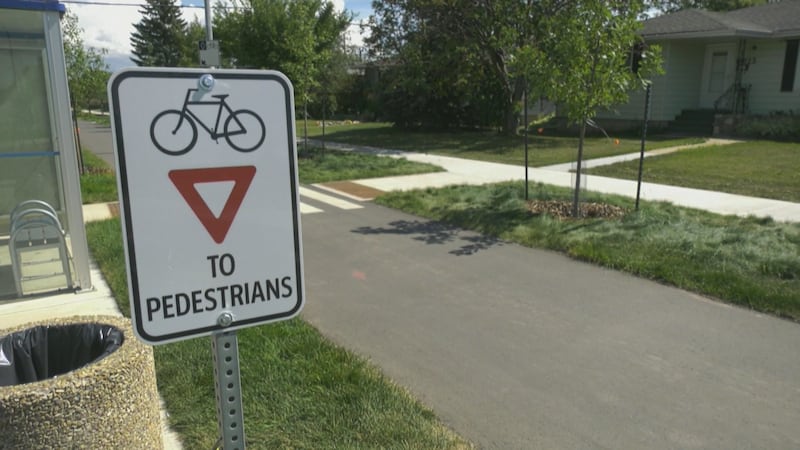
EDMONTON — Alberta Premier Danielle Smith said Saturday her government is planning to make changes to its proposed bike lane legislation just two days after it was tabled in the legislature. The bill, put forward by Transportation Minister Devin Dreeshen, would give the government the power to order some municipal bicycle lanes be removed while also prohibiting some future lanes from being built unless provincial approval is given. Provincial approval would also be needed to keep existing bike lanes that were built at the expense of vehicle traffic, as the bill says those lanes are to be removed when road repair projects on or near the lanes is undertaken by a municipality. The bill, as written, states that municipalities would be responsible for shouldering any costs borne as a result of the legislation, but Calgary’s mayor Jeromy Farkas said Friday he believed that was a mistake. Farkas said the premier’s office had promised him that municipalities wouldn’t be forced to pay and he suggested the government tabled a “premature draft version” of the legislation. Speaking Saturday on her call-in radio show “Your Province, Your Premier” on QR Calgary and 880 CHED, Smith said her chief of staff met with Farkas this week and that she thought the mayor had legitimate concerns. “We’ve got some amendments to propose to that (legislation),” she said. “We want it to be collaborative.” Smith didn’t go into detail on what changes would be made. Dreeshen’s office also didn’t provide specifics when asked for more information Saturday. Instead, it provided a statement attributed to the minister that had previously been shared with reporters on Friday. “This is about better collaboration with cities to ensure we’re making responsible, evidence-based transportation decisions that protect road capacity and make sure transportation networks work for everyone,” Dreeshen said in the statement. The premier fielded multiple questions and concerns about the bike lane legislation on Saturday, which has also faced pushback from cycling advocates and Edmonton mayor Andrew Knack. A caller from Calgary said the language in the bill felt “draconian” and pressed Smith to explain why her government wanted to oversee this level of local decision making. “I really feel that city council and Mayor Farkas can handle this,” the caller said. Another caller from Calgary said he was concerned that downtown sidewalks would be “flooded” with e-scooters should bicycle lanes in the area be removed. “If you want to get rid of the bike paths, fine, but you got to do something about the e-scooters. They’re an absolute hazard,” he said. Smith said in response to both callers that the government’s intention is only to look at bike lanes that reduce space for vehicle traffic or that aren’t well used. “I think that we just wanna make sure that we’re putting them in the right place, that it’s not interfering unduly with regular commuter traffic,” Smith said. “We hope we can work collaboratively to identify better ways of designing them for the future.” Smith also talked about provisions in the bill that would grant her government more oversight of municipal light-rail transit (LRT) projects. The bill states that municipalities must submit plans for provincial approval for any new or expansion LRT projects before they can proceed. The plans would need to include proposed routes, stop locations and further information that will be specified by the government through future regulations. It also says the transportation minister would be able to direct changes to any part of a municipality’s proposed plan. Smith said the government is owed greater oversight of these projects since it’s usually a major funding partner and because the province is planning its own future rail network that would include a train connecting Edmonton and Calgary. She also said public safety is a concern for the government. “I think one of the things that we’ve realized is maybe we need to have more control over who’s allowed on an LRT in the first place,” Smith said. She questioned the effectiveness of LRT stations not having turnstiles and operating on an “honour system” for passengers to pay. “Maybe we’re having people who are creating disorder on the trains, preventing other people from wanting to be on them,” she said. “Those are things that matter to us too, as a funding partner.” This report by The Canadian Press was first published Nov. 21, 2026. Jack Farrell, The Canadian Press