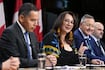
Greg Clark, a member of Alberta’s 2025-26 Electoral Boundaries Commission and former MLA and Alberta Party leader, talks to Alberta Primetime’s Michael Higgins to defend impending changes to the province’s electoral map. The government has tabled legislation that, if passed, would lock in Alberta’s electoral boundaries for the next provincial election. The new map includes controversial changes that extend urban ridings in Calgary and Lethbridge into neighbouring rural areas. The changes have prompted accusations of gerrymandering, while the Opposition has vowed to launch a court challenge. This interview has been edited for length and clarity. Michael Higgins: You were part of the independent panel whose recommendations were rejected by the Danielle Smith government in the spring. How necessary was it for the panel that replaced you to hybridize these urban and rural areas in the redraw of the map and expand of the number of ridings? Greg Clark: That’s something we gave a lot of thought to during our process. The most important difference between our process and this latest panel is talked to more than 2,000 Albertans, travelled about 8,000 kilometres, had two different sets of public hearings, and received a lot of written feedback as well. What Albertans were very clear about, both rural and urban, was they want to vote alongside their neighbours. Seeing constituencies broken up between major urban centres and rural areas beyond what’s strictly necessary to accommodate the arithmetic of electoral boundaries was something that the vast majority of Albertans rejected. MH: We’ve heard the justice minister (Mickey Amery) stating hybrid ridings are the way of the future. How did you approach that element of hybrid ridings as you prioritized your panel’s process? GC: Albertans told us just because you can doesn’t mean you should hybridize those. There are certain cases, places like Medicine Hat or Grande Prairie, where the electoral math doesn’t really work out. Those are cities that are, give or take, 75,000 people. When you have an average constituency size of about 50,000, it makes it challenging. You’re going to have to hybridize at least one of those two, if not both, constituencies in those cities. Places like Lethbridge or Red Deer that have around 100,000 to 110,000 residents fit very nicely into a 55,000-person average constituency, and the obvious choice there for us was to keep those as two urban constituencies, which lined up with what we heard from the public. MH: What makes the mixing of urban and rural votes a concern? Why would that matter? GC: One of the most compelling presentations we received was from someone who never comes to these things. In his own words, he said, “I don’t live in Calgary because I don’t live in Calgary,” and that, to me, was a great description of what it means to vote with your neighbours. If you think about taking a small piece of rural Alberta and putting that together with a big city -- say you’ve got 5,000 voters in the rural area and 50,000 voters in the urban area -- pretty clearly, your MLA is going to have a difficult time representing your views for that rural portion, and vice versa. There’s nothing inherently wrong with it. It is legal to do so – the courts have said so – but they’ve also said any time you use a hybrid constituency, you need to justify with very clear rationale why you’re doing that. MH: Consultation is very much a part of your electoral boundaries commission process. With that in mind, to what degree should the public be afforded the opportunity to provide feedback before the government passes the changes that are now before the legislature? GC: What’s unique about this process is that the government has rejected the original majority opinion that we put forward last spring, which is the first time in Alberta history that’s ever happened and maybe the first time in Canadian history that’s ever happened. Unfortunately, we’re in a real time crunch now. The election is less than a year away, so it really limits the ability for Albertans to have meaningful feedback. You alluded to the fact that there may be some litigation that stems from these latest boundaries. I would not be surprised. What’s disappointing about that is I don’t think Albertans or anyone want judges imposing electoral boundaries when we’ve had a very clear independent process that delivered a majority, that balances all of those challenges of representing rural and remote areas and reflects the vast population growth we’ve seen over the last eight to 10 years in this province. MH: If there are legal challenges, what would you see the courts having to weigh in rendering some form of decision? GC: You could see an injunction for these proposed new boundaries, which are making their way through the legislature. That’s one possibility. If that’s the case, we may find ourselves running the next election on the current set of 87 boundary constituencies. It’s also possible that the court imposes the majority that we put forward back in the spring of 89. All of that is uncertain. We don’t know what may happen. That adds an element of unpredictability. Let’s go back to first principles. Why do we do independent boundary commissions in the first place? We in Canada don’t want our self-interested politicians drawing boundaries that, in perception or reality, could benefit their party at the cost of others, so we hand that job to independent commissions. In our case, we had an independent commission of the two members appointed by the opposition and the judge who was appointed by the UCP came together and came up with a majority map that I think did a good job of balancing out all the challenges that we face in this province. MH: When you weigh all of this at the end of the day, given your experiences with the commission, what concerns you more: the process of getting to these new electoral boundaries or the resulting map itself? GC: Undeniably, it’s the process. I think it’s another example of – unfortunately in really all Western democracies – rejecting institutions and processes that are neutral that deliver a data-driven, evidence-based result that isn’t bound up in what the politics of the day might decide. That problem in the U.S. has existed for a long time. It seems to be coming north to Canada. That’s the reason we do things here like this in Alberta. We don’t want self-interested elected officials drawing boundaries that may suit them. That goes regardless of who’s in power. These processes should exist and should be neutral. It doesn’t matter who the government of the day happens to be.