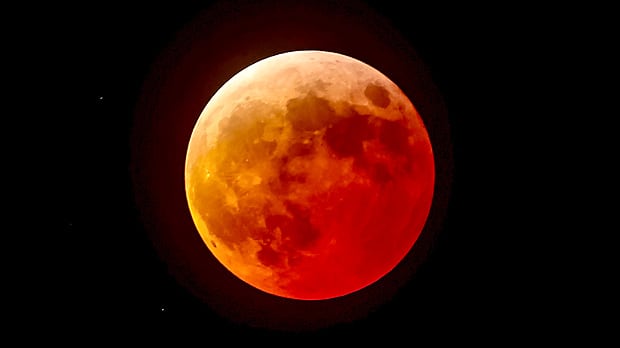
A spectacular lunar event will take place this weekend, but it unfortunately won’t be visible from Canada. Between Sept. 7 and Sept. 8, a blood moon total lunar eclipse will be underway during daytime hours in Canada. It will be best viewed from certain parts of China, Russia, India and Australia. Dr. Ilana MacDonald is the public outreach, communications, and events strategist at the Dunlap Institute for Astronomy & Astrophysics at the University of Toronto. She told CTVNews.ca in a phone interview Thursday that a lunar eclipse happens when the Earth’s shadow covers up the full moon. “The Earth is going between the sun and the moon, and the Earth’s shadow is being cast onto the moon,” she said. “You gradually see the moon disappear … like a circular shadow going over the moon’s surface." The phenomenon resembles a bite missing from the moon, which gradually gets smaller until only a little crescent is left. “Then when the Earth’s shadow completely covers the moon … that’s when you have a total lunar eclipse,” MacDonald says. Why is it called a Blood Moon? The blood moon refers to the colour, which MacDonald said comes from sunlight refracting through the edges of the Earth’s atmosphere, scattering onto the moon’s surface. “Because the Earth’s atmosphere scatters out blue light more than red light, then the surface of the moon tends to have this sort of reddish hue, which can range from a dark orange to a really dark reddish brown,” she says. There’s a possibility of a lunar eclipse every six month, when tilts of the orbits of the earth and moon perfectly align with the sun. MacDonald said a lunar eclipse isn’t always visible from the same location because sometimes it’s below the horizon when it’s happening, like this weekend in Canada. The next lunar eclipse will be in March 2026, but MacDonald said that will be only visible in Northwestern Canada. The one after that will take place on Dec. 31, 2028.