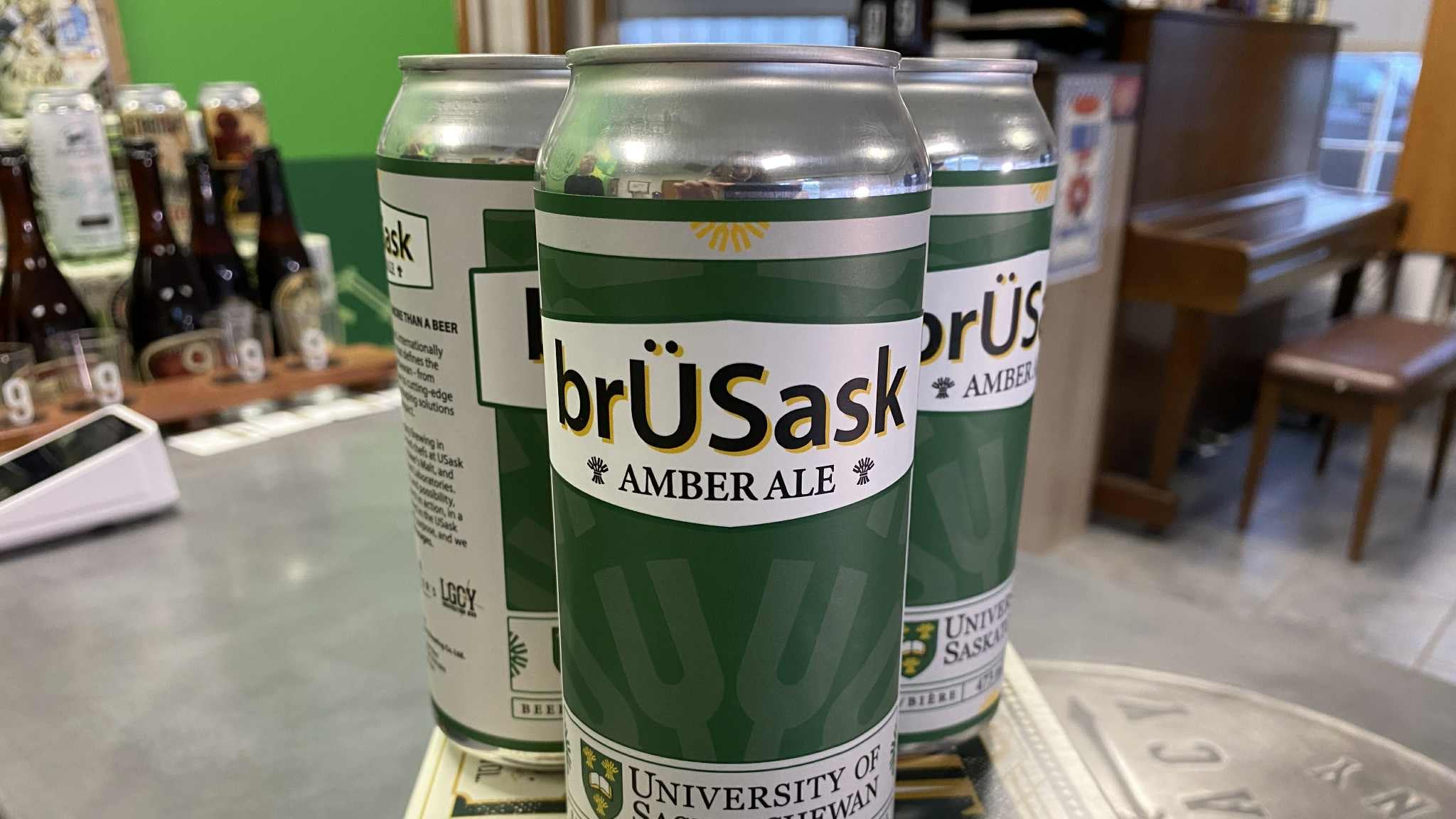
A Saskatoon researcher has teamed up with a local brewery to craft a beer that allows consumers to taste and talk about advancements made in the agriculture sector. Fina Nelson, a PhD candidate at the University of Saskatchewan (USask), is focusing her research on yeast used to make beer. She’s exploring how the genes of different yeast strains react during the fermentation process and how that impacts the flavour. As a result, she’s made – and tasted – a lot of beer. “The sensory evaluation at the end is a really important aspect, so I do get to lick the science,” said Nelson, who spent three years working at a brewery. Now she spends her days in the lab where she grows yeast and ferments beer in small batches. She’s never upscaled production, until now. “This is my first commercial batch,” she said while putting a vibrant green label on a can of brÜSask beer. BrÜSask is an amber ale made in collaboration with the university’s culinary services, ag biotech start-up IntelliYeast Laboratories and 9 Mile Legacy Brewing’s LGCY: Innovation Hub. The recipe, created by 9 Mile’s brewmaster and co-owner, incorporates USask’s research and LGCY: Innovation Hub’s expertise in fermentation. “We happen to have a variety of different fermenters with different capacities and expertise on how to work with them and how to scale up, specifically, fermentation processes,” said hub director Cassy Appelt. Beer has four main ingredients: malted barley, water, hops and yeast, all of which have strong research programs at USask. “We wanted to highlight those research programs in a beer that people can taste and enjoy and have a conversation around,” said Nelson, who had a vision of showcasing Saskatchewan-grown ingredients alongside Saskatchewan-grown research. The beer will be served at campus events to promote the university’s research when the school hosts dignitaries from around the world, according to USask culinary services manager and executive chef James McFarland. “We do a lot of high-profile events on campus, so this is hopefully the beginning,” said McFarland. “The idea is that it is a craft beer series and hopefully the flavours change, and we can learn and explore some ideations around cooking with it.” Nelson is hoping her research on one of beer’s main ingredients will help change the way craft beer is brewed. “A lot of this is done by tradition and people just figuring it out as they go,” she said, adding that beer making dates back at least 13,000 years. “If we can control fermentation, we can produce some novel flavours that haven’t been produced yet.” Science and research can take the “trial and error process” out of beer making, according to Chris Eskiw, co-founder of Saskatoon-based company IntelliYeast Laboratories that provides yeast to craft brewers and distillers. “The study of the yeast provides us with mechanisms on how to control yeast,” Eskiw explained. “If we can do this predictably, we can save money, we can save time and give consumers the products they want.” Innovation in a can BrÜSask was brewed at Saskatoon’s 9 Mile Legacy Brewing. The company’s LGCY: Innovation Hub has a fully functioning brewery that allows different groups to scale up production and take research beyond the lab. Fermentation capacity, which is needed to bring innovation into the commercial sphere, is lacking globally, Appelt said, which is why the company is diversifying its work beyond beer. Besides beer, wine and some non-alcoholic beverages, fermentation is used to create a wide variety of products, including pharmaceuticals, textiles, environmentally friendly glass, and commodity chemicals. “Fermentation is a really central concept. It touches everything that we need as humans to live and thrive and support growing populations,” Appelt said. LGCY has worked with local beverage companies, global biotechnology companies, research groups and academics over the last year and a half. Appelt said she’s particularly excited to have helped bring the brÜSask project to life. “Research in biotechnology doesn’t often translate into a way that people in the general community can always completely understand and see the impact of immediately,” Appelt said. “Having a product like a beer is something that you can provide to people right now, and they can immediately understand the connection between the research that you’re talking about and the thing that benefits them.” The goal is to make new iterations of brÜSask as new research takes off. For now, Nelson is enjoying watching people drink the beer and discuss the research that went into it. And one day, the brew she dreamt up could be the beginning of the next big advancement. “I think so much innovation happens over a beer.”