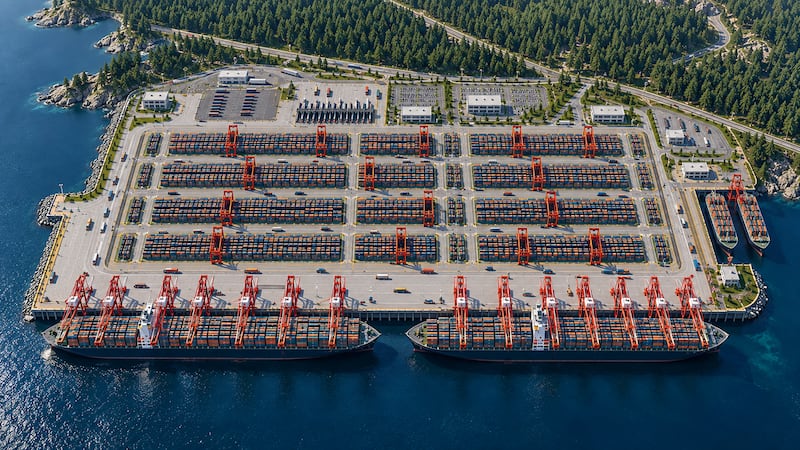
The countdown is on for the Alberta government to submit its proposed pipeline project to the west coast to the federal government’s Major Projects Office. Alberta Premier Danielle Smith reaffirmed her vision Friday that an oil pipeline can happen. “What we’re looking at is feasibility,” Smith said. “What makes the most sense? The easiest route from an engineering point of view, cost effective point of view. How do we get closer to being straight on a deep-water port?” Smith confirmed reports of five possible routes are on the table, with one to southern B.C. and the city of Vancouver, while four others pass through northern B.C. to the Prince Rupert region. “It’s tough because there’s a lot of good opportunities and a lot of good options, but we have to narrow it down to one of those, and that one will be submitted to the Major Projects Office by July 1st,” said Smith. B.C. concerns However, B.C. Premier David Eby said this week his province has yet to find a seat at the table through pipeline discussions. “I hear that there are leaks of potential routes that I don’t know who drew them,” said Eby on Tuesday. “I don’t know whether Premier Smith drew them.” He says there is a lot of work left to do with his province and consulting First Nations. “There is no world in which there will be a pipeline that goes through the north of British Columbia… if it requires the oil tanker ban to be lifted,” said Eby. First Nations concerns Meanwhile, the Nisga’a Lisims government, north of Prince Rupert, says it too has not held discussions with Alberta or Ottawa. “We were not aware that corridors or port locations on our land were being considered by the Alberta government,” read a statement from the First Nations group on Tuesday. “Nothing on our lands can happen without our consent... Anybody can draw lines on a map and speculate about all kinds of projects.” Ottawa available to talk: Hogan Federal officials say they are open to discussions. “Our intention is to work expeditiously and try to make sure we can get West Coast access for Alberta Energy products,” said Corey Hogan, Calgary Liberal MP. “We’re always looking for is engagement. We want to make sure people are participating along the way and making sure that those conversations are robust.” But some pro-business development groups say the prime minister is holding back major projects from being built, saying he is moving at a “snail’s pace” compared to his message of building at “speeds not seen in generations.” “We talk about maybe having shovels in the ground in 2027 and this was what was said in 2025,” said Catherine Swift, president of the Coalition of Concerned Manufacturers and Businesses Canada. “So, in other words, in two years, we might have gone through all the hurdles, the ridiculous hurdles that government puts in the way.” The pipeline push comes as the premier speaks to around 2,000 UCP members at the leader’s dinner at BMO Centre, Friday evening. It’s a 25-minute speech that Smith says is filled with optimism for the future within Canada. The UCP has been facing friction around separation from within its party, and Smith is hopeful a pipeline project can help quiet some of the dissenting voices.