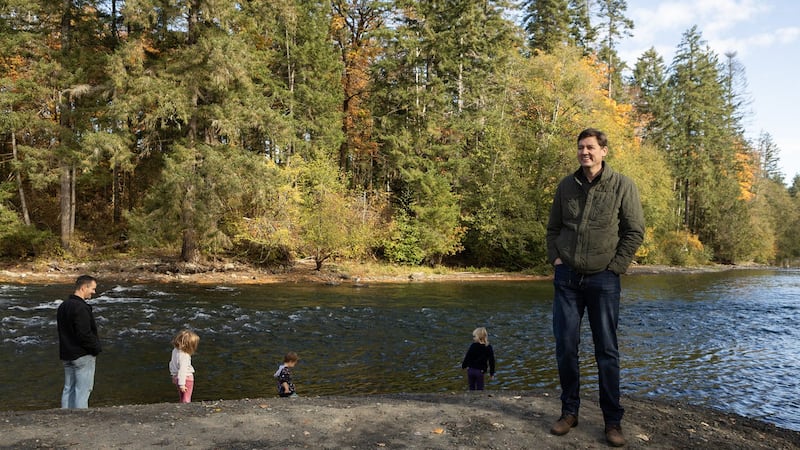
Jaspreet Singh is a Canadian poet who has lived in Alberta for around 20 years. He grew up in India and Kashmir before moving to Canada in 1990. Singh won the 2022 W.O. Mitchell City of Calgary best book prize for his memoir My Mother, My Translator. His 2022 poetry collection How to Hold a Pebble was named one of the best poetry books of the year by the CBC. His book Dreams of the Epoch & the Rock was endorsed and championed by the Pulitzer Prize-winning poet Forrest Gander. His latest poetry collection The Time of the Earth was published by NeWest Press this fall. He’s reading in Calgary Thursday night, Sept. 24, at 7 p.m. as part of Single Onion at Shelf Life Books along with Richard Harrison, Zuleiha Yusuf and Herbert Poll Guttierrez. Q. Why is the title The Time of the Earth? JS: The Time of the Earth refers to “planetary time.” And as you know, Earth is neither 101 billion years old, nor four years old. Only 4.54 billion years old! Q. The poet Rita Wong has praised your work for “stretching us towards deep time with immediate presence and tender precision.” What is a deep-time poem? JS. In a way, time is the subject of all poems. However, not all poems entangle history of Earth, history of life and history of humans. Deep-time poems aspire to do so. Remember the days when people talked about the “two cultures?” Whether it was OK to use the word “oxygen” in a poem? These days, “oxygen” on the page doesn’t stir any discussion about what poetry is and what poetry is not. But a deep-time poem goes way beyond inserting some scientific word in a poem. Like eco-poems, a deep-time poem engages with relationality and connectivity, how interconnected we are to other humans, other species, and the more-than-human. A deep time poem always carries strands of astonishment, wonder, and that sense of awe. A deep-time poem reminds us a “human-centric world” is a dangerous fiction. A deep-time poem also aspires to bring the deepness of time to the foreground. For instance, it is impossible not to associate the word “oxygen” on the page with the Great Oxygenation Event some 2.6 billion years ago when cyanobacteria radically raised the concentration of oxygen in the atmosphere. One might look at this from another angle. I am typing these words with my hands. How old are my hands? How old are your hands? Our hands are older than our exact age in the passport. Our hands are almost as old as the Earth. So many planetary processes over billions of years have shaped/formed our hands. Q. Tell me about your Tuscany Station, Calgary, poem. I love everything about this poem, including the final image: “I feel the Chinook/Dropping like an/Orange to the ground.” JS. Have you ever waited for a train in downtown Calgary? Even when I am not waiting, I hear the LRT announcement in my mind. The train to Tuscany, etc. Tuscany Station, etc. The poem began as a response to the “announcing voice” i heard on a platform. Suddenly I couldn’t help but think about the hundreds of ironic place names (in Canadian cities) chosen by some “developer.” Then one day both my persona and I travelled all the way to Tuscany [Station]. Q. Who’s Helmut Weissert, earth scientist? JS: My book of poems is dedicated to him. Helmut is an emeritus professor of geology at ETH Zurich. Colleagues and friends call him Helmi with affection. Helmi participated in the stratigraphic commission and has a lot to say about the arrival of the informally defined anthropocene epoch. Once in a while, I walk with him in the mountains. Often I discuss with him the urgent need to decolonize the anthropocene. What baffles both of us is why prominent geologists are not keen on (acknowledging) and working through the problematic histories of geology. Q. ‘His myths were basically mountains and different forms of water’: Were those your myths? What did you think about mountains when you were a little kid? JS. The poems in the collection have multiple speakers/personas. The speaker in the poem you mention feels they are 40 years older than me! My myths? During my childhood, the finest myth I heard involved the origin of mountains. Once upon a time, elephants could fly! Until some whimsical god took away the privilege. Mountains are elephants who can no longer fly. Where are the lost wings? Clouds are the “Lost wings” of elephants. Sad and beautiful and lost these clouds. But always celebrating freedom and metamorphosis! Q. What about interspecies relationships? JS. New knowledge (and old knowledge) in the fields of biology, ecology, chemistry, and geology tells us that it is impossible for humans to survive without other species. Bad news for techno-feudal lords and oligarchs who would like to disappear on a spaceship to Mars. Q. Do rivers have rights? JS. I recommend Robert Macfarlane’s newest book Is a River Alive? as a more detailed answer to your remarkable question. Q. This is the third anthropocene poetry book you’ve written. How have they evolved? JS. “Still Astonished” trilogy is more an exploration and an investigation rather than a fninished product. I continue to investigate ways to make poems in this special ecological-biological-geological moment in human history. Some poets call such a project as “geologiising/ecologiising” poetry -- but I try to stay away from names. If someone insists on classification, I say these are failed deep-time poems. Next time I will fail better. Q. What’s next? JS. I don’t know. Right now, I am researching this line in my “Still Astonished” trilogy: “Much of Earth’s water is older/than the Earth/even older/than the Sun.” Perhaps this one line could be a seed for my next book.