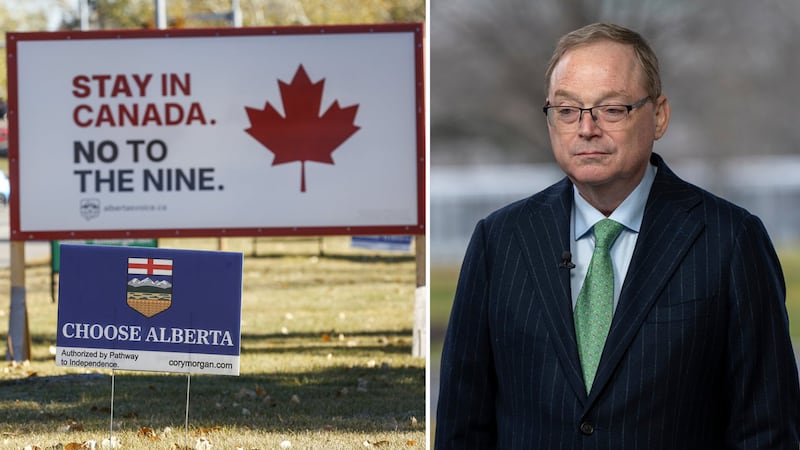
New polling shows Albertan appetite to leave Canada is lacking — but despite the low support, experts aren’t counting out a 2026 referendum. A survey from the non-profit Angus Reid Institute found current favourability in the province to leave confederation is still a minority at 36 per cent. And that minority shrinks even further when assessing how serious the support is: only 19 per cent say they would “definitely” vote to leave were a vote to be held. That compares to 52 per cent of Albertans who say they’d “definitely” vote to stay in Canada. But that doesn’t mean the conversation on separation is dying out. “One of the questions we asked was about how closely people were following these discussions, and in Alberta, it’s more than three in four,” pollster Jon Roe said. Roe points out those who would vote to leave in a hypothetical referendum are focused on things like an east-to-west national pipeline, the federal emissions cap and Bill C-69. Last week, after the election, Premier Danielle Smith’s government introduced a bill that would sharply lower the bar for citizens seeking to trigger province-wide referendums. The move has even caught the attention of American conservative television network Fox News. In a segment this week, entertainment personality Jesse Watters said America wants Alberta. “They’re the powerhouse,” he said. “We don’t want Quebec; they’re a bunch of old Liberals. They’re conservative in Alberta.” The Angus Reid Institute conducted the survey online between May 6 and 8. It polled a randomized sample of 790 Albertan adults and 577 Saskatchewan adults who are members of the Angus Reid Forum. A probability sample of this size carries a margin of error of three percentage points in Alberta and four percentage points in Saskatchewan 19 times out of 20. Maddened municipalities As the referendum fires are stoked, the mayors of Alberta’s two biggest cities say a separation vote would be “devastating” to their local economies. They call the discussion a needless distraction during a period in which the country should be focused on unity. “It is very dangerous talk,” Edmonton Mayor Amarjeet Sohi told the Canadian Press. “It is dangerous talk for our economy. It’s dangerous talk for our social cohesion. It’s going to tear apart communities.” Calgary Mayor Jyoti Gondek echoed the economic stress. She pointed out Friday that her municipal government has butted heads with the province over multiple issues — but it’s never threatened to leave. All for political gain? The local pushback comes as some speculate the separation talk is being used as a distraction — something Smith has denied. The opposition Alberta NDP says she’s being selfish and dangerous by risking a separation referendum in part to avert the emergence of a political rival. Those accusations follow a CTV News interview Wednesday, in which Smith said she doesn’t support separating her province from Canada but that Albertans have genuine grievances with the federal government. “I think you can see that if there isn’t an outlet, it creates a new party,” the premier said. “In Quebec right now, the Parti Quebecois is polling highest of the provincial parties, and we also see that the Bloc has won a significant number of seats. I don’t want to see that happen.” The UCP government has previously faced an uprising of sorts within its ranks. In early 2022, then-Premier Jason Kenney spoke of trying to tamp down big tent discontent, reportedly telling insiders, “The lunatics are trying to take over the asylum.” On Thursday, Opposition NDP MLA Christina Gray said Smith’s own words show she is jeopardizing national unity to bolster her own power. “Why is the premier dividing the country and our province just to avoid dividing her party?” she asked. “My advice to Danielle Smith would be to tone down the rhetoric and work constructively with the new prime minister,” political analyst John Brennan said Friday. “(The party) thinks they’re being clever by saying, ‘We’ll just have a referendum and let people express their views.’” “But once that train has left the station, you don’t know where it’s going.” With files from the Canadian Press